
You have probably seen “PSA:” pop up in a text, caption, or TikTok video and felt that instinctive urge to pay attention. It sounds official, urgent, and important, even when the message turns out to be funny, dramatic, or playful. That contrast is exactly why the term works so well online.
From serious alerts to sassy reminders, PSA has transformed into one of the internet’s favorite attention-grabbing slang terms. Understanding how and why people use it can help you read online conversations more clearly and communicate more naturally in today’s digital culture.
PSA Meaning in Texting and Online Chat
In texting slang, PSA stands for Public Service Announcement, but its meaning is far more casual than the original formal version.
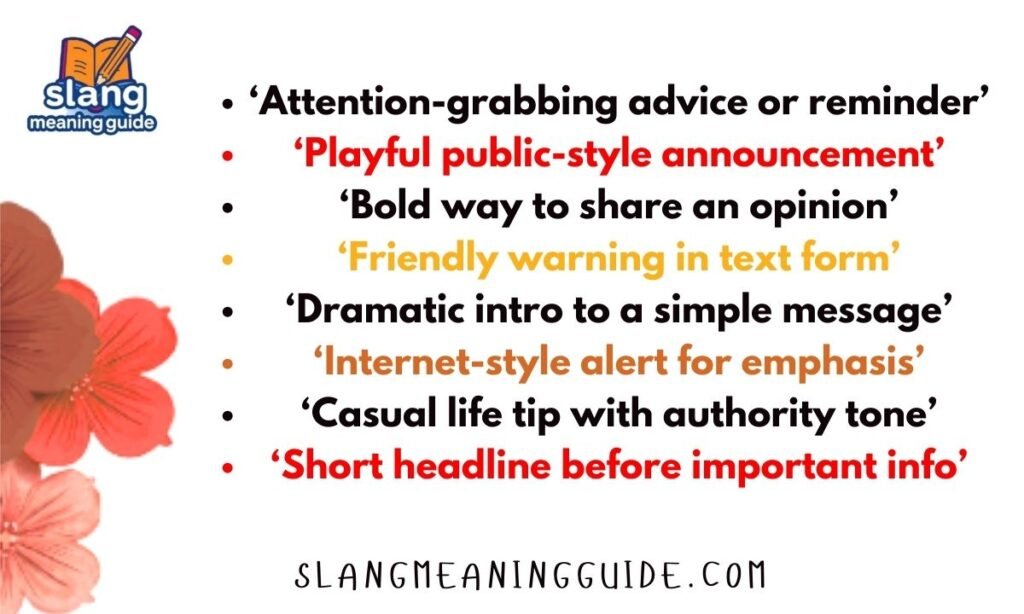
In everyday digital conversations, people use PSA to introduce advice, reminders, warnings, or opinions in a way that feels important, playful, or dramatic. It signals that the sender wants attention, even if the message itself is lighthearted.
In most chats, PSA does not mean a government or official broadcast. Instead, it works as a friendly alert or social cue that says, “Listen up, this matters,” even when the topic is simple.
Friends often use PSA to highlight helpful information, funny observations, or emotional truths that they want others to notice quickly.
- Friendly reminder: “PSA: Don’t forget the deadline is tonight.”
- Helpful advice: “PSA: Drink water before your headache gets worse.”
- Playful warning: “PSA: Don’t text your ex when you’re bored.”
In texting, PSA adds emphasis without sounding bossy. It keeps the message short, clear, and engaging, which fits perfectly into fast-moving conversations where attention spans are short.
PSA Slang Origin and Linguistic History
The term PSA originally comes from Public Service Announcement, a phrase used in radio and television broadcasts, especially from the 1940s onward. Governments, nonprofits, and public agencies used PSAs to inform people about safety, health, and civic responsibility. These messages were serious, formal, and authoritative.
As internet culture grew, people began borrowing formal language and using it ironically. Online users adopted PSA to mimic the tone of official announcements, but they applied it to everyday situations, jokes, and opinions. This playful contrast between serious wording and casual content helped PSA spread rapidly across forums, social media platforms, and texting culture.
- Traditional meaning: Official public information broadcasts.
- Early online use: Ironically serious posts on forums and blogs.
- Modern slang use: Casual, humorous, or dramatic advice and reminders.
This shift reflects a broader trend in internet language, where formal expressions become comedic or expressive tools. PSA now feels natural in memes, captions, and everyday chats, even though its roots remain deeply formal.
Social Media Usage on Snapchat, TikTok, and Instagram
On social media, PSA functions as a powerful attention hook. Creators use it to make their posts sound urgent, relatable, or authoritative, even when the content is humorous or emotional. This technique works especially well on fast-scrolling platforms like TikTok, Snapchat, and Instagram, where users decide in seconds whether to keep watching or reading.
On TikTok, creators often open videos with “PSA for anyone who needs to hear this,” followed by advice, humor, or emotional storytelling. On Instagram, PSA appears frequently in captions, stories, and meme pages. On Snapchat, it is used for quick alerts or reminders shared among friends.
- TikTok: “PSA: If he wanted to, he would.”
- Instagram: “PSA: Self-care isn’t selfish.”
- Snapchat: “PSA: Party starts at 8, not 7.”
Across platforms, PSA creates a sense of importance. Even simple messages feel bigger, bolder, and more engaging when framed as an announcement.
Formal vs Informal Use of PSA
The meaning of PSA changes depending on whether it appears in a formal or informal setting. In professional, medical, or government contexts, PSA keeps its original definition as a serious public message meant to educate or protect. While In casual digital communication, PSA becomes expressive, humorous, and conversational.
In formal contexts, PSAs aim to inform large audiences about health, safety, or social responsibility. In slang, the goal shifts toward grabbing attention, expressing emotion, or delivering advice in a relatable way.
- Formal use: Public health campaigns, safety alerts, nonprofit awareness messages.
- Informal use: Texting, memes, captions, humorous warnings.
Understanding the difference helps avoid tone mismatches. Using slang-style PSA in professional writing can sound unprofessional, while using formal PSA language in casual chats may feel stiff and awkward.
Common Misunderstandings About PSA Meaning
Many people misunderstand PSA because they associate it only with formal broadcasts. This leads them to interpret casual uses as overly serious or confusing. In reality, slang PSA rarely carries official authority and usually functions as expressive emphasis.
Another common mistake involves assuming PSA always introduces serious advice. Online, PSA often introduces jokes, sarcasm, or playful commentary. Missing this tone shift can lead to misreading the emotional intent behind a message.
- Misunderstanding tone: Thinking PSA always means serious warning.
- Ignoring context: Overlooking humor or sarcasm.
- Confusing definitions: Mixing medical or legal meanings with slang.
Recognizing context is essential. In texting and social media, PSA almost always carries informal, expressive meaning rather than official authority.
Usage Tips and Emotional Context
PSA works because it taps into emotion and attention. People naturally react when they sense urgency or authority. Even playful PSAs trigger curiosity, which is why the term spreads so well across digital platforms.
Emotionally, PSA can express care, humor, frustration, encouragement, or drama. The emotional tone depends entirely on the message following the acronym. Writers and speakers often use PSA to amplify their feelings without writing long explanations.
- Supportive: “PSA: You’re doing better than you think.”
- Funny: “PSA: Coffee before everything.”
- Dramatic: “PSA: Never trust anyone who says ‘trust me.’”
To use PSA effectively, match its emotional tone to the situation. In sensitive conversations, keep it gentle. In playful settings, let humor lead.
Comparisons With Similar Slang Abbreviations
PSA belongs to a family of short internet abbreviations designed to introduce information quickly. Each has its own tone and function, even though they often overlap.
| Abbreviation | Full Form | Typical Tone | Common Use |
| PSA | Public Service Announcement | Bold, expressive | Advice, humor, warnings |
| FYI | For Your Information | Neutral, factual | Updates, info sharing |
| ICYMI | In Case You Missed It | Casual, informative | Recaps, reminders |
| TMI | Too Much Information | Playful, awkward | Oversharing |
| IMO | In My Opinion | Soft, personal | Personal views |
PSA stands out because it sounds authoritative while remaining playful. This combination makes it especially effective for grabbing attention in busy digital spaces.
Practical Examples in Real Communication
Seeing PSA used in real contexts makes its meaning clearer. The phrase adapts easily to different emotional tones, topics, and platforms, which explains its lasting popularity.
In texting, it often appears as a quick heads-up. On social media, it frames jokes, advice, or motivational content. In group chats, it signals useful updates.
- Texting: “PSA: Mom’s home, lower the volume.”
- Group chat: “PSA: Meeting moved to tomorrow.”
- Social caption: “PSA: Rest is productive too.”
Each example shows how PSA compresses information, emotion, and attention into three simple letters.
When to Avoid Using PSA
Despite its versatility, PSA does not fit every situation. In formal writing, academic settings, or sensitive emotional contexts, using PSA slang can sound dismissive or immature.
Avoid PSA when the topic requires empathy, seriousness, or professionalism. In such moments, direct language works better than playful slang.
- Avoid in: Professional emails, academic papers, serious emotional discussions.
- Avoid when: Delivering bad news, discussing trauma, or addressing formal audiences.
Using PSA thoughtfully ensures your message remains appropriate, respectful, and effective.
Summary Tables for Quick Understanding
PSA Meanings by Context
| Context | Meaning |
| Texting | Friendly advice or reminder |
| TikTok | Attention-grabbing life tip or humor |
| Motivational or funny caption | |
| Formal media | Official public announcement |
PSA vs Similar Abbreviations
| Term | Purpose | Tone |
| PSA | Announce advice or opinion | Bold, playful |
| FYI | Share information | Neutral |
| ICYMI | Recap updates | Casual |
| IMO | Share opinions | Soft |
Frequently Asked Questions
What does PSA mean in slang?
It means Public Service Announcement used casually to share advice or warnings.
Is PSA serious or funny?
It can be either, depending on context and tone.
What does PSA mean on TikTok?
It introduces advice, humor, or emotional messages to grab attention.
Can I use PSA in texting?
Yes, it works well for quick alerts and reminders.
Is PSA still popular?
Yes, it remains widely used across social media and messaging platforms.
Final Thoughts
PSA meaning slang reflects how language evolves with culture. What once served as a formal broadcast tool now fuels humor, advice, motivation, and social connection online. Its power lies in its simplicity and emotional flexibility.
Whether you use PSA to warn friends, share wisdom, or crack jokes, it remains one of the most effective attention-grabbers in modern digital communication. Understanding its meaning helps you read between the lines and join conversations with confidence and clarity.
In today’s fast-moving online world, three letters can carry surprising impact. PSA proves exactly that.