
Two words. Both about gender expression. Both wildly misunderstood. And yet people use them interchangeably online like they mean the same thing — they don’t.
The distinction matters more than most people realize, and once you see it clearly, a lot of online conversations start making a lot more sense. Here’s the full breakdown.
Femboy vs Tomboy: Core Definitions
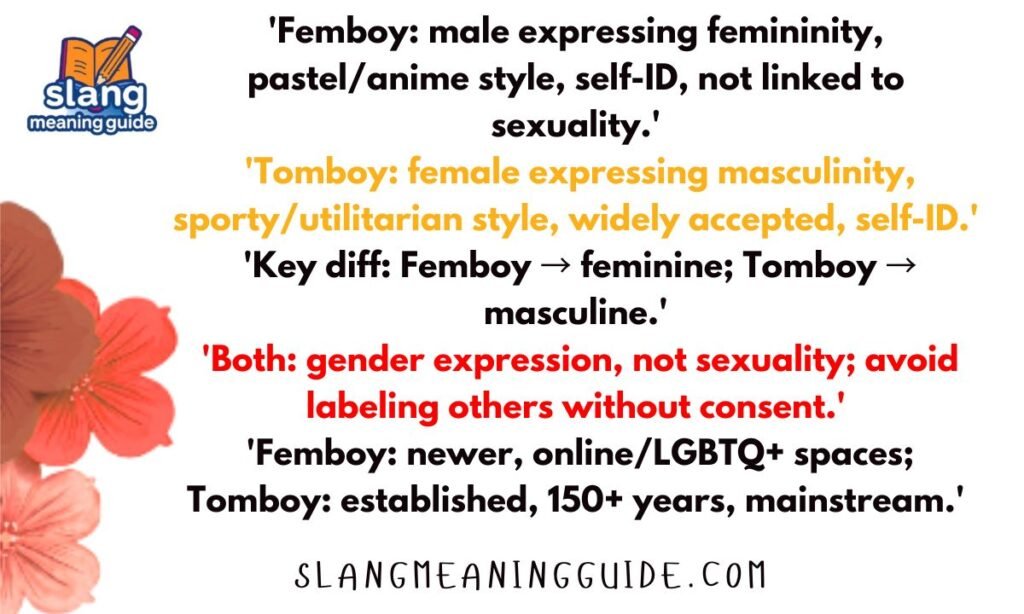
A femboy is typically a male-identifying person who embraces traditionally feminine traits — clothing, mannerisms, aesthetics, or all three. The term blends “feminine” and “boy” and is used both as self-identification and as a descriptor in online communities.
It focuses on a male person expressing femininity in ways that fall outside traditional masculine norms. A tomboy is typically a female-identifying person who embraces traditionally masculine traits — preferring sports, roughhousing, gender-neutral or masculine clothing, and activities historically associated with boys.
The term has existed in mainstream English for well over a century and carries a much longer cultural history than femboy.
Femboy — Male-identifying person who presents femininely. Example: A teenage boy who wears skirts, uses pastel aesthetics, and identifies with the femboy label online.
Tomboy — Female-identifying person who presents masculinely. Example: A girl who prefers hoodies and jeans, plays on the boys’ soccer team, and rejects traditionally “girly” activities.
Self-identification matters — Both labels are most meaningful when someone chooses them for themselves rather than having them assigned by others.
Neither term defines sexuality — A femboy isn’t necessarily gay. A tomboy isn’t necessarily lesbian. Expression and orientation are separate things.
Both words sit at the intersection of gender expression and social expectation. Neither one is about who someone is attracted to — that’s a separate conversation entirely. What they share is a willingness to step outside the lane society traditionally assigned based on sex.
The History and Origin of Both Terms
Tomboy has the longer history by far. The word appeared in English as early as the 1550s, originally used to describe a rude or boisterous boy. By the mid-1800s, the meaning had shifted to describe girls who behaved in ways associated with boys — playing rough, rejecting dresses, preferring outdoor activity.
For most of the 20th century, tomboy carried a relatively neutral or even charming connotation. Society tolerated tomboy behavior in girls, partly because masculinity was seen as aspirational.
Femboy is a far newer term. It emerged in internet culture during the early 2000s, growing out of anime fandom communities, LGBTQ+ online spaces, and eventually spreading into mainstream social media. It gained significant traction on platforms like Tumblr, Reddit, and later TikTok.
Unlike tomboy, femboy arrived already carrying cultural tension — because femininity in male-identifying people has historically faced much stronger social resistance than masculinity in female-identifying people.
- Tomboy origin — English language, mid-1800s, describing gender-nonconforming girls.
- Femboy origin — Internet slang, early 2000s, emerging from anime and LGBTQ+ online communities.
- Cultural tolerance gap — Society has historically been more comfortable with tomboys than femboys due to long-standing double standards around femininity.
- Reclamation — Both terms have been reclaimed by communities who use them with pride rather than as insults.
How Each Term Is Used Online Today
Online usage has evolved both terms significantly. Tomboy has maintained its relatively mainstream, family-friendly reputation. It shows up in fashion content, sports coverage, personal essays, and casual conversation without much controversy.
The tomboy aesthetic — oversized tees, sneakers, caps, relaxed silhouettes — has become genuinely trendy in fashion circles.
Femboy has a more charged online presence. It appears heavily in anime communities, LGBTQ+ spaces, meme culture, and fashion content.
Some use it as proud self-identification. Others encounter it as a label applied without consent, which is why context and consent around the word matter more here than with tomboy.
- Tomboy online — Fashion hashtags, sports commentary, lifestyle content, self-identification in bios.
- Femboy online — Anime communities, LGBTQ+ TikTok, meme culture, fashion and aesthetic subcultures.
- Aesthetic movements — Both have associated aesthetics: tomboy style leans utilitarian and sporty; femboy style leans soft, pastel, and often anime-influenced.
- Use with care — Applying either label to someone else without their input can feel presumptuous or offensive depending on context.
Key Similarities Between Femboys and Tomboys
Despite sitting on opposite ends of the gender expression spectrum, femboys and tomboys share more common ground than most people expect. Both represent a departure from traditional gender norms.
Both have communities built around shared identity and aesthetic. And both have faced — and continue to face — varying degrees of social judgment for simply presenting themselves the way they want to.
Both terms also tend to get oversexualized online in ways that misrepresent what the labels actually mean for most people who use them. A tomboy isn’t performing masculinity for anyone’s approval.
A femboy isn’t performing femininity for attention. These are expressions of personal identity, not performances for an audience.
- Gender nonconformity — Both step outside traditional expectations for their assigned sex at birth.
- Community identity — Both have active online communities, aesthetics, and cultural touchpoints.
- Misrepresentation — Both get reduced to caricatures online, which flattens what are often deeply personal identities.
- No sexuality assumption — Neither label tells you anything definitive about who that person is attracted to.
| Trait | Femboy | Tomboy |
| Typical gender identity | Male-identifying | Female-identifying |
| Expression direction | Feminine | Masculine |
| Historical origin | Early 2000s internet | Mid-1800s English |
| Social acceptance | Still contested in many spaces | Broadly accepted |
| Common platforms | TikTok, Reddit, anime communities | Fashion, sports, lifestyle content |
| Linked to sexuality? | No | No |
Key Differences Between Femboys and Tomboys
The most important difference is direction. A femboy moves toward femininity. A tomboy moves toward masculinity. That’s the clearest and most consistent distinction across every context where these terms appear.
The social reception also differs sharply. Tomboy has been normalized for generations — most people encountered it in childhood books, TV shows, or family conversations without any controversy.
Femboy is newer, more contested, and carries more social weight in conversations about gender because it challenges norms around male femininity, which many cultures still treat as more transgressive than female masculinity.
- Direction of expression — Femboy: feminine. Tomboy: masculine.
- Social normalization — Tomboy is mainstream; femboy is still working toward wider acceptance.
- Online presence — Femboy has a stronger presence in explicitly LGBTQ+ spaces; tomboy crosses more freely into mainstream culture.
- Historical longevity — Tomboy has a 150+ year history; femboy is roughly two decades old as a recognized term.
Common Misconceptions About Both Terms
The biggest misconception about tomboys is that they will “grow out of it.” Decades of research and lived experience show that gender expression in childhood doesn’t reliably predict adult identity, orientation, or presentation. Calling tomboyishness a phase dismisses a real and ongoing expression of identity.
The biggest misconception about femboys is that the label is inherently tied to being transgender or gay. Many femboys are cisgender and heterosexual.
The label describes expression, not identity or attraction. Conflating them creates confusion and — more importantly — misrepresents the actual people using the term.
- “Tomboys grow out of it” — False; gender expression is personal and doesn’t follow a predictable timeline.
- “Femboy means gay or trans” — False; femboy describes presentation, not sexual orientation or gender identity.
- “These are insults” — For many people, both terms are embraced labels they chose for themselves.
- “It’s just a phase” — This assumption gets applied to both groups and is consistently reductive.
Practical Comparison: Femboy vs Tomboy Side by Side
| Category | Femboy | Tomboy |
| Who uses the term | Male-identifying people, online communities | Female-identifying people, broad mainstream use |
| Typical aesthetic | Soft, pastel, feminine clothing, anime-influenced | Sporty, utilitarian, masculine clothing |
| Cultural moment | Rising through social media, 2010s–present | Established for over 150 years |
| Common misconception | Always gay or trans | Will eventually become “more feminine” |
| How it’s used online | Self-ID, meme culture, LGBTQ+ spaces | Fashion, sports, casual self-description |
| Level of mainstream acceptance | Growing but contested | Broadly accepted |
Both labels are real, used by real people who find genuine meaning in them. Neither one requires outside validation, and neither one should be assigned without the person’s own input. The most respectful approach is to use these terms when someone uses them for themselves — and to ask rather than assume everywhere else.
When to Use These Terms — and When Not To
Use femboy or tomboy when someone uses those words to describe themselves. Follow their lead. These are personal labels that carry personal weight, and letting people self-define is always the right starting point.
Avoid applying either label to someone else based on appearance alone. What looks like a femboy aesthetic to you might just be someone’s personal style with no connection to the term.
What looks like a tomboy presentation might be a non-binary person, a butch lesbian, or someone who simply prefers comfortable clothes. Appearance doesn’t tell the whole story, and assuming it does leads to conversations that feel presumptuous at best.
- Do use — When someone self-identifies with the term.
- Don’t use — When you’re assigning it based on how someone looks.
- Do ask — If you’re genuinely unsure how someone identifies and you have a close enough relationship to ask.
- Don’t assume — That either label tells you anything about their sexuality, gender identity, or how they want to be treated.
FAQ
What is the main difference between a femboy and a tomboy?
A femboy is a male-identifying person who presents femininely; a tomboy is a female-identifying person who presents masculinely.
Does being a femboy mean someone is gay?
No — femboy describes gender expression, not sexual orientation, and many femboys identify as straight.
Is tomboy still a commonly used term today?
Yes — tomboy remains widely used in fashion, sports, and everyday conversation with broad mainstream acceptance.
Can someone be both a femboy and a tomboy?
The terms describe opposite directions of gender expression, so they don’t typically apply simultaneously to one person.
Are these terms considered offensive?
Neither term is inherently offensive, but applying either label to someone without their consent can feel presumptuous or disrespectful.