
You’ve seen it in comments, heard it in videos, and maybe someone even called you one. It sounds like a gaming term. It is — but it’s become something much bigger than that.
NPC started inside video games and quietly became one of Gen Z’s sharpest social labels. Whether it’s a compliment, an insult, or a viral TikTok trend depends entirely on who’s using it and why.
What Does NPC Mean in Slang?
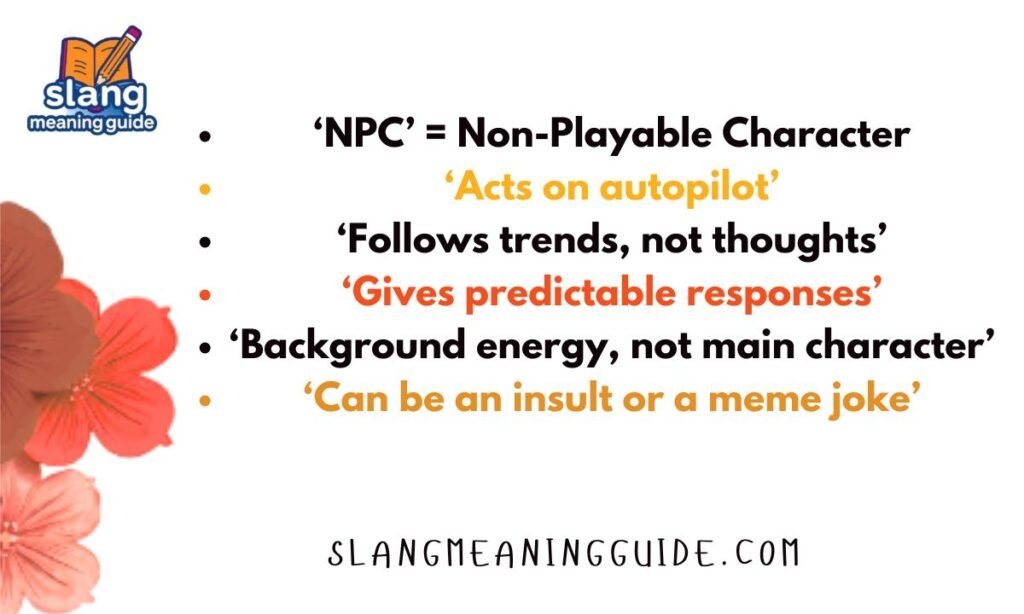
NPC stands for Non-Playable Character. In video games, an NPC is any character the player cannot control — a background figure programmed to follow a fixed script, repeat the same lines, and never deviate from its routine no matter what happens around it.
In slang, NPC describes a real person who behaves the same way. Someone who lacks independent thought, follows the crowd without question, gives robotic or predictable responses, and seems to move through life on autopilot.
The label suggests a person has no real inner world — they just exist in the background of someone else’s story.
The Origin of NPC Slang
NPC as a gaming term has existed since the earliest days of role-playing games. Dungeon & Dragons players used it in the 1970s to describe characters run by the game master rather than players.
Video games then adopted the term to describe every non-player character — shopkeepers, quest givers, random townspeople — who populate the game world but have no real agency.
The leap from gaming to social slang happened gradually online. Around 2016, the term began appearing on forums like Reddit and 4chan to describe people who seemed to accept mainstream narratives without question.
By 2018, NPC memes had spread widely, depicting political figures and social commentators as grey, blank-faced characters reciting scripted lines. The meme was controversial, but it planted the term firmly in internet culture. From there, Gen Z picked it up, stripped it of most of its political edge, and turned it into everyday social commentary.
NPC Meaning in Gen Z Culture
For Gen Z, calling someone an NPC is a statement about personality and presence. It means the person doesn’t bring original energy. They follow trends without adding anything. They give surface-level answers, blend into the background, and never seem to have a real take on anything.
The opposite of an NPC in Gen Z culture is the main character — someone with clear goals, strong energy, a distinct personality, and the confidence to move through the world on their own terms. Gen Z values authenticity above almost everything else.
Calling someone an NPC is essentially saying they have none. It’s one of the more cutting labels in modern slang precisely because it suggests the person isn’t even fully awake to their own life.
NPC Meaning on TikTok and Social Media
TikTok gave NPC slang a second, completely different life in 2023. Creators began doing NPC livestreams — performing as video game characters in real time, repeating robotic phrases, reacting mechanically to gifts and comments, and moving with stiff, programmed energy.
The trend went viral globally, with creators earning thousands of dollars per stream through viewer gifts.
This TikTok NPC trend flipped the original meaning. Instead of NPC being an insult, creators chose to perform as NPCs deliberately — leaning into the absurdity and making it entertainment.
Phrases like “gang gang,” “rose on the sea,” and “ice cream so good” became iconic NPC livestream catchphrases. The trend showed how quickly internet culture can take a label and completely invert its meaning based on context and creativity.
When Someone Calls You an NPC — What Does It Mean?
If someone calls you an NPC in a casual conversation or comment section, they’re usually suggesting one of these things:
- You gave a predictable response — Your take was the expected one, nothing original.
- You’re following the crowd — You adopted a trend or opinion without thinking it through.
- You seem checked out — You’re going through the motions without real engagement.
- You reacted robotically — Your response felt scripted or flat.
Context matters a lot. Between close friends, it might be a lighthearted jab. In a public comment section, it usually carries more bite. And on TikTok, someone calling themselves an NPC is often just setting up content.
Is NPC an Insult or Just a Meme?
NPC exists in both categories depending on who’s using it and how. As an insult, it’s a pointed critique — you’re calling someone intellectually passive, personality-free, or blindly conformist. That’s not gentle. It reduces a person to a background character in their own life.
As a meme, NPC is playful and self-aware. People call themselves NPCs when they do something mindless, repeat the same routine, or blank out during a conversation. “I just walked into a room and forgot why I’m here — full NPC moment.” In that context, it’s humor about the autopilot parts of human behavior that everyone recognizes.
The safest read: if someone calls you an NPC with a laugh, it’s a joke. If they say it to dismiss your opinion, it’s an insult designed to shut down conversation rather than continue it.
Examples of NPC Slang in Real Sentences
- “He just agreed with everything the group said. Total NPC.”
- “I’ve been on full NPC mode today — wake up, coffee, work, repeat.”
- “Don’t be an NPC, think for yourself before you share that.”
- “Her response was so scripted. She sounded like an NPC giving a tutorial.”
- “I went to the party and didn’t talk to anyone. I was literally an NPC in the background.”
- “That TikTok creator made $10K doing NPC streams last week.”
- “Stop letting people NPC you into opinions you don’t actually hold.”
- “He walked past me without acknowledging anything — full NPC behavior.”
- “She called me an NPC for not having a hot take on the situation.”
- “The new guy at work feels like an NPC — same phrases, same schedule, every day.”
NPC vs Main Character — Key Differences
| Trait | NPC | Main Character |
| Decision making | Follows scripts and trends | Makes independent choices |
| Social presence | Blends into the background | Commands attention naturally |
| Originality | Repeats popular opinions | Forms and expresses their own views |
| Energy | Passive and predictable | Active and distinctive |
| Self-awareness | Low — goes through motions | High — intentional about life |
| How others see them | Background figure | Central, memorable presence |
The main character label is everything NPC is not. Main characters have a clear sense of self, take risks, drive their own story, and leave an impression. NPCs populate the world around them without shaping it.
Related Slang Terms Similar to NPC
- Main character — The opposite of NPC. Someone who owns their narrative with confidence and individuality.
- Side character — A softer version of NPC. Present in the story but not driving it.
- Beta — Someone who lacks leadership energy, follows rather than leads.
- Simp — A person who abandons their own needs to chase validation from someone else.
- Rizz — Natural charm and social magnetism — almost the anti-NPC quality.
- Delulu — So lost in an unrealistic belief that they’ve disconnected from reality.
- No thoughts, head empty — Humorous self-description for an NPC moment.
- Sheep — Someone who follows the crowd without independent thought — same energy as NPC.
Frequently Asked Question
What does NPC mean when someone uses it as an insult?
It means the person thinks you’re acting predictable, unoriginal, or blindly following others without real independent thought.
What started the NPC TikTok trend?
Creators began performing as video game NPCs in livestreams in 2023, repeating robotic phrases and movements in exchange for viewer gifts.
Can NPC be used as a compliment?
Rarely — but when someone deliberately performs as an NPC for humor or entertainment, it flips into something self-aware and creative.
Is calling someone an NPC offensive?
It can be — it implies the person lacks personality, original thought, or genuine self-awareness, which is a meaningful criticism.
What is the opposite of an NPC in slang?
The main character — someone who lives with intention, strong personality, and clear individual energy.