
Language keeps evolving, and every generation adds its own flavor to everyday words. Gen Z slang shows up everywhere, from social media captions to casual conversations. Understanding these expressions can help you follow trends, jokes, and online culture. Here are a few popular Gen Z terms that are widely used in 2026.
Core Meanings Explained
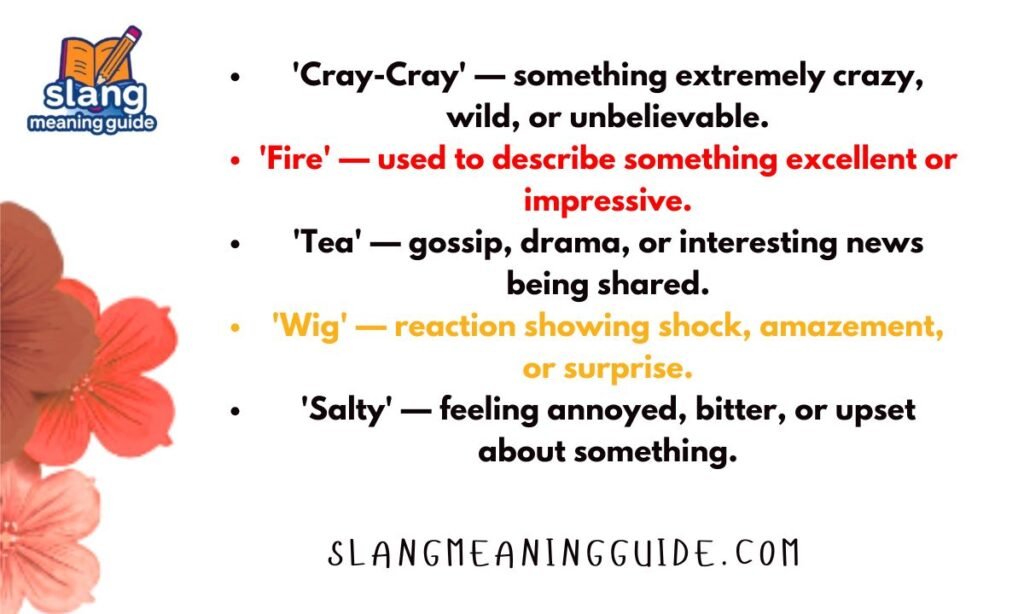
Cray-Cray
Definition: “Cray-cray” means something extremely crazy, wild, or unbelievable.
Key Usage: People use it to describe situations, behavior, or events that feel chaotic or shocking.
Examples:
- “That party last night was cray-cray.”
- “Traffic today is absolutely cray-cray.”
- “The plot twist in that movie was cray-cray.”
Fire
Definition: “Fire” means something is excellent, impressive, or very good.
Key Usage: Often used to describe music, outfits, food, or creative content.
Examples:
- “That new song is fire.”
- “Your sneakers are fire.”
- “This burger is fire.”
Tea
Definition: “Tea” refers to gossip, news, or interesting information.
Key Usage: People use it when sharing updates or talking about drama.
Examples:
- “Spill the tea about what happened.”
- “I heard some tea about that project.”
- “She always has the best tea.”
Wig
Definition: “Wig” expresses shock or amazement, as if something was so surprising it knocked off your wig.
Key Usage: Used when reacting to something impressive or unexpected.
Examples:
- “That performance… wig!”
- “Your transformation photos made me say wig.”
- “The ending of that show was pure wig.”
Salty
Definition: “Salty” means being annoyed, bitter, or upset about something.
Key Usage: Often used when someone reacts emotionally to a loss or criticism.
Examples:
- “He’s still salty about losing the game.”
- “Don’t be salty, it was just a joke.”
- “She seemed salty after the meeting.”
Origin + Evolution Timeline
| Term | Estimated Origin | Platform Where It Blew Up | Current Status |
| Cray-Cray | Early 2000s | Twitter / Pop culture media | Still used casually |
| Fire | 2010s | Instagram / Music culture | Extremely common |
| Tea | 2010s | YouTube / Drag culture | Very widely used |
| Wig | Mid-2010s | Twitter / Meme culture | Popular reaction slang |
| Salty | Early 2010s | Gaming communities | Common everyday slang |
These expressions gained traction through online communities and social media platforms. Many started in niche groups such as music fans, gaming circles, or internet meme culture before spreading widely across TikTok, Twitter, and Instagram.
Common Misunderstandings
| Slang | Common Misunderstanding | Correct Understanding |
| Cray-Cray | Always negative behavior | Often playful exaggeration |
| Fire | Related to actual flames | Means excellent or impressive |
| Tea | Refers to the drink | Means gossip or information |
| Wig | Talking about real hair | Expression of shock or amazement |
| Salty | About taste or food | Means annoyed or bitter |
Many people outside Gen Z misinterpret these words because they read them literally. In online conversations, context matters. The tone usually indicates whether the slang is playful, complimentary, or critical.
Formal vs. Informal Uses
| Term | Informal Use | Formal / Professional Equivalent |
| Cray-Cray | “That meeting was cray-cray.” | “That meeting was extremely chaotic.” |
| Fire | “Your presentation was fire.” | “Your presentation was excellent.” |
| Tea | “Tell me the tea.” | “Share the latest information.” |
| Wig | “That result… wig!” | “That result was very surprising.” |
| Salty | “He’s salty about losing.” | “He seems frustrated about the outcome.” |
Gen Z slang works best in casual conversations, social media posts, and friendly chats. In professional settings, more neutral wording usually communicates ideas more clearly and avoids confusion.
Comparisons With Similar Expressions
- Tea vs. Gossip — Both involve sharing information, but tea usually implies fresh or juicy details.
- Fire vs. Lit — Both praise something impressive, but fire is more widely used today.
- Salty vs. Bitter — Both show annoyance, but salty often refers to minor frustration.
- Cray-Cray vs. Wild — Both describe chaotic situations, though cray-cray is more playful.
- Wig vs. Shocked — Both express surprise, but wig adds humor and exaggeration.
Frequently Asked Questions
What is Gen Z slang?
Informal words and expressions popular among younger internet users.
Where do most slang terms spread today?
Social media platforms like TikTok, Instagram, and Twitter.
Are these slang words appropriate for work emails?
Generally no, because they are considered informal.
Why does slang change so quickly?
Online culture evolves fast and new trends appear constantly.
Do older slang terms disappear completely?
Some fade out, but many remain in casual language for years.