
It looks simple. Just three letters.
Yet it can completely change the tone of a conversation.
Sometimes it feels thoughtful. Other times… confusing.
So what does “hmm” actually mean when someone texts it?
What Does “Hmm” Mean in Texting?
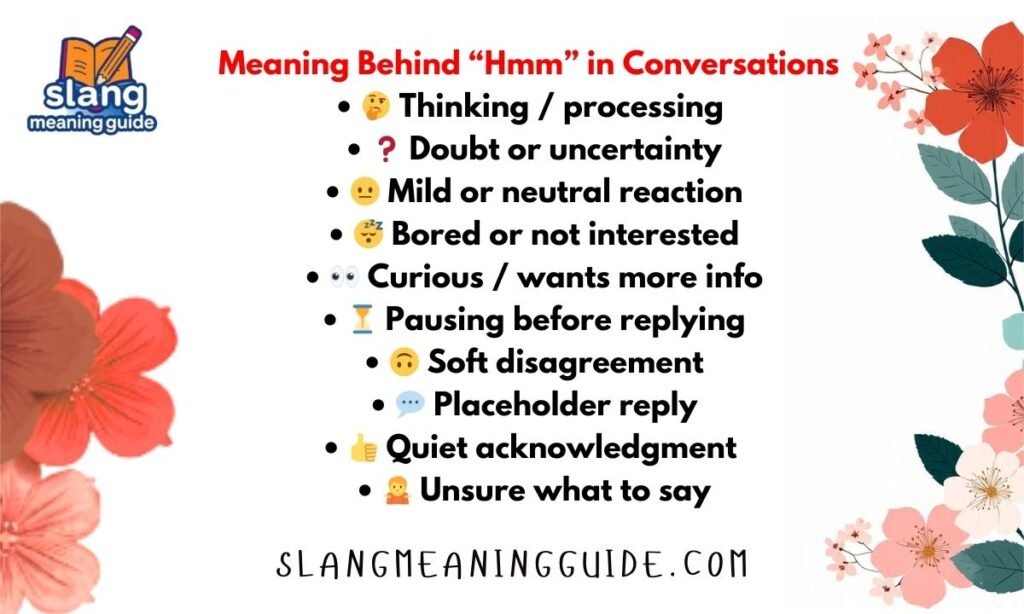
“Hmm” is a non-verbal thinking sound turned into text. It reflects pause, doubt, curiosity, or hesitation depending on context. It is one of the most context-sensitive expressions in digital communication. The same “hmm” can signal interest or disinterest based on timing, tone, and conversation flow.
- It can show thinking → “Hmm… let me check that.”
- It can signal doubt → “Hmm, I’m not sure about that.”
- It may imply disinterest → “Hmm.” (short reply)
- It can express curiosity → “Hmm, tell me more.”
- It may even act as a soft reaction instead of a full reply
Because it lacks clear structure, interpretation depends heavily on how and when it is used.
Core Meanings Explained
Thoughtful Pause
This is the most neutral and original meaning of “hmm.” It indicates that the person is thinking before responding.
It usually appears when someone needs time to process information.
- “Hmm… let me think about that.”
- “Hmm, that’s interesting.”
- “Hmm, I need a minute.”
- “Hmm… okay, I see your point.”
- “Hmm, give me a second.”
This version is generally positive or neutral.
Doubt or Uncertainty
“Hmm” often signals skepticism or hesitation about what was said. It is commonly used when someone is not fully convinced.
- “Hmm, I don’t know about that.”
- “Hmm… are you sure?”
- “Hmm, that sounds odd.”
- “Hmm, I need more proof.”
- “Hmm… maybe, maybe not.”
Tone here matters. Longer “hmm…” often softens disagreement.
Disinterest or Boredom
A short “hmm” can sometimes indicate lack of engagement. It is often used when someone doesn’t want to continue the conversation.
- “Hmm.”
- “Hmm okay.”
- “Hmm, cool.”
- “Hmm… yeah.”
- “Hmm, alright.”
This use can feel dismissive if overused.
Curiosity or Intrigue
Sometimes “hmm” shows interest and encourages more information. It acts like a conversational prompt.
- “Hmm… go on.”
- “Hmm, that sounds exciting.”
- “Hmm, what happened next?”
- “Hmm, I’m curious now.”
- “Hmm… explain that.”
In this context, it keeps the conversation alive.
Passive Response or Placeholder
“Hmm” can also act as a filler reply when someone doesn’t have much to say. It helps maintain flow without committing to a strong opinion.
- “Hmm, I see.”
- “Hmm, okay noted.”
- “Hmm, got it.”
- “Hmm… makes sense.”
- “Hmm, alright then.”
This usage is common in casual chats.
Origin + Evolution Timeline
“Hmm” originated as a spoken sound used to express thinking or hesitation long before texting existed. It transitioned into digital communication as messaging became more conversational and informal.
Timeline Overview
| Term | Estimated Origin | Platform Where It Blew Up | Current Status |
| Hmm | Pre-digital speech (centuries old) | SMS & early chat apps (2000s) | Widely used, evergreen |
| Hmm… | Early texting era | MSN Messenger, Yahoo Chat | Common for tone emphasis |
| Hmmm | Social media expansion | WhatsApp, Facebook | Adds emotional nuance |
| Hmm? | Messaging apps | Instagram, Snapchat | Used for questioning tone |
Today, “hmm” remains a core digital expression used across all platforms.
Common Misunderstandings
Many people misinterpret “hmm” because it lacks clear emotional markers.
Without context, it can easily be taken the wrong way.
- It may seem rude when it is actually neutral
- It can feel dismissive when the person is just thinking
- It might appear sarcastic without intention
- It can be read as boredom instead of curiosity
- It often creates confusion in short conversations
Understanding tone and timing is key to interpreting it correctly.
Formal vs. Informal Uses
“Hm” and “hmm” are rarely used in professional communication. They are mostly informal. In formal settings, clearer language replaces them.
Usage Comparison Table
| Term | Informal Use | Formal/Professional Equivalent |
| Hmm | “Hmm, not sure.” | “I am uncertain.” |
| Hmm… | “Hmm… let me think.” | “Let me review this.” |
| Hmmm | “Hmmm, interesting.” | “That is interesting.” |
| Hmm? | “Hmm?” | “Could you clarify?” |
| Hmm okay | “Hmm okay.” | “Understood.” |
In professional environments, clarity always beats ambiguity.
Comparisons With Similar Expressions
Understanding “hmm” becomes easier when compared with other slang or reaction terms.
- Hmm vs. Okay — Hmm suggests thinking, while okay shows agreement or acknowledgment.
- Hmm vs. Eh — Hmm is thoughtful, eh often signals indifference.
- Hmm vs. Oh — Hmm reflects processing, oh shows realization.
- Hmm vs. Lol — Hmm is neutral or reflective, lol expresses amusement.
- Hmm vs. K — Hmm is softer, K can feel abrupt or dismissive.
These subtle differences shape how messages are perceived.
When to Use “Hmm” Effectively
Using “hmm” correctly depends on context, tone, and relationship with the other person.
It works best in casual conversations where nuance is understood.
- Use it when you need time to think
- Use it to soften disagreement
- Use it to show curiosity
- Avoid overusing it in serious discussions
- Avoid using it alone in sensitive conversations
Balance is key to avoiding miscommunication.
When to Avoid “Hmm”
There are situations where “hmm” can create confusion or tension.
In such cases, clarity matters more than tone.
- Professional emails or work chats
- Emotional or serious conversations
- Conflict resolution discussions
- First-time interactions
- Situations requiring clear decisions
Replacing it with direct language improves communication.
Psychological Meaning of “Hmm”
“Hm” reflects a natural human behavior: pausing to process information.
In texting, it acts as a bridge between thought and response.
It can signal:
- Cognitive processing
- Emotional hesitation
- Social politeness
- Passive engagement
- Subtle disagreement
Because it mirrors real-life thinking sounds, it feels natural in digital communication.
Cultural and Digital Influence
Different cultures and platforms interpret “hmm” slightly differently.
In some contexts, it feels polite. In others, it may seem cold.
- Younger users use it more casually
- Older users may find it vague
- Social media often exaggerates its tone
- Messaging apps rely heavily on it for quick replies
Its flexibility is what keeps it relevant.
Frequently Asked Questions
What does “hmm” mean in texting?
It usually shows thinking, doubt, or mild curiosity depending on context.
Is “hmm” rude?
It can feel rude if used alone without explanation.
What does “hmm…” with dots mean?
It usually indicates deeper thought or hesitation.
Is “hmm” positive or negative?
It is neutral but can lean either way based on tone.
Should I reply to “hmm”?
Yes, especially if you want to clarify or continue the conversation.
Conclusion
“Hm” may look simple, but it carries layered meaning. Its tone depends entirely on context, timing, and intent. Used well, it adds nuance to conversations. Used poorly, it creates confusion.