
It looks simple, just two letters.
Yet it can shift meaning based on context.
You’ll see it in emotional messages and digital discussions alike.
Understanding it helps you avoid confusion and respond accurately.
Core Meanings Explained
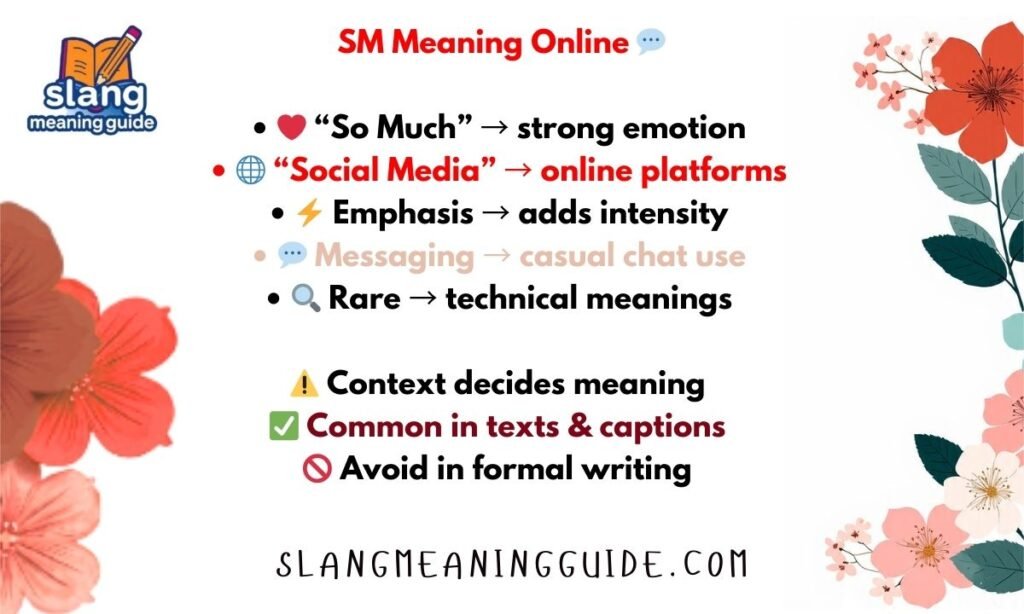
SM = “So Much”
This is the most common slang meaning. It adds intensity to emotions or statements.
It is widely used in texting, captions, and casual chats.
- “I miss you sm.”
- “Thank you sm for this.”
- “I love this song sm.”
- “That helped me sm.”
- “I needed this sm today.”
SM = “Social Media”
This meaning appears in digital and professional discussions.
It refers to platforms and online networks.
- “SM strategy needs improvement.”
- “Post this on SM.”
- “SM trends change fast.”
- “We saw growth on SM.”
- “SM marketing drives traffic.”
SM = Emotional Emphasis Marker
Here, SM works as a quick emotional amplifier.
It replaces longer phrases like “very much” or “a lot.”
- “I appreciate it sm.”
- “That matters sm to me.”
- “I’m grateful sm.”
- “This means sm.”
- “I care sm about this.”
SM = Casual Short Message Reference
In some contexts, SM loosely connects to messaging itself.
It may refer to quick digital communication habits.
- “Send me an SM later.”
- “Got your SM.”
- “Reply via SM.”
- “Check your SM inbox.”
- “I’ll drop an SM.”
SM = Rare Alternate Meanings
Outside slang, SM carries technical and niche meanings.
These depend entirely on the field or context.
- “SM element” (Samarium in chemistry)
- “SM rank” (Sergeant Major in military)
- “SM legal mark” (Service Mark in business)
- “SM practice” (Sadomasochism in psychology context)
- “SM tech” (Short Message in telecom)
Origin + Evolution Timeline
SM developed along two parallel paths. One came from emotional shorthand in texting. The other came from the rise of digital platforms. Both meanings became mainstream as online communication expanded.
| Term | Estimated Origin | Platform Where It Blew Up | Current Status |
|---|---|---|---|
| SM (“So Much”) | Early 2010s texting culture | Snapchat, TikTok | Widely used in casual chat |
| SM (“Social Media”) | Mid-2000s internet era | Facebook, blogs | Standard digital term |
| SM (general use) | 2010s | Twitter, Instagram | Dual meaning accepted |
| SM (modern slang) | 2020s | Messaging apps | Everyday shorthand |
Common Misunderstandings
SM often creates confusion because it has multiple meanings. Without context, readers may interpret it incorrectly. Tone and topic usually reveal the intended meaning.
- Confused between “so much” and “social media”
- Misread emotional messages as technical references
- Used in formal writing where clarity is required
- Assumed universal meaning without context clues
- Misinterpreted in professional discussions
Formal vs. Informal Uses
SM works best in informal communication. In professional writing, clarity matters more than speed, so full phrases are preferred.
| Term | Informal Use | Formal/Professional Equivalent |
|---|---|---|
| SM | “Thanks sm for your help.” | “Thank you very much for your help.” |
| SM | “We need better SM content.” | “We need improved social media content.” |
| SM | “I appreciate it sm.” | “I greatly appreciate it.” |
| SM | “Post this on SM.” | “Publish this on our social media platforms.” |
| SM | “This matters sm.” | “This is highly important.” |
In casual settings, SM saves time and feels natural. While In professional contexts, writing the full phrase avoids ambiguity and ensures clarity.
Comparisons With Similar Abbreviations
- TYSM: Means “thank you so much,” more specific than SM
- LYSM: “Love you so much,” expresses affection directly
- IMO: Shares opinion, while SM adds emphasis
- IDK: Signals uncertainty, unrelated to intensity
- TBH: Adds honesty, not emphasis
- LOL: Shows humor, while SM adds emotional weight
- DM: Refers to messaging, not intensity
- IG: Platform-specific, while SM is broader
Frequently Asked Questions
What does SM mean in texting?
It usually means “so much,” used to emphasize feelings or statements.
Does SM always mean social media?
No, it depends on context; it can also mean “so much.”
Is SM appropriate in professional writing?
It’s better to avoid it and use full phrases.
Where is SM most commonly used?
It appears in texts, captions, and online conversations.
How do I know which meaning applies?
Look at the context, tone, and surrounding words.