
You just got a text. It ends with a single 💙. Now you’re staring at your phone, wondering — is this friendly? Is this flirty? Is it even romantic at all? The color blue carries more weight than you’d think. Before you overthink your reply, here’s exactly what the blue heart emoji means and when people really use it.
What Blue Heart Emoji Means
The blue heart emoji 💙 is a digital heart symbol colored blue, used across texting and social media to express warmth, trust, and care — but without the intense romantic charge of a red heart ❤️. It sits comfortably in the space between “I care about you” and “I love you deeply,” making it one of the most versatile heart emojis in digital communication.
Because blue is culturally linked to calm, loyalty, and stability, the 💙 naturally reads as sincere but relaxed. People reach for it when they want to show support, celebrate a friendship, or add a warm sign-off that doesn’t send mixed signals. Think of it as the emoji equivalent of a firm, reassuring handshake — genuine, steady, and non-dramatic.
Core Meanings Explained
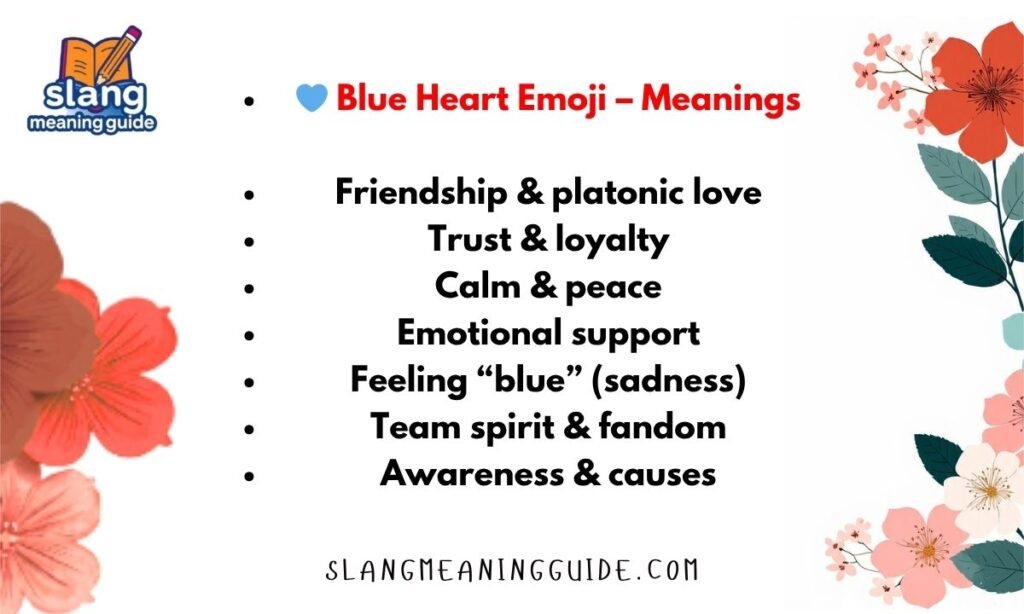
Platonic love and friendship
The most common use. Sends warmth to a close friend without implying romance.
- “Miss you, bestie! 💙”
- “You’ve always had my back. 💙”
Trust and loyalty
Blue symbolizes reliability. The 💙 often signals “I’m on your side, no matter what.”
- “I’ll always be here for you. 💙”
- “We’ve been friends for 15 years for a reason. 💙”
Peace and calm
Used to express serenity, self-care, or a relaxed mood.
- “Just finished my meditation. Feeling so good. 💙”
- “Take it easy today. You deserve it. 💙”
Support for causes and awareness
Blue is tied to causes like autism awareness, anti-bullying, and water safety campaigns.
- “Proud to support autism awareness month. 💙”
- “Stand up against bullying. 💙”
Team colors and fandom
Sports fans use 💙 for teams with blue in their palette — like the Dodgers, Mets, or Dallas Cowboys.
- “Let’s go, Dodgers! 💙⚾”
- “My team, always. 💙🏀”
Sadness or “feeling blue”
In emotional contexts, the 💙 can gently signal low mood or an expression of condolence.
- “Tough day. 💙”
- “Thinking of you during this hard time. 💙”
Origin and Evolution
The blue heart didn’t appear overnight. It grew from the expansion of digital emoji sets in the early 2010s. Here’s a quick timeline of its journey:
| Term / Version | Estimated Origin | Platform Where It Became Popular | Current Status |
|---|---|---|---|
| Unicode 6.0 💙 | 2010 | Early Android and iOS messaging | Standard across all platforms |
| Emoji 1.0 official set | 2015 | Twitter, Instagram, iMessage | Fully supported globally |
| Cause-related use | 2015–2017 | Instagram, Facebook awareness campaigns | Common in advocacy posts |
| Sports fandom use | 2018–present | X (Twitter), TikTok | Highly active in sports communities |
| “Bromance” / platonic trend | 2020–present | TikTok, Threads, iMessage | Growing as casual daily use |
How People Use 💙 in Conversations
People drop the 💙 at the end of supportive messages, as a sign-off between friends, or alongside content that features the color blue. It functions as a soft emotional cue — present enough to feel warm, but subtle enough not to overwhelm.
On social media, brands and creators also use it to connect with audiences in a friendly, non-salesy way. It shows up in birthday replies, encouragement posts, and thank-you comments constantly.
Text thread:
A: “I got the job! After six months of trying!”
B: “I KNEW you would!! So proud of you 💙”
Instagram comment:
“Thank you for this community. You all keep me going. 💙”
Twitter/X post:
“Happy World Ocean Day 🌊💙 Let’s protect what we love.”
Common Misunderstandings
The 💙 gets misread surprisingly often. Because it’s a heart shape, some people assume it always carries romantic weight. In reality, the color shifts the meaning significantly — and context matters far more than the shape itself.
- Wrong: A 💙 from a friend means they have a crush on you.
- Wrong: It’s a “cold” or distant version of love.
- Wrong: Sending 💙 in a work message is inappropriate.
- Wrong: It always signals sadness or grief.
- Right: Context determines everything — who sent it, in what conversation, and what they were talking about.
Formal vs Informal Use
The 💙 is flexible enough to appear in both casual texts and semi-professional social media posts. However, its appropriateness shifts depending on tone and audience. In informal settings, it’s a natural emotional add-on. In formal contexts, it should be used carefully and sparingly.
Informal examples:
- “Happy birthday! Hope your day is amazing 💙🎂”
- “Rooting for you always. 💙”
- “Best road trip ever with you guys 💙🚗”
Semi-formal / brand / public figure examples:
- “Thank you to everyone who showed up today. Your support means the world. 💙” — charity social post
- “Wishing our team strength and resilience this season. 💙” — sports brand post
- “Grateful for this community every single day. 💙” — creator sign-off
Comparison With Similar Heart Emojis
| Emoji | Meaning | Where It’s Used | Difference From 💙 |
|---|---|---|---|
| ❤️ Red Heart | Deep romantic or passionate love | Couples, declarations of love | More intense and explicitly romantic |
| 🩵 Light Blue Heart | Gentle care, peace, loyalty | Friendly messages, wellness content | Softer and more delicate in tone |
| 💜 Purple Heart | Deep affection, military support, K-pop fandom | Close bonds, fan communities | More spiritual/deep; tied to specific fandoms |
| 💛 Yellow Heart | Happiness, close friendship, sunshine | Best friends on Snapchat, cheerful posts | Brighter and more playful than 💙 |
| 🖤 Black Heart | Dark humor, deep love, edgy tone | Sarcasm, goth aesthetic, grief | More intense and often ironic |
Examples in Social Media and Text Messages
DM between friends: “Can’t believe we’ve known each other for 10 years. Time flies 💙”
Twitter reply: “This thread made my morning. Thank you for always speaking up. 💙”
Instagram story reply: “You look so happy here 💙 loved seeing this”
TikTok comment: “This video helped me so much. 💙 You have no idea.”
Text to sibling: “Good luck at your interview today. You’ve got this. 💙”
Frequently Asked Questions
Is the blue heart emoji romantic?
Not typically — it leans platonic and is more commonly used to show friendship, trust, or support rather than romantic love.
What does it mean when a guy sends 💙?
It usually signals friendly warmth or loyalty rather than romantic interest, though context always matters.
What causes is the blue heart associated with?
It’s commonly linked to autism awareness, anti-bullying campaigns, and water conservation efforts.
Can I use 💙 in a professional context?
Yes, in semi-formal social media posts or community messages it works well, but avoid it in strict professional or corporate emails.
What’s the difference between 💙 and 🩵?
The 💙 is bolder and often tied to loyalty and friendship, while the 🩵 light blue heart feels softer and is more associated with peace and gentleness.