
Gen Z slang moves fast — what was cool last month might already be dead. April 2026 has its own set of trending terms, and this list covers all of them. Whether you’re a parent, a teacher, or just trying to keep up, this guide breaks it down clearly.
What Is Gen Z Slang and Why Does It Keep Changing?
Gen Z slang comes primarily from TikTok, gaming culture, and Black internet culture. It spreads faster than any previous generation’s language because social media compresses the cycle from niche phrase to mainstream usage into days, not years.
The Top 20 Gen Z Slang Terms for April 2026
This month’s list mixes returning staples with newer terms picking up steam on TikTok and across social platforms. Some of these you’ve heard. Others are just breaking out now.
| Slang Term | Meaning | Example |
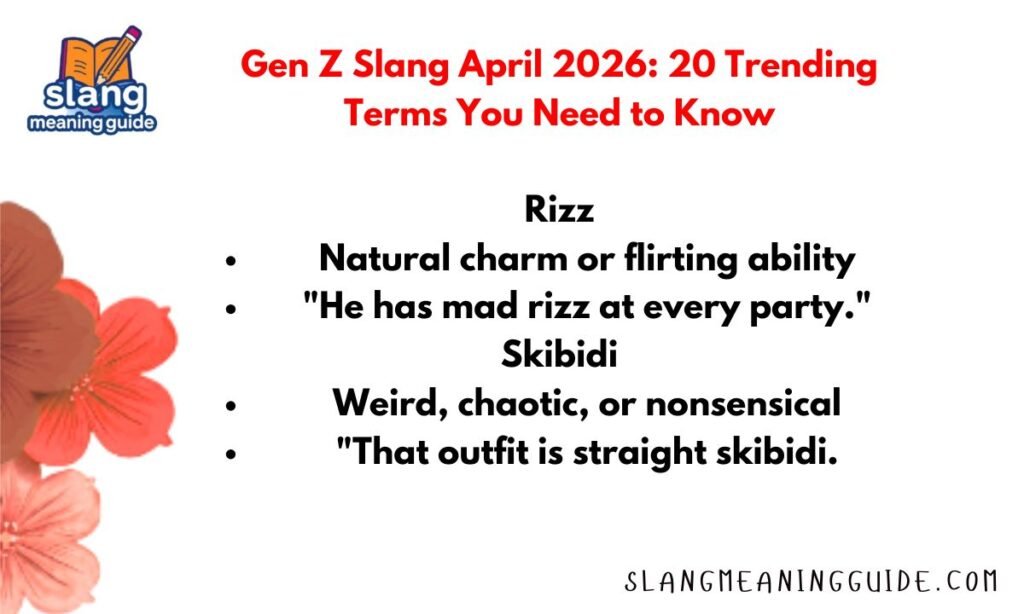
| Rizz | Natural charm or flirting ability | “He has mad rizz at every party.” |
| Skibidi | Weird, chaotic, or nonsensical | “That outfit is straight skibidi.” |
| Aura | Cool energy or social credibility points | “Lost aura for that bad take.” |
| Slay | Nailed something perfectly | “You slayed that presentation.” |
| No cap | No lie, for real | “This is fire, no cap.” |
| Brain rot | Mental fog from too much mindless content | “TikTok gave me serious brain rot.” |
| Fanum tax | Playfully stealing someone’s food | “Stop fanum taxing my fries.” |
| Chuzz | An unattractive or worse version of someone | “That’s my chuzz era photo.” |
| Gyatt | Exclamation for something impressive | “Gyatt, that’s actually huge.” |
| Sigma | Independent, drama-free lone wolf | “He’s full sigma, no group chat.” |
| Delulu | Delusional or wishfully unrealistic | “Thinking he’ll text? Delulu.” |
| Mid | Average, nothing special | “That movie was completely mid.” |
| Sus | Suspicious or shady | “Your excuse sounds really sus.” |
| GOAT | Greatest of all time | “She’s the GOAT of speedrunning.” |
| 6 7 | Nonsense hype phrase or punchline | “Hit 6:07 on the clock — 6 7!” |
| Lowkey | Subtly, secretly, or quietly | “Lowkey obsessed with this track.” |
| It’s giving | Strongly radiates a specific vibe | “This fit is giving main character.” |
| Ate | Completely excelled at something | “She ate that routine, no crumbs.” |
| Crashing out | Losing emotional control publicly | “He crashed out over a game.” |
| Cheugy | Outdated, trying too hard, uncool | “Skinny jeans are so cheugy now.” |
Slang Terms That Are New or Growing in April 2026
Not every term on this list has been around for years. A few are picking up momentum right now, and these are worth paying attention to.
Chuzz: The Upgrade on “Chopped”
Chuzz is getting traction as a sharper, more specific term than its predecessor. It refers to a worse or uglier version of someone — often used in a self-deprecating way. You’ll hear it in TikTok comments when someone posts an unflattering photo and jokes, “this is my chuzz.”
The term fits neatly into Gen Z’s habit of turning insults inward for humor. It’s not usually mean-spirited. Most uses are playful and self-aware, which is exactly the kind of tone that spreads on TikTok in 2026.
6 7: The Hype Phrase That Doesn’t Need Logic
This one is deliberately nonsensical. “6 7” functions as a reaction, a punchline, or a hype call. It gained momentum through short-form video and has the same energy as other random internet-born phrases that work because they’re absurd. You don’t need context to use it — that’s the whole point.
The phrase also connects to clock-watching culture, where catching a specific time like 6:07 or 6:17 becomes a shareable micro-moment. It’s low effort, highly repeatable, and perfect for comment sections.
Slang That Crossed Over Into Adult and Workplace Culture
Some Gen Z terms don’t stay on TikTok. A handful have made it into offices, news articles, and everyday adult conversation. That crossover is usually the sign that a term has reached peak mainstream status.
Brain Rot Goes Corporate
Brain rot started as a self-aware joke about consuming too much mindless content. Now it shows up in workplace conversations, mental health discussions, and even journalism. People use it to describe phone addiction, doom-scrolling, and the feeling of intellectual numbness after a long week online.
It’s one of the few Gen Z slang terms that carries genuine meaning beyond the joke. When someone says “I have brain rot from this meeting,” they’re making a real point with a funny wrapper.
Fanum Tax in the Office
Fanum tax came from a Twitch streamer and went viral as a term for playfully taking someone’s food. It sounds niche, but it landed in workplace culture because food-stealing at the office is universal. The phrase gave people a funny name for something that already happened everywhere.
Now coworkers use it unironically. That’s the full Gen Z slang lifecycle — niche internet origin, TikTok explosion, mainstream adoption, office use.
Slang That’s Fading Out in 2026
Not everything stays relevant. Part of understanding current Gen Z slang is knowing what’s on its way out.
Bussin — was massive in 2022 and 2023 for food. Rarely used now without irony.
Periodt — peaked hard and has become a punchline rather than a serious exclamation.
Vibe check — still understood but rarely used organically in 2026.
Hits different — overused to the point of becoming cliché, even among the age group that coined it.
The pattern is consistent: once a term appears in a brand’s marketing campaign or a news segment explaining it to parents, its shelf life drops fast.
How Gen Z Slang Spreads So Quickly
TikTok’s algorithm is the main engine. A single viral video can push a phrase to millions of people within 48 hours. Unlike older slang that spread through music, TV, or peer groups over months, TikTok collapses that timeline completely.
Gaming culture and streaming add another layer. Terms like “sigma,” “GOAT,” and “sus” all have roots in gaming communities that moved onto broader platforms. Black creators and Black internet culture drive a significant portion of new slang, with terms spreading outward from those communities before going fully mainstream.
Quick Reference: How to Use These Terms Correctly
Using Gen Z slang wrong is worse than not using it at all. Here’s a fast guide on context.
High-use, safe terms: No cap, slay, lowkey, mid, sus, GOAT. These are fully mainstream. Anyone can use them without sounding forced.
Trending but niche: Chuzz, 6 7, crashing out. Use these in the right context — mostly online, mostly casual, mostly with people who already know them.
Handle with care: Fanum tax, gyatt, aura. These work in casual settings but can land awkwardly in formal or professional contexts.
Ironic use only in 2026: Bussin, periodt, hits different. These are understood but using them sincerely reads as out of touch.
Frequently Asked Questions
What is the most popular Gen Z slang term in April 2026?
Rizz and brain rot remain the two most widely used and recognized terms heading into April 2026.
What does “chuzz” mean in Gen Z slang?
Chuzz refers to a less attractive or worse version of someone, often used in a self-deprecating or playful way.
What does “crashing out” mean?
Crashing out means losing emotional control or having a visible meltdown, usually over something minor.
Is “no cap” still used in 2026?
Yes, no cap is still widely used and has become mainstream enough that most age groups recognize and use it.
What does “it’s giving” mean?
It means something strongly projects a specific energy or vibe, as in “this outfit is giving main character.”
Conclusion
Gen Z slang in April 2026 reflects a generation that communicates fast, shifts culture quickly, and uses humor to say serious things. The 20 terms in this list cover what’s trending now, what’s crossing into mainstream culture, and what’s already on the way out. Check back monthly — this language doesn’t wait for anyone.