
You got called a 304. Or someone dropped the number in your group chat. Maybe you saw it on TikTok and had absolutely no idea what it meant. Here’s the full breakdown — where it came from, what it actually means, and why it matters.
What’s a 304 Meaning — Quick Explanation
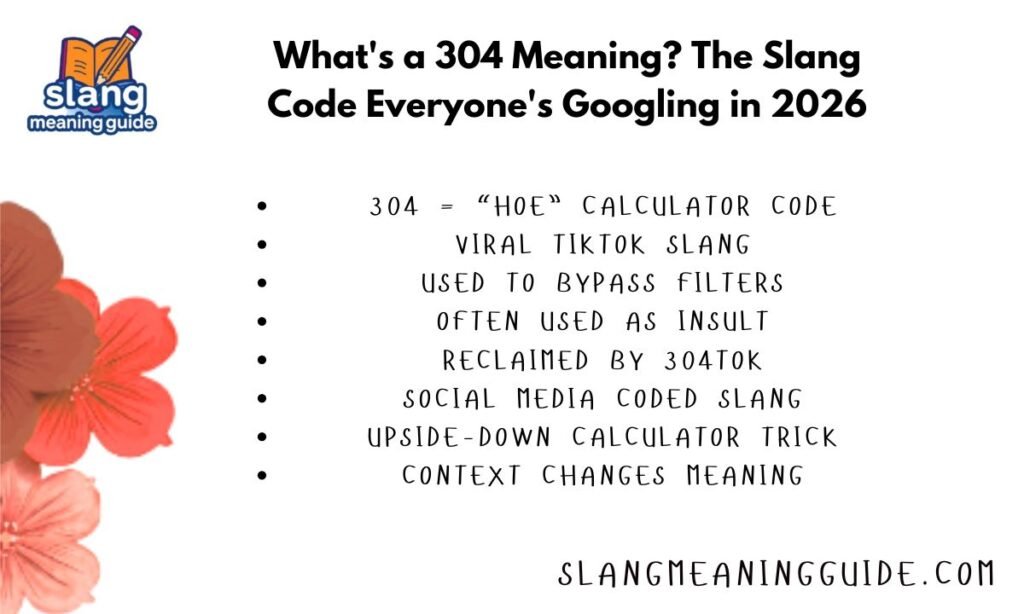
“304” is coded slang for the word “hoe.” When you type 304 into an old LED calculator and flip it upside down, the numbers visually resemble the letters H-O-E. That visual trick is where the whole thing started.
In simple terms, calling someone a 304 is a way to label a woman as sexually promiscuous — without using the actual word. It is a disguised insult designed to slip past content filters on social media. Context shapes whether it lands as a joke, a slur, or even, in some communities, a reclaimed identity.
In Simple Terms
The number 304 works as a coded substitution. It replaces a word that would get posts flagged or removed on platforms like TikTok and Instagram. People use it to say something they know they cannot say outright.
Because it looks like an innocent number, it passes through moderation. Most people outside internet culture have no idea what it means, which is exactly the point. The code gives the word plausible deniability.
Example Uses
- “She’s out here acting like a real 304.”
- “The comments were calling her a 304 all day.”
- “304tok is for people who own the label without shame.”
Origin and Background
The term is older than TikTok by a wide margin. It traces back to a calculator-trick trend that teenagers used in the 1990s and early 2000s.
The Calculator Trick That Started It All
Flipping numbers to spell words on LED calculators was a popular playground game. Words like “hello” (07734) and “shell” (7735) were classics. The “304 equals hoe” trick was part of that same wave and circulated in schools long before social media existed.
The first documented online definition appeared on the Online Slang Dictionary on January 7th, 2000, submitted by a user from Indiana. Urban Dictionary entries followed through the 2000s and 2010s. The term quietly built a presence in online communities for over a decade before breaking into mainstream awareness.
How It Moved Into the Internet Age
The term gained real traction when algospeak — the practice of replacing banned words with codes — became essential for creators on TikTok. Sex workers, in particular, adopted 304 as a way to discuss their work without getting accounts banned.
A TikTok community called 304tok emerged specifically around this usage. Within that community, many women reclaimed the word on their own terms, using it as a neutral or even positive self-identifier rather than an insult. That split — insult vs. reclaimed identity — defines how the word operates today.
Social Media Influence
304 exists in its current form almost entirely because of how social media content moderation works. Platforms ban words. Users find workarounds. Numbers are harder to filter than text.
TikTok’s strict moderation rules pushed an entire vocabulary underground, and 304 became one of the most widely recognized codes. The hashtag #304tok built a real community. Creators used it to discuss experiences, answer questions about the industry, and talk openly about topics that explicit terms would not allow.
Outside 304tok, the number spread through reaction videos, meme pages, and relationship content — especially in spaces influenced by “red pill” or “high-value man” rhetoric, where the word was used to criticize women’s sexual choices.
Real-Life Conversations: How It Actually Appears
Seeing the word in context makes the meaning click faster than any definition. Here is how it shows up across different platforms and conversations.
WhatsApp Chat
Friend 1: Did you see her stories last night? Friend 2: Yeah she’s been acting like a full 304 lately Friend 1: Not my place to judge tbh
The word is used casually here, as shorthand between friends. It carries a judgment but stops short of the actual word.
Instagram DMs
User: lol why are people in the comments calling her a 304 Reply: Because she posted that and people are pressed. It means hoe btw — calculator trick
Here the word appears in a context of confusion. Many people genuinely do not know what it means and ask directly.
TikTok Comments
Video caption: “304 things only 304s understand” Comments: “The 304tok community is everything” / “We built different” / “own it bestie”
This is the reclaimed usage. Women in the 304tok community adopt the term with humor and solidarity. The tone is completely different from how it is used as an insult.
Text Message Between Friends
Person A: He literally called me a 304 after one date Person B: Red flag. Block him immediately
Here the label is clearly used as an insult by a third party. The recipient knows it and the response reflects how damaging the word can be when weaponized.
Emotional and Psychological Meaning
Words used to label sexual behavior carry real weight. The “304” label does not land the same way for everyone who receives it.
Personal-Style Insight
For women who have had this word directed at them as an attack, it lands as shame and humiliation. It is a tool to police behavior. It signals that the speaker is judging a woman’s choices against an unspoken standard she had no say in setting.
For women who reclaim it through 304tok or use it with irony among close friends, the meaning flips. They strip away its power to wound by owning it first. That reclamation is genuine and reflects a long tradition of marginalized groups taking back words used against them.
Neither experience cancels out the other. Both exist at the same time, which is what makes the term so complicated to navigate.
Usage in Different Contexts
The same number means something completely different depending on who is saying it, where, and to whom.
Social Media
On TikTok, the usage splits cleanly between insult and community. In 304tok, it represents identity and solidarity. In manosphere or “alpha male” content, it is used to criticize women who do not meet traditional expectations. Both live on the same platform.
Friends and Relationships
Among friends who know each other well, it often gets used as light humor or casual shorthand. The context and history between people determines whether it lands as playful or harmful.
Work and Professional Settings
In professional settings, the term has no place. Using a coded sexual slur at work carries the same weight as saying the word itself. The fact that it looks like a number does not make it appropriate. HR would not find the calculator explanation amusing.
Casual vs. Serious Tone
Tone changes everything with this word. Said laughingly among close friends, it reads differently than typed in all caps in a comment section at someone. Intention matters, but so does impact.
When NOT to Use It
There are situations where using this word — even casually — causes real harm and reflects poorly on the person using it.
- Do not use it to label someone without their consent, even as a joke
- Do not use it toward someone after a breakup or conflict
- Do not use it in professional, academic, or public settings
- Do not use it to describe someone’s appearance, clothing, or past choices
- Do not use it thinking the number disguise makes it harmless
The code does not soften the meaning. It just makes it harder to catch.
Common Misunderstandings
People get a few things wrong about this term consistently. Here is what actually matters.
“It’s Just a Number”
No. Everyone in internet culture knows exactly what it means. Pretending otherwise is not a defense. Using it carries the full weight of the actual word, regardless of how it is written.
“It’s Harmless Because It’s Coded”
The disguise was built to bypass filters, not to make the word nicer. Saying something in code does not change what you are communicating. The person receiving it understands the message just fine.
“It Only Applies to Women”
Primarily yes, but the usage has expanded. Some communities now use it toward men or in gender-neutral ways, though the original and most common usage targets women specifically.
Tone Confusion
A lot of people see 304 in a 304tok context and assume it is always positive. Then they encounter it used as an attack and feel blindsided. The same word operates differently depending on community. Learn the room before you use it.
Comparison Table: 304 Across Contexts
| Context | Tone | Intent | Safe to Use? |
| 304tok community | Positive / reclaimed | Identity and solidarity | Among members, yes |
| Close friend group | Neutral / playful | Casual shorthand | Depends on relationship |
| Manosphere content | Negative | Shaming or labeling | No |
| Relationship argument | Hostile | Insult | No |
| Professional setting | Inappropriate | Any use | No |
| TikTok comment sections | Mixed | Varies widely | With caution |
Key Insight: The number does not change its meaning. The community and intent do.
Variations and Related Forms
Several related terms and spellings exist across platforms. Here are the most common ones.
5304 — Upside down reads “hoes” (plural). Used the same way as 304.
Code 304 — Refers to a situation where someone is trying to date a person others see as a 304.
304 culture — A broader critique of social norms around female sexuality, used both negatively and analytically.
304tok — The TikTok subculture built around sex workers and people who reclaim the label.
Certified 304 — A phrase used both as an insult and as a self-identifier, depending on the speaker.
How to Respond When Someone Uses It
How you respond depends entirely on the situation and what outcome you want.
Casual Replies
- “I literally just Googled that and now I’m offended”
- “That’s a new one”
- “Cool calculator trick bro”
Funny Replies
- “304? That’s a solid number, I’ll take it”
- “I prefer the full 5304 if we’re being real”
Mature Replies
- “That’s not something I’m cool with being called”
- “I’d appreciate it if you didn’t use that toward me”
- “You know what that means, and so do I — let’s not”
Respectful Replies
If someone uses the term in genuine ignorance, a simple explanation works better than anger. Most people who do not spend time on these platforms genuinely have no idea what the number means.
Regional and Cultural Usage
The word did not hit all cultures at the same time or in the same way.
Western Culture
The United States is where the term originated and where it sees the heaviest use. It is tied directly to American internet culture, hip-hop slang, and the specific calculator trick that spawned it. The TikTok community built around it is primarily based in the US and UK.
Asian Culture
In East and Southeast Asian internet communities, the number appears mostly in English-language content. Local language platforms have their own coded terms for similar concepts. Among younger, English-speaking Asian users on TikTok, 304 is recognized but less commonly used than in Western spaces.
Middle Eastern Culture
In many Middle Eastern communities, the term circulates in private or underground chat groups rather than openly on public social media. Cultural sensitivities around discussing sexuality publicly make the coded usage even more practical — and potentially more harmful, since there is less pushback against its use as a shaming tool.
Global Internet
On Reddit, Discord, and global gaming platforms, the term travels without much cultural context. Many international users encounter it through memes and use it without understanding its full weight. The calculator origin often has to be explained from scratch.
Generational Differences
How old you are shapes how you experience this word entirely.
Older millennials and Gen X users often encounter it for the first time as adults and find it baffling. They were not raised with calculator-trick slang as a social currency and tend to see it as juvenile once they learn the meaning.
Gen Z knows the word but occupies both sides of it. Some use it as a shaming tool. Others are part of communities actively dismantling that use. For Gen Z, the word is contested territory.
Gen Alpha is growing up seeing it without the historical context. For the youngest internet users, 304 may land as simply a number they have heard used in certain ways — without fully understanding the weight behind it.
Is It Safe for Kids?
No. The word is not appropriate for young audiences regardless of its coded format. Children and teenagers see this number in comment sections and TikTok videos without always having the context to understand what is being said.
Parents and educators should know that 304 is not a neutral number in online spaces. It carries the full meaning of a sexual slur, just one step removed.
Frequently Asked Questions
What does 304 mean in slang?
304 is coded slang for “hoe,” derived from typing the number into a calculator and flipping it upside down to read the word.
Why do people call someone a 304?
To label a woman as sexually promiscuous without using the actual word — often to avoid social media content filters.
Is being called a 304 always an insult?
Not always — in the 304tok community on TikTok, many women reclaim and embrace the label on their own terms.
What is 304tok?
A TikTok subculture built by sex workers and sexually liberal women who use the 304 label positively and discuss their experiences openly.
Can men be called a 304?
The term primarily targets women, but some online communities now apply it more broadly, though this is less common.
Conclusion
The number 304 is not just a number — it is a coded label with a long history, a complicated present, and real consequences when used carelessly. Knowing what it means protects you from being blindsided by it and helps you decide whether or how to use it yourself. Context, community, and consent are what separate the word from a weapon.