
Someone just texted you “idm” and you are not sure if that is good or bad. Does it mean they are chill with your idea, or are they brushing you off? This guide breaks down every meaning, every context, and exactly how to respond.
What Does IDM Mean in Text?
IDM is a widely used texting abbreviation that most people encounter daily without knowing its full range of meanings. The core definition is simple, but the emotional tone shifts depending on who sends it and how.
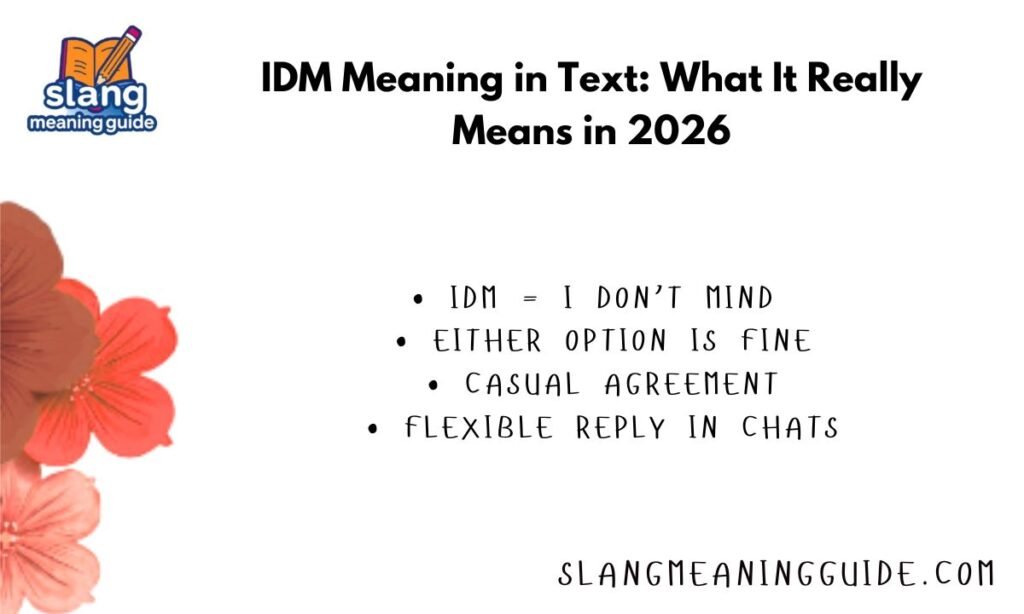
I Don’t Mind
The primary and most common meaning of IDM is “I don’t mind.” It is a quick way of saying you are flexible, agreeable, or have no strong preference about something. It signals openness without enthusiasm or resistance.
When someone asks “do you want pizza or tacos tonight?” and the reply is “idm,” they are genuinely leaving the choice to you. There is no hidden frustration. There is no passive aggression. It is clean, casual, and efficient for everyday decision-making.
This is the meaning used in the overwhelming majority of texts, DMs, and chat messages. If you receive IDM in a low-stakes conversation about plans, food, or scheduling, this is almost certainly what the sender intended.
Either Option Is Fine
IDM also works as a shorthand for “either option works for me.” It is slightly more specific than “I don’t mind” because it implies there were two or more choices on the table. The person is not avoiding a decision — they are actively communicating that both options are acceptable.
This version appears often when making group plans. Someone asks the group “movie at 7 or 8?” and several people reply “idm” — meaning the time genuinely does not matter to them either way. It keeps conversations moving without dragging out unnecessary back-and-forth.
Casual Agreement or Acceptance
In some conversations IDM functions less as a preference statement and more as a gentle yes. It can mean “sure, go ahead” or “that works for me” without spelling it out. The tone is soft and agreeable rather than enthusiastic.
Think of it as the texting equivalent of a relaxed shrug followed by a nod. It does not say “I love this idea” but it clearly says “I am not opposed to it.” In casual friendships this kind of low-key agreement is completely normal and comfortable.
How IDM Is Used in Real Conversations
The meaning of IDM stays consistent, but the way it lands changes based on who is sending it and what platform you are on. Reading the full context always helps.
IDM in Text From a Girl
When a girl sends IDM, it usually signals genuine flexibility. Girls tend to add context around it more than guys do, so a bare “idm” from a girl can feel slightly more loaded — especially in early dating situations. Pay attention to what came before it.
In close friendships, though, IDM between girls is completely casual. “Want to go to the mall or the park?” — “idm honestly, you pick” is a normal exchange between two people who trust each other and are genuinely unbothered about the outcome.
IDM in Text From a Guy
Guys use IDM in a very direct, no-drama way. It is usually a clean one-word reply with no subtext. “Wanna watch the game or go out?” — “idm” means the guy literally does not have a preference and is happy either way.
In romantic contexts, though, a repeated pattern of IDM responses can come across as disinterested. If someone always defers with “idm” and never expresses a preference, it may signal low investment in the relationship or conversation, even if that is not their intention.
IDM on Snapchat and Instagram
Social platforms have their own texting cultures, and IDM fits naturally into both of the biggest visual platforms.
IDM on Snapchat
Snapchat conversations are fast, short, and built for efficiency. IDM appears constantly in streaks and quick planning exchanges. “Wanna do a streak pic here or outside?” — “idm u pick” is a completely typical Snapchat exchange.
It also shows up in group chats when planning meetups or deciding on content. Nobody expects a paragraph. IDM does the job in three characters and keeps the chat moving at Snapchat speed.
IDM on Instagram
On Instagram, IDM appears in DM conversations and occasionally in comment replies. Someone might ask “should I post the first one or the second?” in their story and get “idm both are good” in the DM inbox.
It blends with compliments here in a way you do not always see in pure text messaging. “Idm which one you post, honestly both look amazing” is Instagram-typical: casual agreement wrapped in light encouragement. The platform’s tone is naturally more affirming.
Is IDM Rude, Passive Aggressive, or Flirty?
This is the question most people actually want answered. IDM is not inherently rude, but context and repetition can make it feel that way.
When IDM Feels Positive
When someone uses IDM after being asked for a genuine preference and they follow it with a warm redirect — “idm, whatever you want!” — it reads as warm and considerate. They are putting the other person first. That is a caring response, not a cold one.
When IDM Feels Neutral
A bare “idm” with no added warmth or context lands as neutral. It is not unfriendly. It is just functional. This is the most common experience of IDM and it should not be overthought or interpreted as anything deeper.
When IDM Feels Slightly Off
If someone uses IDM repeatedly throughout a conversation, especially in response to genuine questions about how they feel, it can start to feel like they are checked out. One IDM is flexibility. Five IDMs in a row is emotional absence. That distinction matters.
How to Respond When Someone Sends IDM
You got an IDM. Now what? The right response depends on what you were asking and the energy of the conversation.
Casual replies:
- “Ok cool, let’s do [option]”
- “Perfect, I’ll pick then”
- “Lol okay I’ll just decide”
Funny replies:
- “You always say that, I’m making you choose this time”
- “That’s not helping lol, heads or tails?”
- “Classic you 😂 fine I’ll pick”
Neutral replies:
- “Got it, going with [option] then”
- “Sounds good”
- “Cool, I’ll sort it out”
Professional replies: If IDM appears in a work-adjacent chat, treat it as “that works for me” and move forward with your proposed plan. Confirm the decision so everyone is aligned: “Great, going with Tuesday then.”
IDM vs Similar Slang Terms
IDM gets confused with similar abbreviations all the time. Here is a clear breakdown of what separates them.
| Abbreviation | Full Meaning | Key Difference from IDM |
| IDM | I don’t mind | Flexible, no preference |
| IDC | I don’t care | Can feel colder or dismissive |
| NVM | Never mind | Withdrawing a statement |
| IKR | I know right | Agreement with shared feeling |
| NGL | Not gonna lie | Introducing an honest opinion |
| WTV | Whatever | Casual but sometimes dismissive |
| YH | Yeah | Simple agreement |
| TBH | To be honest | Preceding a candid statement |
The biggest confusion is between IDM and IDC. “I don’t mind” carries warmth and openness. “I don’t care” can sound indifferent or dismissive, even if the sender did not mean it harshly. Choosing between them matters more than people realize.
IDMF Meaning in Text
IDMF is a stronger, more emphatic version. It means “I don’t mind f***ing” — or in a cleaner interpretation used mostly on iPhone keyboards, it is sometimes autocorrected from or typed in place of a stronger “I really don’t mind.” Context makes the version clear.
On iPhones where autocorrect is aggressive, IDMF can also appear accidentally. If you receive it and the conversation is completely innocent, it is very likely an autocorrect slip or a typo for IDM. Do not read into it unless everything else in the conversation suggests otherwise.
IDM and the “IDM NM” Combo
“IDM NM” means “I don’t mind, never mind” or more commonly “I don’t mind, not much.” The NM adds a relaxed qualifier. If someone asks “what are you up to?” and you reply “idm nm” — you are saying you are flexible and nothing much is happening.
This combo appears most often when making spontaneous plans. One person asks if the other is free and they reply “idm nm, what’s up?” — casual availability with no commitment pressure. It is a very natural way to open the door to plans without sounding overeager.
IDM in Professional and Work Settings
IDM is casual slang. It does not belong in formal professional communication. Emails, official Slack messages, client-facing documents, and business proposals should always spell out “I don’t mind” in full.
In relaxed internal team chats on platforms like Slack or Teams, IDM might appear between close colleagues and nobody will bat an eye. But the moment the conversation involves a manager, client, or external contact, switch to full phrases. Professionalism is clarity, and clarity means no abbreviations that could confuse.
Other Meanings of IDM
Outside of texting, IDM stands for Intelligent Dance Music — a genre of electronic music known for complex rhythms and experimental production. Artists like Aphex Twin, Boards of Canada, and Autechre define the genre.
In software, IDM also refers to Internet Download Manager — a popular download accelerator tool used widely in parts of Asia, South Asia, and the Middle East. If someone mentions IDM in a tech forum or software discussion, this is almost certainly what they mean.
In project and business contexts, IDM can also mean Information Delivery Manual — a technical document used in construction and engineering projects. This version appears in BIM (Building Information Modelling) workflows.
When You Should Avoid Using IDM
IDM works brilliantly between people who already communicate casually. It breaks down in three specific situations.
With people who do not know internet slang. Older relatives, formal contacts, and people who text infrequently will not know what IDM means. They may misread it, ignore it, or feel confused by it. Spell it out.
In sensitive emotional conversations. When someone shares something difficult and needs your input, replying with IDM can feel cold and unhelpful. This is a moment that needs full words and full presence, not an abbreviation.
When you actually have a preference. IDM means something when it is genuine. Using it to avoid conflict or to seem low-maintenance when you actually care about the outcome creates miscommunication and quiet frustration over time. Be honest instead.
Frequently Asked Questions
What does IDM mean in texting?
IDM means “I don’t mind” — a casual way to show flexibility or agreement without strong preference.
Is IDM the same as IDC?
No. IDM is warmer and more open; IDC (“I don’t care”) can sound cold or dismissive depending on tone.
What does IDM mean from a girl or a guy?
The meaning is identical — both use it to signal flexibility — but girls tend to add more context around it while guys often send it alone.
Is IDM appropriate to use at work?
Only in very casual internal chats between close colleagues. Avoid it in formal emails, client messages, or official communications.
Can IDM ever feel passive aggressive?
Yes, if used repeatedly when genuine engagement is expected. One IDM is casual; too many in a row can signal emotional disengagement.
Conclusion
IDM meaning in text is almost always “I don’t mind” — simple, flexible, and genuinely agreeable in the right context. It is one of the most harmless and useful abbreviations in modern texting, as long as you know when to use it and when to write your actual feelings out instead. Read the room, match the energy, and IDM will never lead you wrong.