
Someone just sent you a message and signed off with “HTH.” It could be warm and helpful, or it could have an edge of sarcasm you didn’t expect. Three letters, two possible meanings, and one very important tone question. Here’s exactly what HTH means in text, where it came from, and how to read it correctly every time.
What Does HTH Mean in Text?
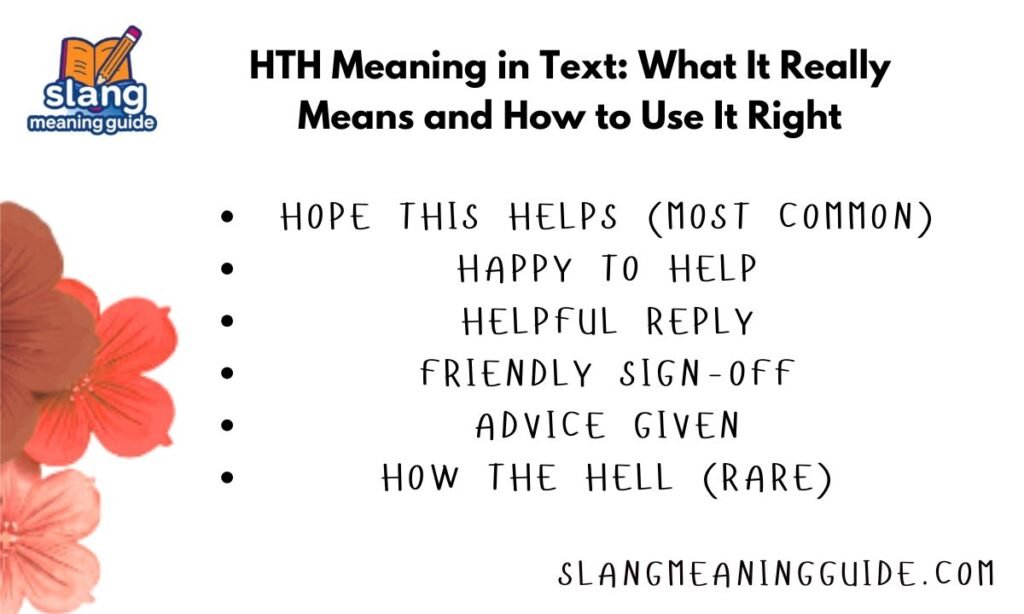
HTH is a text abbreviation with two closely related meanings that both connect to the idea of helping someone.
Primary meaning:
- Hope This Helps — used after sharing advice, instructions, a link, or useful information
- Signals: “I tried to be useful, I hope this does the job”
Secondary meaning:
- Happy to Help — used as a response when someone thanks you for helping
- Signals: “No problem, glad I could assist”
Less common meanings:
- How the Hell — informal, used to express disbelief (example: “HTH did that happen?”)
- Have to Have — niche usage in consumer or retail contexts, rarely seen in casual texting
Quick identification:
- If HTH appears at the end of an explanation or instructions → Hope This Helps
- If HTH appears after someone says thank you → Happy to Help
- If HTH appears after something surprising or absurd → How the Hell
Origin and Background of HTH
HTH has been around longer than most people realize. It didn’t start with smartphones or social media — it grew out of early internet culture.
Early 2000s: HTH first appeared in online tech forums, bulletin boards, and early email threads. The first recorded Urban Dictionary entry for HTH dates to November 2002.
Forum culture: Sites like Experts Exchange and later Stack Overflow became hubs where developers and programmers ended helpful posts with HTH — a polite way to close after sharing a solution.
Email adoption: As email became the dominant communication tool in workplaces, HTH migrated into semi-formal email sign-offs, especially in tech, IT, and support environments.
Mainstream texting: HTH moved into casual texting and messaging apps as smartphone usage exploded in the 2010s.
2020s usage: HTH is now common across Reddit, Discord, WhatsApp, group chats, and DMs — not just tech communities. It’s widely understood across age groups, though older generations tend to be more comfortable with it than Gen Z, who often spell out “hope this helps” in full or skip the formality entirely.
The abbreviation stuck because it fills a genuine communication need: a polite, efficient way to wrap up a helpful message without sounding formal or stiff.
Deeper Meaning and Tone Behind HTH
HTH carries more emotional nuance than it looks like it should. The same three letters can land very differently depending on how the surrounding message reads.
When HTH feels warm and genuine:
- The person gave detailed, thoughtful advice before signing off with HTH
- The tone of the conversation is friendly or collaborative
Example: “You’ll find the setting under General > Privacy > Location. HTH!”
When HTH feels neutral and professional:
- Used in a semi-formal context like a work chat or support thread
- No extra warmth, just efficient helpfulness
Example: “Here’s the documentation link — HTH.”
When HTH feels sarcastic or dismissive:
- The “help” offered is vague, unhelpful, or obvious
- Used sarcastically after non-answers or after pointing out something the person should already know
Example: Someone asks how to fix a complex bug, and the response is “Have you tried turning it off and on again? HTH.” — in this case, HTH is passive-aggressive
- Urban Dictionary explicitly notes this sarcastic use: HTH can mean the sender is deliberately unhelpful while appearing to help
Key takeaway: HTH is not inherently sarcastic. Read the message it follows, not just the abbreviation.
HTH in Real Conversations
Here’s how HTH actually shows up across different conversation types:
Tech support or problem-solving:
- “Run the update, restart your device, then clear the cache. HTH!”
- “Here’s the troubleshooting thread I used when mine broke: [link]. HTH.”
Friends helping friends:
- “The restaurant opens at 6 and you don’t need a reservation on weekdays. HTH!”
- “I’ve attached my notes from that lecture — HTH for your exam.”
After someone says thank you:
- A: “That actually worked, thank you!”
- B: “HTH 😊” (meaning Happy to Help)
Group chats or forums:
- “For anyone wondering — yes, the event was rescheduled to next Saturday. HTH.”
- “Dropping this recipe link here since a few people asked. HTH.”
Sarcastic use (context makes it clear):
- “Maybe try Googling it? HTH.” — dry, slightly dismissive
- “The answer is literally in the title. HTH.” — pointed, not friendly
HTH Across Different Platforms
HTH shows up in different ways depending on where the conversation is happening.
Text messages and DMs:
- Casual and friendly
- Usually genuinely helpful in tone
- Common when someone shares a tip, recommendation, or quick answer
WhatsApp and iMessage:
- Used in both one-on-one chats and group threads
- Often appears when someone shares a resource, link, or instruction
- More common among millennials than Gen Z
Reddit and online forums:
- High frequency, especially in advice subreddits, tech communities, and Q&A threads
- Sarcastic use is more common here than in personal messaging
- Often paired with HAND (Have a Nice Day) in forum culture: “HTH. HAND.”
Emails (semi-formal):
- Used in work emails, especially in tech, IT, and support roles
- Sits at the boundary between formal and casual — acceptable in most workplaces but not appropriate for executive-level communication
- Example sign-off: “Let me know if you have questions. HTH!”
Discord:
- Appears in help channels and community servers
- Used when someone posts a solution to a common problem
- Tone varies by server — casual servers use it playfully, support servers use it professionally
Facebook groups:
- Common in niche interest groups, parenting groups, and DIY communities
- Usually genuine, not sarcastic
HTH in Professional vs Casual Settings
The same abbreviation reads differently depending on who you’re sending it to.
In casual settings:
- Completely natural and warm
- Fits any situation where you’re sharing helpful information with someone you know
- Works well in texts, DMs, group chats, and community forums
- Examples:
- “Here’s the playlist I mentioned — HTH!”
- “I think the deadline is Friday but double-check with the teacher. HTH.”
- “Added you to the shared doc. HTH for the project.”
In formal or professional emails:
- Acceptable in most modern workplaces, especially tech and creative industries
- Avoid with senior leadership, clients you don’t know well, or very formal contexts
- Safe to use with teammates, colleagues, or peers you have an existing rapport with
- Safer alternatives for formal emails:
- “Please let me know if you need anything else.”
- “I hope this answers your question.”
- “Don’t hesitate to reach out if you need further clarification.”
Rule of thumb: If you’d feel comfortable saying “hope this helps” out loud to this person, HTH works in writing too.
When to Use HTH and When to Avoid It
Use HTH when:
- You’ve just answered a question and want to close warmly
- You’re sharing a link, file, tip, or recommendation
- Responding to a thank-you in a casual conversation
- Writing in a group chat where everyone communicates casually
- You want to sound helpful without being overly formal
Avoid HTH when:
- Writing to senior management or formal business contacts
- The situation is serious, emotional, or sensitive
- You haven’t actually provided useful information (it will read as sarcastic)
- The person you’re messaging isn’t familiar with texting slang
- You’re writing to someone from a different generation who might not recognize it
Context check before sending HTH:
- Did I actually help with something? → Yes: use it. No: skip it or it sounds sarcastic.
- Is this a casual relationship? → Yes: use it freely. No: spell it out or use a formal closing.
- Is this a serious conversation? → If yes: skip HTH entirely.
HTH vs Similar Slang and Alternatives
HTH lives alongside other helpful-sounding closers and alternatives. Here’s how they compare:
| Expression | Meaning | Tone |
| HTH | Hope This Helps / Happy to Help | Warm, casual |
| NP | No Problem | Casual, relaxed |
| IIRC | If I Recall Correctly | Informational, modest |
| FYI | For Your Information | Neutral, informational |
| FWIW | For What It’s Worth | Humble, offering perspective |
| LMK | Let Me Know | Open, inviting follow-up |
| TBH | To Be Honest | Candid, conversational |
| YMMV | Your Mileage May Vary | Cautious, qualifying advice |
HTH vs NP:
- HTH closes a message where you gave information. NP responds to being thanked.
- They often pair together: “Sure, here’s the file. HTH!” → “Thanks!” → “NP!”
HTH vs FYI:
- FYI shares information proactively. HTH hopes information you just shared is useful.
- FYI leads the message. HTH closes it.
Common Misunderstandings About HTH
A few things regularly trip people up when they encounter HTH.
It’s always sarcastic — not true. In most conversations, HTH is completely sincere. The sarcastic use is real but contextual, not the default.
HTH only means “Hope This Helps” — it also means “Happy to Help” as a thank-you response, and rarely “How the Hell” in an entirely different tone.
It’s unprofessional — HTH is acceptable in most modern workplaces and has been in email culture for over two decades. The Cambridge Dictionary even includes it as a recognized written abbreviation.
Younger people use it most — actually, Gen Z tends to spell out “hope this helps” in full or skip the formality. HTH is more common among millennials and older users who grew up with forum and email culture.
HTH at the end of a bad answer is still nice — if someone gives you no useful information and then types HTH, it almost certainly reads as passive-aggressive. The abbreviation doesn’t save an unhelpful response.
Variations and Related Forms of HTH
HTH doesn’t exist in complete isolation. A few related forms appear in similar contexts.
HTH! — exclamation mark softens it and makes it warmer
hth — lowercase feels more casual and relaxed, popular in Discord and fast chats
HTH 😊 — paired with a smiley to add warmth and make sincerity clear
HAND, HTH — classic forum pairing: Have a Nice Day, Hope This Helps (common on Stack Overflow and Reddit threads)
HTHFY — Hope This Helps For You (extended version, less common)
Hope this helps! — spelled out version, used when the person prefers avoiding abbreviations
How to Respond When Someone Sends HTH
Your response depends on which version of HTH was used and what the conversation calls for.
Casual replies (after genuine help):
- “It did, thanks! 🙌”
- “Super helpful, appreciate it”
- “That actually fixed it, thank you!”
Friendly replies:
- “You’re a lifesaver 😭”
- “Okay that helped more than I expected”
- “Saving this message forever”
Mature or professional replies:
- “Thank you, that clarifies things.”
- “Helpful, I’ll follow up if I have questions.”
- “Appreciated — that answered exactly what I needed.”
When HTH felt sarcastic:
- Don’t engage with the sarcasm directly
- Simply continue asking for help: “Still not sure — any other ideas?”
- Or acknowledge without validating: “Got it, I’ll keep looking”
Psychological and Emotional Meaning of HTH
HTH does something subtle that longer phrases sometimes don’t: it signals effort without demanding recognition. The person who types HTH is saying “I tried to help you” while also leaving the door open — they hope it helps, they’re not declaring that it definitely will.
- It’s humble in tone — “hope” implies the outcome isn’t guaranteed
- It puts the recipient’s needs first — the focus is on whether they find it useful, not on how much effort the sender put in
- It closes a loop without creating pressure — the conversation can end or continue naturally
- It works as both a warm gesture between friends and a professional sign-off between colleagues
That small dose of warmth at the end of an otherwise functional message is exactly why HTH has stayed useful for over two decades.
Frequently Asked Questions
What does HTH mean in text messages?
HTH most commonly means “Hope This Helps,” used after sharing information, advice, or a useful resource.
Is HTH formal or informal?
HTH sits in the middle — casual enough for texts and group chats, acceptable in most workplace emails, but too informal for executive or highly formal communication.
Can HTH be sarcastic or rude?
Yes — if the “help” provided is vague, obvious, or unhelpful, HTH can come across as passive-aggressive or dismissive.
Is HTH still commonly used in 2026?
Yes, particularly among millennials, in Reddit threads, Discord help channels, tech forums, and workplace emails — though Gen Z tends to spell it out in full.
What should I reply when someone sends HTH?
If they helped you, confirm it: “It did, thanks!” If they responded to your thank-you with HTH (Happy to Help), a simple “Appreciate it!” or emoji works perfectly.
Conclusion
HTH is one of those abbreviations that does more emotional work than its three letters suggest. It closes a helpful exchange politely, signals genuine effort, and keeps the tone light without being overly casual.
The key is knowing which version you’re reading — Hope This Helps, Happy to Help, or the rarer sarcastic edge that context makes clear. Read what comes before it, check the tone, and HTH becomes one of the easier pieces of digital shorthand to decode and use correctly.