

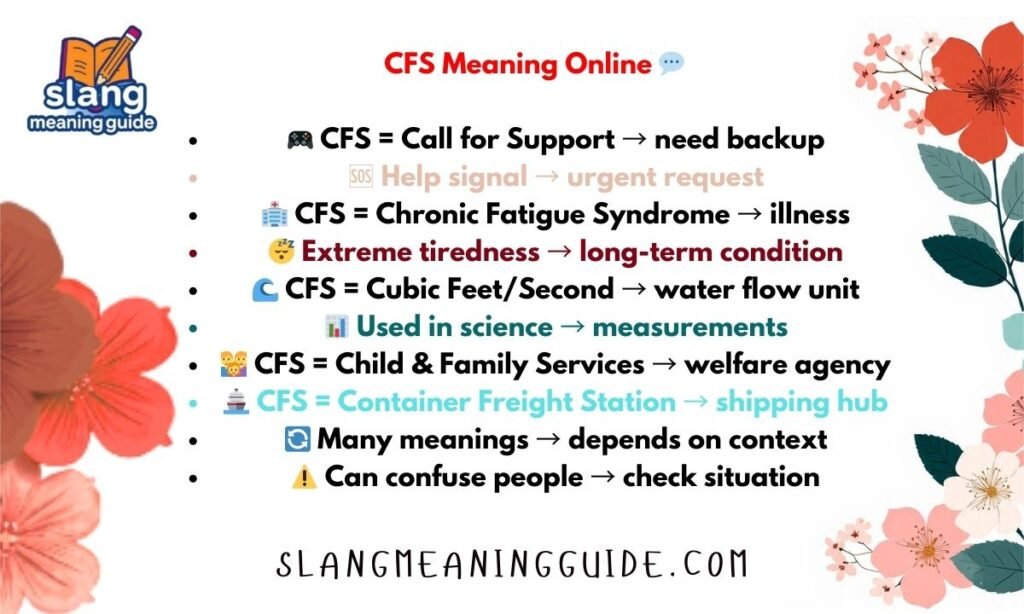
Ever stumbled on the letters CFS and wondered what they meant? Across contexts, CFS can hint at very different things. In one setting it might be a quick digital cry for help, while in another it could be an official title or a scientific term. This three-letter mystery pops up everywhere – from gaming chats to medical clinics to engineering reports. Read on to uncover the many meanings behind CFS and why context is key.
Core Meanings Explained
Call For Support (Gaming/Chat Slang)
In online gaming and chat groups, CFS commonly stands for “Call for Support.” Players type CFS to signal they need backup or help in a game or group activity. It’s like waving a hand in text form. This usage grew out of team-based games in the 2000s, where quick shorthand was vital. CFS in chat means “I could really use another player right now.”
- Gaming backup: A player under attack might type, “CFS at mid lane! Enemies incoming!” meaning “bring support to the middle lane now.”
- Emergency heal: In a role-playing raid, someone might yell, “CFS! I’m down to 10% health!” – asking teammates for immediate healing.
- Team effort: During a boss fight, a team leader might message, “CFS, let’s take it together.” This summons extra help to defeat a tough enemy.
- Real-world twist: Even outside games, people borrow it to mean “I need help.” For example, at work chat: “CFS—my report deadline is today and I’m swamped.” (asking colleagues to pitch in).
The tone is urgent and practical. When you see CFS in a chat, think “Hey, I could use assistance!” It’s direct and action-oriented.
Usage tips: Remember, context matters. On a game server or team chat, CFS is a request for backup. If someone’s playing an online strategy game, they mean exactly that.
Chronic Fatigue Syndrome (Medical)
In medical and health circles, CFS almost always means “Chronic Fatigue Syndrome.” This is a serious, chronic illness marked by extreme, unexplained fatigue lasting over six months, along with other symptoms like sleep problems and muscle pain. Doctors and researchers use “CFS” because it’s shorter than repeating the full name.
- Patient context: A doctor might note, “The patient meets criteria for CFS after ruling out other conditions.” Here CFS is shorthand for the diagnosis.
- Discussing symptoms: Someone might say, “I’ve been dealing with CFS for years. It really impacts my daily life.” This clearly refers to the syndrome.
- Support communities: In health forums or support groups, “CFS patient support group” means a group for people with chronic fatigue syndrome.
- Awareness: Headlines or pamphlets may use CFS as an abbreviation. Example: “New CFS research could bring hope.”
This is formal usage. CFS here is not slang – it’s an officially recognized illness (also called ME/CFS). When used this way, the audience is typically healthcare providers or people talking about health.
Prevalence and facts: Studies estimate around 0.2%–0.4% of the population may have CFS. It affects more women than men. Long COVID has even raised interest, as many post-COVID patients report ME/CFS-like symptoms.
Cubic Feet per Second (Engineering/Science)
In engineering, hydrology, and environmental science, CFS stands for “Cubic Feet per Second.” It’s a unit of flow rate, measuring volume of water (or fluid) that passes a point every second. Think of it as how many cubic feet of water flow down a river each second. This is a standard technical term and is usually written in capitals (sometimes “cfs”).
- River flows: You might see “Streamflow = 500 CFS.” That means 500 cubic feet of water per second.
- Dam releases: An engineer reporting, “We’re releasing water at 1,000 CFS to manage reservoir levels.”
- Water usage: In irrigation, “The canal can carry up to 250 CFS” tells farmers how much water is available.
- Reports and charts: Government or research papers often graph river discharge in CFS.
For example, 1,000 CFS is a huge flow – imagine 1,000 basketballs’ volume passing a point each second. When you read CFS in a scientific context, it’s a precise measure.
Child and Family Services (Social Welfare)
In social work and government, CFS often means “Child and Family Services.” These are agencies or programs focused on child welfare, foster care, adoption, and family support. The acronym helps professionals talk quickly about departments or initiatives.
- Agency name: “Washington CFS” might refer to a state’s Child and Family Services department.
- Case files: A social worker might write, “Referred to CFS for additional services.”
- Public notices: Headlines like “CFS investigating reports of child abuse.”
- Collaboration: A teacher emailing, “Let’s involve CFS to help this student’s family.”
Here, CFS isn’t casual slang; it’s an official program. It’s used in case reports or news in fields like social work and family law.
Container Freight Service (Logistics)
In shipping and logistics, CFS can refer to “Container Freight Station.” This is a facility where cargo is grouped (consolidated) or separated (deconsolidated) when it’s moving in containers, especially for less-than-container-load (LCL) shipments.
- Cargo consolidation: A freight coordinator might say, “Ship the goods to our L.A. CFS for consolidation.”
- Shipping docs: A bill of lading might note, “Pickup at Mumbai CFS after customs clearance.”
- Logistics planning: “We schedule deliveries to the Port CFS weekly.”
- Informal chat: Among freight brokers: “Drop the crates at CFS before 5 PM.”
This usage is industry-specific. If you work in import/export, you’ll see CFS used in documentation and conversation. It’s the “warehouse” for containers and usually appears in capital letters. For context: “CFS” here is not an acronym a gamer or doctor would normally use. It lives in a different world – that of ports, trucks, and warehouses.
Origin and Evolution Timeline
| Term | Estimated Origin | Platform Where It Blew Up | Current Status |
|---|---|---|---|
| Call For Support | Early 2000s (online gaming) | Multiplayer games (MMORPGs, MOBAs) | Common in gaming/team chat; still used on Discord and Slack when needing backup |
| Chronic Fatigue Syndrome | 1988 (CDC case definition) | CDC / medical research community | Widely recognized chronic illness; criteria refined (1994 Fukuda, 2011 ICC); prevalence ~0.2–0.4% |
| Cubic Feet/Second | 19th century (industrial era) | Engineering, hydrology textbooks | Standard unit for flow; still used globally in scientific and infrastructure reports |
| Child & Family Services | Early 20th century | Social welfare agencies / state gov’ts | Active government agencies in many countries, ongoing child welfare and protective services |
| Container Freight Station | 1950s–70s (container shipping) | Global shipping industry | Common in international logistics; used by freight forwarders and ports |
Over time, CFS has grown far beyond its roots in any single field. For gamers in the 2000s, CFS meant a quick plea for backup. As online slang spread through forums and chats, the shorthand gained a foothold in everyday texting.
By contrast, in medicine CFS was coined much earlier – it was first defined by the CDC in 1988 and later revised in 1994 and 2011. The same letters trace back even further in science: cubic feet per second has been a flow unit for over a century. The table above shows each term’s origin and how it’s used today.
Common Misunderstandings
Because CFS pops up in so many fields, confusion is common. People often jump to one interpretation without realizing others exist. For example, a casual reader might mistake a health article for gaming slang, or vice versa. It’s also easy to mix up CFS with similar-sounding acronyms (like “close friends story” on Instagram, which is a different slang usage).
- Medical vs. Slang: Seeing “CFS” in a message could be a gamer asking for backup or someone noting a serious illness. Without context, the meaning isn’t clear.
- Professional vs. Casual: A friend texting “CFS this weekend?” (meaning “Close Friends Story”) can be baffling if you know CFS only as Chronic Fatigue Syndrome.
- Logistics vs. Social work: An industry newcomer might see “CFS” on a shipping manifest and wonder why child services got involved.
- Overheard chat: In a group chat, one person’s “CFS” (wanting tech support) might confuse others who think it’s a meme or inside joke.
The key to avoiding mistakes is context. If you hear CFS mentioned, look at where it’s said: a hospital, a chat group, a government office, or a physics lab. That will usually tell you which definition to use.
Formal vs. Informal Uses
Acronyms often have informal shortcuts and formal expansions. CFS is no different. In casual chat, people might say “CFS!” as shorthand, but in formal writing or professional speech, the full term or a different phrase is used. Consider these examples:
| Term | Informal Use (Acronym) | Formal/Professional Equivalent |
|---|---|---|
| Call for support | “CFS! We need help in this raid!” | “Requesting backup.” / “Help needed here!” |
| Chronic Fatigue Syndrome | “I was diagnosed with CFS.” | “Diagnosed with chronic fatigue syndrome.” |
| Cubic feet per second | “River flow is 800 CFS.” | “The discharge rate is 800 cubic feet per second.” |
| Child & Family Services | “Report sent to CFS.” | “Report sent to Child and Family Services.” / “local child welfare agency” |
| Container Freight Station | “Load at the CFS by Monday.” | “Load at the container freight station by Monday.” |
In each case, the informal side saves typing or speaking time. A gamer might simply type “CFS” instead of spelling it out, and a social media user might say “CFS” to friends. But in a report or conversation, we spell out the words for clarity.
For example, a report might say “The patient continues to struggle with chronic fatigue syndrome,” not just “CFS”. And a freight invoice will usually give the full location name rather than just “CFS.” This distinction keeps communication clear: slang lives in chat, full terms live in documents.
Comparisons With Similar Abbreviations
CFS vs. LOL: Both are internet acronyms, but LOL (“laugh out loud”) signals humor or laughter, while CFS (in gaming) signals need for help. One is a reaction, the other a request.
CFS vs. FFS: FFS (“for f***’s sake”) expresses frustration or urgency in everyday texting. CFS is usually a straightforward cry for backup in a game or serious condition in health. The similarity in letters can cause a pause, but FFS is emotional exasperation and CFS is usually factual.
CFS vs. LFG: LFG (“let’s f**king go”) is another gaming slang showing excitement or readiness. CFS is the opposite—asking others to come to you rather than gearing up. Both appear in gamer lingo, but they trigger very different vibes.
CFS vs. ASAP: ASAP (“as soon as possible”) also signals urgency. If a gamer types CFS ASAP, they doubly emphasize they need help now. But ASAP by itself is a standalone urgent request, whereas CFS is specific to help in action contexts.
CFS vs. BRB/AFK: “Be right back” (BRB) or “away from keyboard” (AFK) mean someone is leaving temporarily. These acronyms exit a conversation, while CFS (call for support) invites others into action. Confusing them would reverse roles completely.
CFS vs. FYI/IMO: FYI (“for your information”) and IMO (“in my opinion”) are about sharing information or views. They carry no urgency. CFS, by contrast, carries urgency or seriousness. Seeing CFS where an opinion marker might go (or vice versa) can be jarring.
CFS vs. CCTV/CFO/etc.: Outside texting, acronyms like CFO (Chief Financial Officer) or CCTV (Closed Circuit TV) could momentarily spring to mind if one mishears “CFS.” But once context is clear (business vs tech vs chat), the correct expansion emerges.
CFS vs. CF (Call friend, Cold Fusion, etc.): Shorter acronyms like CF or IF can stand for many things too. CFS itself is a bit longer and field-specific. Always decode acronyms by where and how they’re used.
Each of these highlights that CFS may seem to share letters with other shorthand, but its meaning comes from context. Know the setting—game chat, tech talk, or a news article—and you’ll know which side of the comparison applies.
Frequently Asked Questions
What does CFS mean in online chats?
In gamer and team chats, CFS usually means “Call For Support,” a request for help or backup.
Can CFS refer to a medical condition?
Yes – in healthcare contexts, CFS typically stands for “Chronic Fatigue Syndrome,” a debilitating illness involving extreme fatigue.
How can I tell what CFS stands for?
Look at the context: gaming or text slang implies help or casual meaning, medical articles imply the syndrome, engineering reports imply flow rate, etc. Context clues reveal the correct meaning.
Is CFS used on Instagram?
Sometimes. On Instagram, CFS often means “Close Friends Story,” a private story feature. It’s an example of social media slang use.
Why does CFS have multiple meanings?
Because different industries invented it independently. One acronym can serve many fields, so people created CFS for unrelated concepts over time. Without context, it’s easy to mix them up.
Is “CFS” only slang or formal?
It’s both. CFS is slang in texting and gaming, but it’s also a formal abbreviation in medicine, engineering, and logistics. The meaning depends entirely on who’s saying it and where.
Should I be careful using CFS?
Yes. Always ensure your audience knows which meaning you intend. If you’re messaging a friend about a game, “CFS” is fine for “call for support.” But in a professional setting, spell things out or clarify to avoid confusion.
Can CFS ever mean something else?
Occasionally, yes. Rare uses include “Check For Spam” in forums or other niche terms. New slang appears all the time. When in doubt, check the surrounding text or ask what was meant.