
You’ve likely seen “CYA” at the end of a message, in a chat, or buried inside a work email and paused for a moment. It looks simple, but its meaning can shift completely depending on context. Sometimes it feels friendly and casual. Other times, it carries a serious, professional tone. Understanding what CYA means and how people use it can save you from awkward moments and miscommunication.
In this guide, we’ll break down the full meaning of CYA in texting, social media, and professional communication. We’ll explore its origins, common uses, tone differences, real-life examples, and best practices so you always know exactly what someone means and how to respond.
What Does CYA Mean in Text?
In modern communication, CYA has two primary meanings, and the intended meaning depends entirely on context.
- Casual meaning: See you or see ya later
- Professional slang meaning: Cover your ass, meaning to protect yourself from blame or risk
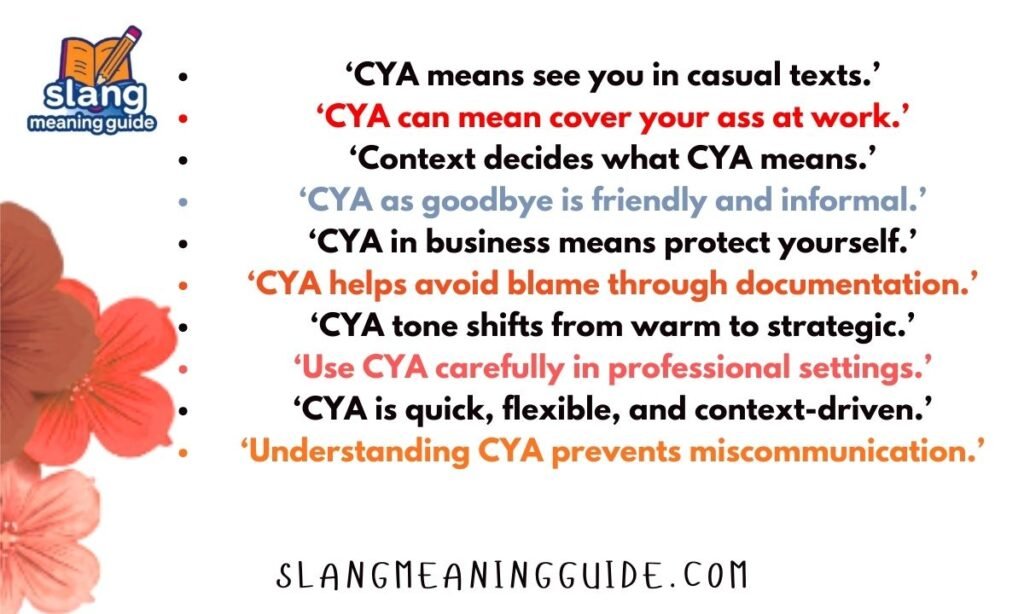
In everyday texting, CYA almost always means “see you” and is used as a friendly, informal goodbye. While In work and business settings, however, CYA usually means “cover your ass,” referring to taking precautions to avoid responsibility or liability.
Context decides everything. The same three letters can signal warmth or caution.
The Two Main Meanings of CYA Explained
1) CYA as “See You” or “See Ya”
This is the most common meaning in texts, chats, and casual emails. It’s quick, friendly, and informal.
Examples:
- “Gotta run, CYA later!”
- “Thanks for hanging out, CYA!”
- “Talk soon, CYA tomorrow.”
In these cases, CYA works as a relaxed way to close a conversation. It feels natural, light, and conversational.
2) CYA as “Cover Your Ass”
In professional or workplace contexts, CYA means taking steps to protect yourself from blame, mistakes, or liability. This can involve documenting work, saving emails, or getting instructions in writing.
Examples:
- “Send a follow-up email to CYA.”
- “Always document decisions to CYA.”
- “Loop them in on the email to CYA.”
This version is practical and strategic, but it can sound blunt or harsh, especially in formal writing.
In business, CYA is about protection, not politeness.
How Context Changes the Meaning of CYA
Because CYA has two drastically different meanings, context is critical. The setting, tone, and relationship between speakers determine which meaning applies.
Casual Context
- Texting friends
- Social media messages
- Gaming chats
- Informal emails
Here, CYA almost always means “see you.”
Professional Context
- Workplace chats
- Business emails
- Corporate meetings
- Legal or administrative communication
Here, CYA usually means “cover your ass.”
Tone Check
If the message feels friendly, warm, or relaxed, CYA = see you.
If the message feels strategic, cautious, or procedural, CYA = cover your ass.
Origins and History of CYA
“See You” Version
The “see ya” meaning of CYA became popular during the rise of early internet chatrooms, instant messaging, and SMS texting in the 1990s and early 2000s. Shortened forms helped users type quickly, especially when character limits were strict.
CYA joined other abbreviations like:
- BRB (be right back)
- TTYL (talk to you later)
- LOL (laugh out loud)
“Cover Your Ass” Version
This version of CYA traces back to mid-20th century military and corporate slang. It described practical steps taken to avoid punishment, blame, or legal trouble. Over time, it became part of office language, especially in corporate, bureaucratic, and legal environments.
One version grew from speed and convenience. The other grew from caution and accountability.
How CYA Is Used in Different Contexts
Casual Texting and Messaging
In personal communication, CYA is almost always friendly.
Examples:
- “Heading out now, CYA later!”
- “Great catching up, CYA soon.”
- “CYA tomorrow at lunch.”
Tone: Warm, relaxed, informal
Social Media
On platforms like Instagram, Snapchat, and TikTok, CYA often appears as a lighthearted sign-off.
Examples:
- “That’s all for today, CYA!”
- “Live was fun, CYA next time!”
Tone: Playful, friendly, casual
Gaming and Online Communities
Gamers frequently use CYA to sign off after matches or sessions.
Examples:
- “GG everyone, CYA next round.”
- “Logging off, CYA tomorrow.”
Tone: Friendly, quick, informal
Workplace Communication
In business environments, CYA typically refers to risk management and documentation.
Examples:
- “Let’s confirm everything in writing to CYA.”
- “Save that email to CYA later.”
- “Add them to the thread to CYA.”
Tone: Practical, cautious, strategic
Why CYA Can Be Risky in Professional Settings
While “cover your ass” is widely understood, using the phrase directly can sound crude, defensive, or unprofessional, especially in formal communication.
Why it can backfire
- Sounds blunt or harsh
- Can imply distrust
- May appear defensive
- Can weaken professional tone
Safer alternatives
Instead of writing “CYA,” consider:
- “For documentation purposes”
- “To ensure clarity”
- “For record-keeping”
- “To confirm details”
These phrases maintain professionalism while achieving the same goal.
Professional tone protects credibility. Choose words carefully.
How to Respond to CYA in Text Messages
Casual Replies
- “Later!”
- “See you!”
- “CYA!”
Friendly and Playful Replies
- “Don’t be a stranger!”
- “Catch you soon!”
- “Looking forward to it!”
Professional Replies
If someone says “CYA” meaning cover your ass:
- “Noted, I’ll document it.”
- “Thanks, I’ll follow up.”
- “Understood, I’ll keep records.”
Common Misunderstandings About CYA
Misconception 1: CYA always means “see you”
Truth: It can also mean “cover your ass,” especially in business contexts.
Misconception 2: CYA is always casual
Truth: In professional environments, it often carries strategic or defensive meaning.
Misconception 3: It’s safe in all emails
Truth: In formal communication, CYA may sound unprofessional and should be avoided.
CYA in Professional Risk Management
In business, CYA reflects defensive communication strategies designed to reduce personal risk.
Common CYA practices
- Documenting conversations
- Sending follow-up emails
- Saving written approvals
- Keeping records of decisions
- Confirming verbal instructions in writing
CYA is not about paranoia. It’s about accountability and protection.
Cultural and Regional Variations
United States and United Kingdom
- Casual: “See you”
- Professional: “Cover your ass”
Canada and Australia
- Strong usage in professional slang for “cover your ass”
- Common casual use in texting
Caribbean (Jamaican Patois)
In some dialects, “cya” or “cyah” can mean “cannot” or “can’t.”
This meaning is highly context-specific and regional.
Other Meanings of CYA
Although rare in everyday conversation, CYA can also stand for:
Cyanuric Acid (Pool Maintenance)
A chemical stabilizer used to protect chlorine from sunlight in swimming pools.
Example:
- “Check the CYA levels in the pool.”
Military or Technical Acronyms
In specialized settings, CYA may appear in documentation, but these meanings are uncommon in daily communication.
When You Should Avoid Using CYA
Avoid CYA When:
- Writing to clients
- Communicating with senior management
- Sending formal emails
- Writing reports or proposals
- Speaking in official meetings
Why?
Because it can:
- Sound informal
- Appear careless
- Undermine professionalism
Professional Alternatives to CYA
Instead of saying:
“Email them to CYA.”
Try:
- “Email them for documentation.”
- “Send a confirmation for clarity.”
- “Follow up to ensure records are complete.”
These sound polished and professional while keeping the same intent.
Examples of CYA in Real-Life Situations
Texting a Friend
“Running late, CYA in 20!”
Ending a Social Media Chat
“Thanks for watching, CYA next time!”
Work Email Reminder
“Let’s document the process to CYA in case of questions later.”
Team Collaboration
“Please confirm the specs in writing to CYA.”
Tone Differences: Friendly vs Defensive
Understanding the tone shift of CYA is essential.
| Context | Meaning | Emotional Tone |
|---|---|---|
| Texting friends | See you | Warm, friendly |
| Social media | See you | Casual, playful |
| Gaming | See you | Relaxed |
| Work chat | Cover your ass | Strategic, cautious |
| Corporate email | Cover your ass | Defensive, professional |
Why CYA Became So Popular
CYA survived and thrived because it solves two communication needs:
- Speed: Quick, easy goodbye
- Protection: Simple way to express caution
Few abbreviations can cover both emotional warmth and professional strategy.
CYA works because it is short, flexible, and context-driven.
Frequently Asked Questions
What does CYA usually mean in texting?
It usually means “see you” or “see ya later.”
Can CYA be rude?
Only when used as “cover your ass” in formal or sensitive situations.
Is CYA okay in professional emails?
It’s better to avoid it and use more professional alternatives.
What’s the safest meaning to assume?
In casual texts, assume “see you”; in work chats, assume “cover your ass.”
Are there alternatives to CYA?
Yes, use “talk soon,” “see you later,” or professional phrases like “for documentation.”
Final Thoughts
CYA is a short acronym with two powerful meanings that depend entirely on context. In casual texts, it’s a friendly goodbye that keeps conversations light and warm. In professional settings, it becomes a practical tool for protecting yourself and managing responsibility. Knowing when and how to use CYA helps you communicate clearly, avoid confusion, and maintain the right tone.
Understanding CYA isn’t just about slang. It’s about reading context, adapting your language, and communicating with intention. When used thoughtfully, CYA becomes a useful part of both social and professional communication.