
Three letters. One abbreviation. At least four completely different meanings depending on who sends it and where. You have probably seen DND in a text, a Slack message, a Discord server, or a phone notification — and wondered which version you were actually looking at. The answer is not always obvious, and getting it wrong can lead to a very awkward reply. This guide covers every meaning of DND, where each one came from, how people use each version today, and exactly how to tell them apart in context.
Core Meanings of DND Explained
DND does not carry a single fixed meaning. It shifts depending on the platform, the relationship between the people communicating, and the context of the conversation. Most people recognize one version and assume that is the only one — which is exactly where the confusion starts.
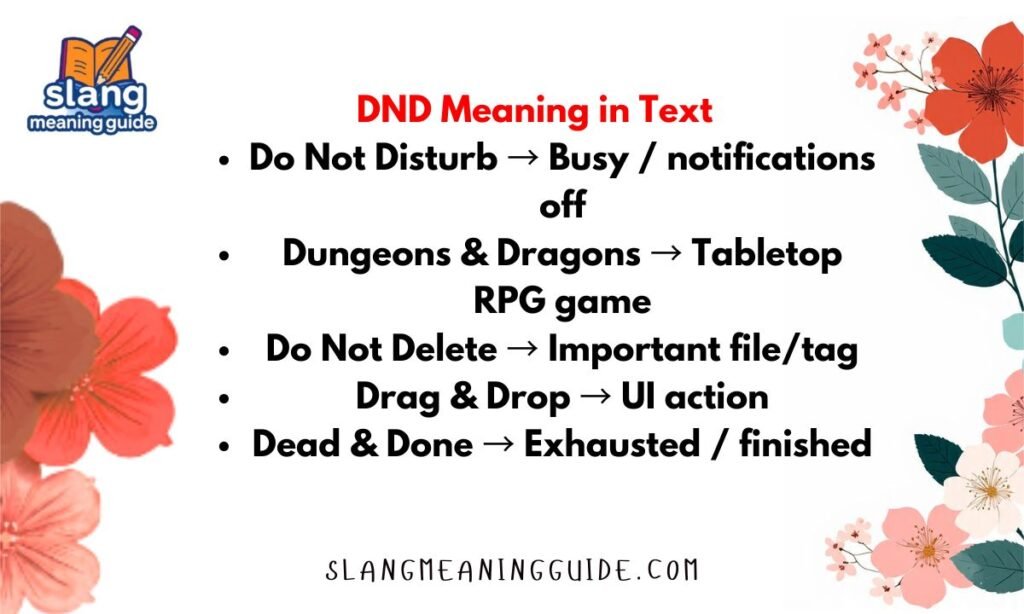
1. Do Not Disturb
Definition: DND most commonly means “Do Not Disturb.” It signals that someone is unavailable, busy, or has turned off notifications and does not want to be interrupted. This is the most widely recognized meaning across texting, social media, and workplace communication tools.
- “I’ve got my DND on all night — big exam tomorrow.”
- “She’s in DND mode. She’ll reply when she’s ready.”
- “DND from 9 to 5 on weekdays. Work calls only.”
- “Sorry I missed your text — had DND on during the meeting.”
2. Dungeons and Dragons
Definition: In gaming circles — especially on Discord, Reddit, and Twitch — DND almost always refers to Dungeons and Dragons, the popular tabletop role-playing game. If someone in a gaming community says “I’m into DND,” they are almost never talking about phone settings.
- “We’ve been running a DND campaign every Friday night for two years.”
- “Anyone have a good DND one-shot for beginners?”
- “My DND character is a chaotic neutral rogue — obviously.”
- “The new DND sourcebook dropped and I already need it.”
3. Do Not Delete
Definition: In professional, technical, and IT environments, DND sometimes means “Do Not Delete.” You will see this on shared files, database fields, system folders, or internal documentation where deletion would cause serious problems. It is less common in casual texting but very standard in workplace settings.
- “Leave the DND tag on that folder — it’s linked to the backup system.”
- “Mark all core config files as DND before the migration.”
- “The DND label on that record means it cannot be archived.”
- “Our IT policy flags DND files separately from regular archives.”
4. Drag and Drop
Definition: In some technical documentation and UI/UX discussions, DND is shorthand for “Drag and Drop” — the action of clicking, holding, and moving elements across a screen. This usage is specific to design, development, and software conversations and rarely appears in casual texting.
- “The DND interface makes it easy to reorder the dashboard tiles.”
- “Build the whole layout with DND — no code needed.”
- “The DND functionality broke on mobile after the last update.”
- “Users expect DND to work on every element, not just the sidebar.”
5. Dead and Done
Definition: In informal, Gen Z-heavy texting and social media, “DND” occasionally appears as slang for “Dead and Done” — meaning completely exhausted, finished, or overwhelmed. It is the least standardized meaning and tends to appear in casual chats or reaction posts rather than direct communication.
- “That presentation drained me. I’m DND for the rest of the week.”
- “Three back-to-back flights? I am absolutely DND right now.”
- “Gym session hit different today. DND. Good night.”
- “After that argument I’m DND — I need a full reset.”
Origin and Evolution Timeline
DND did not appear with a single meaning and stay that way. Each version of the term developed in a different community at a different time. “Do Not Disturb” was the earliest standardized use, originally tied to hotel door signs and telephone systems long before smartphones existed.
When Apple and Android added DND modes to their operating systems, the term moved fully into everyday digital conversation. Dungeons and Dragons has carried the DND abbreviation since the game’s launch in 1974, but its online usage exploded in the 2010s alongside streaming platforms like Twitch and shows like Stranger Things that brought tabletop gaming into the mainstream.
The technical meanings — “Do Not Delete” and “Drag and Drop” — developed in workplace and developer communities as those tools became standard. “Dead and Done” is the most recent arrival, emerging from Gen Z texting culture in the early 2020s.
| Term | Estimated Origin | Platform Where It Blew Up | Current Status |
|---|---|---|---|
| Do Not Disturb | Pre-digital (hotel signs, phone systems); digital adoption ~2012 | iOS / Android settings, iMessage, WhatsApp | Active — the dominant meaning in general texting |
| Dungeons and Dragons | 1974 (game launch); online rise ~2016–2019 | Discord, Reddit, Twitch, YouTube | Active — primary meaning in gaming communities |
| Do Not Delete | Early 2000s IT practices | Internal workplace tools, file systems, databases | Active — niche but consistent in professional/technical use |
| Drag and Drop | Mid-2000s software documentation | Developer forums, UX/UI design communities | Active — limited to technical contexts |
| Dead and Done | Early 2020s Gen Z slang | TikTok, Twitter/X, casual group chats | Emerging — informal and not universally recognized |
Common Misunderstandings
Most confusion around DND comes from people defaulting to the one meaning they know best. Someone outside gaming communities who receives “I’m in DND mode all weekend” might assume the person has phone notifications off — when they actually mean they are deep in a Dungeons and Dragons campaign.
The reverse happens too. A Gen Z texter using DND to mean “Dead and Done” might confuse someone who only knows the phone setting meaning. Context almost always resolves the ambiguity, but when context is missing, the misread can cause genuine communication problems — missed messages, unanswered calls, or awkward follow-ups.
- Assuming one meaning is universal. DND is not a standard acronym with a single definition — it depends entirely on who is using it and where.
- Mistaking gaming DND for phone DND. “I’m going DND for the weekend” in a Discord server almost certainly means Dungeons and Dragons, not phone silence.
- Overlooking the professional meaning. In workplace chats, DND on a document or file tag rarely means “Do Not Disturb” — it almost always means “Do Not Delete.”
- Treating “Dead and Done” as a widely understood term. This meaning is emerging but not universal — using it with older contacts or in professional chats can confuse people.
- Applying Drag and Drop outside technical contexts. Using DND for “Drag and Drop” in a casual text will almost always be misread as “Do Not Disturb.”
Formal vs. Informal Uses
The version of DND you use signals a lot about the context you are operating in. “Do Not Disturb” sits comfortably in both casual and professional settings — it is understood broadly and carries no ambiguity in most conversations.
The gaming reference is entirely informal. “Do Not Delete” lives primarily in professional and technical environments. Knowing which version fits the situation keeps your communication clean and avoids the kind of confusion that makes people send a follow-up just to clarify what they meant.
| Term | Informal Use | Formal / Professional Equivalent |
|---|---|---|
| Do Not Disturb | “I’m on DND — catch you later.” | “I’m in a focus block until 3 PM and have notifications silenced.” |
| Dungeons and Dragons | “DND night starts at 7 — don’t be late.” | “We’re running a tabletop RPG session this evening.” (Never abbreviated in formal writing) |
| Do Not Delete | “Tag it DND so no one touches it.” | “Please mark this file as retained and exempt from routine deletion.” |
| Drag and Drop | “Just DND the file into the folder.” | “The interface supports drag-and-drop functionality for file organization.” |
| Dead and Done | “Today destroyed me. DND. Bye.” | No professional equivalent — avoid in formal communication entirely. |
Comparisons With Similar Abbreviations
DND is not alone in the world of multi-meaning abbreviations. Several common texting terms carry the same kind of ambiguity — one abbreviation, multiple readings, context-dependent decoding.
- BRB (Be Right Back) vs. BRB (Big Red Button) — BRB is almost universally understood as “Be Right Back” in texting, but in technical and military contexts it refers to a physical or software emergency stop. Same problem as DND: one group assumes one meaning, another group assumes another.
- AFK (Away From Keyboard) — Like “Do Not Disturb,” AFK signals unavailability, but it is more specific to gaming and digital work environments. DND is broader and more widely used outside those communities.
- IDK (I Don’t Know) — IDK is a single-meaning abbreviation with no ambiguity. DND is the opposite — it requires context to decode. IDK is simpler and safer in mixed audiences.
- GG (Good Game) — GG comes from gaming, just like the Dungeons and Dragons version of DND. Both are perfectly clear inside gaming communities and potentially confusing outside them.
- OOO (Out of Office) — OOO and “Do Not Disturb” DND both communicate unavailability, but OOO is strictly professional. DND is more casual and broader in application across both personal and work contexts.
- NGL (Not Gonna Lie) — NGL is generational slang with a single meaning, similar to how “Dead and Done” DND is Gen Z-specific. Both are clear within their generation but can confuse older contacts.
- TBH (To Be Honest) — TBH is another single-meaning abbreviation. It shows how most slang terms are simpler than DND because they carry one fixed meaning regardless of community or context.
- SMH (Shaking My Head) — SMH is emotionally expressive, like the “Dead and Done” version of DND. Both communicate a reaction rather than a status or request. The difference is that SMH is universally recognized in that one meaning, while DND is not.
Frequently Asked Questions
What does DND mean in texting?
It most commonly means “Do Not Disturb” — the person has silenced their notifications and is not available to respond.
What does DND mean in gaming?
In gaming communities, DND almost always refers to Dungeons and Dragons, the tabletop role-playing game.
How do you tell which meaning of DND someone is using?
Context is the clearest signal — platform, the topic of the conversation, and the relationship between the people communicating all narrow it down immediately.
Is DND ever used in professional settings?
Yes — “Do Not Disturb” is widely used in workplace tools like Slack and Teams, and “Do Not Delete” is standard in IT and file management contexts.
Is “Dead and Done” a widely recognized meaning for DND?
Not universally — it is emerging Gen Z slang that is clear in younger, informal circles but will likely confuse people outside that group.
Conclusion
DND is one of the clearest examples of how a short abbreviation can carry completely different weight depending on who is reading it. The meaning shifts with the platform, the community, and the conversation — and defaulting to the first interpretation that comes to mind is how miscommunication happens. Read the context before you reply, match the meaning to the situation, and you will navigate DND without a single awkward follow-up message.