
You receive a text with “GBTS” and stare at it for a solid five seconds. Your brain runs through every possibility. You type back something vague just to avoid looking clueless. Four letters — one abbreviation — and suddenly the conversation has completely shifted.
What Does GBTS Mean in Text?
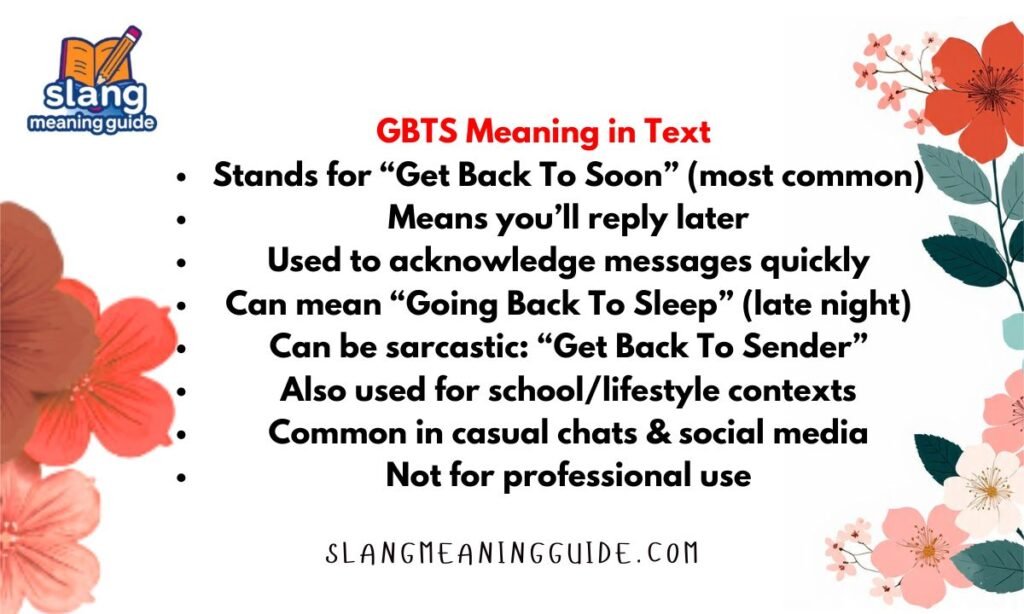
GBTS most commonly means “Get Back To Soon” — but that is only the beginning.
At its core, GBTS is a quick way to tell someone you will follow up with them shortly. It works like a text-based placeholder — a signal that says “I saw this, I care, and I will respond properly when I can.” It removes the pressure of an immediate full reply while keeping the conversation alive and respectful.
The term lives almost entirely in informal digital spaces. You will find it in iMessage threads, WhatsApp chats, Snapchat conversations, and Twitter DMs. It travels fast because it solves a real problem — how do you acknowledge a message when you genuinely cannot respond right now? GBTS does exactly that in four clean letters.
Core Meanings Explained
GBTS as “Get Back To Soon”
Definition: A polite, casual signal that you acknowledge a message and plan to respond fully in the near future.
- “GBTS, just got into a meeting.”
- “Busy right now but GBTS.”
- “Don’t forget me — GBTS when I land.”
- “GBTS, need to check my schedule first.”
This is the most widely used meaning. It maintains connection without forcing an instant response.
GBTS as “Going Back To Sleep”
Definition: Used late at night or early in the morning to explain why someone is signing off or going quiet after briefly waking up.
- “Saw your message, GBTS — talk tomorrow.”
- “It’s 3 AM, GBTS lol.”
- “Just woke up randomly. GBTS, good night.”
- “Can’t deal with this right now, GBTS.”
This version shows up most in late-night conversations. The tone is drowsy and casual — no detailed explanation needed.
GBTS as “Get Back To Sender”
Definition: Used humorously or dismissively when someone wants to redirect a message, reject an idea, or playfully push back on what was said.
- “That excuse? GBTS.”
- “This energy is not it — GBTS.”
- “Nah, that story doesn’t add up. GBTS.”
- “I didn’t ask for all that. GBTS.”
This usage leans comedic. It borrows from postal language and gives the reply a sarcastic or playful edge.
GBTS as “Got Back To School”
Definition: A status update shorthand used when someone returns to school after a break, often paired with complaints or updates.
- “GBTS today — already exhausted.”
- “Break is over. GBTS, send help.”
- “GBTS and the homework is already piling up.”
- “Finally GBTS after being sick all week.”
Students use this in group chats to signal their return or to update friends on their situation.
GBTS as “Going Back To Basics”
Definition: Used in lifestyle, fitness, or motivational contexts to signal a return to foundational habits or a simpler approach.
- “No more overcomplicating things. GBTS.”
- “New week, GBTS — sleep, water, gym.”
- “Deleted the apps. GBTS with my routine.”
- “Feeling off lately so I’m GBTS with my schedule.”
This meaning appears mostly on social media captions, Twitter, and wellness-adjacent conversations.
Origin and Evolution Timeline
GBTS did not come from one viral moment — it built up quietly across platforms.
| Term | Estimated Origin | Platform Where It Blew Up | Current Status |
| GBTS (Get Back To Soon) | Early 2010s | SMS / iMessage | Active and widely used |
| GBTS (Going Back To Sleep) | Mid 2010s | Twitter / Snapchat | Common in late-night texting |
| GBTS (Get Back To Sender) | Late 2010s | Twitter / Instagram | Growing — mostly humorous |
| GBTS (Got Back To School) | Early 2020s | TikTok / Group Chats | Seasonal and recurring |
| GBTS (Going Back To Basics) | 2021–present | Instagram / Wellness Twitter | Rising in lifestyle content |
How GBTS evolved over time:
- Early 2010s — “Get Back To Soon” emerges as a practical texting shorthand in SMS culture
- 2015–2017 — Spreads onto Twitter and Snapchat with the “Going Back To Sleep” variation
- 2018–2020 — Humorous uses like “Get Back To Sender” appear in meme culture and comment sections
- 2020–2022 — TikTok students adopt “Got Back To School” during pandemic-era school transitions
- 2023–present — Wellness and self-improvement communities adopt “Going Back To Basics” on Instagram and Twitter
Common Misunderstandings
The biggest problem with GBTS is that people assume one meaning covers every situation.
Someone who knows only the “Get Back To Soon” version will completely misread a late-night “GBTS” that means “Going Back To Sleep.” The two carry very different implications — one promises a follow-up, the other closes the conversation.
Getting them mixed up can create real confusion about whether someone is being responsive or brushing you off.
Common mistakes people make with GBTS:
- Assuming it always means “Get Back To Soon” — context changes the meaning entirely
- Missing the dismissive humor in “Get Back To Sender” — it reads as rude if you take it literally
- Confusing it with GTB — “GTB” means “Go To Bed” which overlaps with the sleep version
- Expecting a time frame — “soon” in GBTS is intentionally vague, not a specific promise
- Using it in serious conversations — it feels too casual when the topic demands real attention
- Overlooking tone — a lowercase “gbts” feels softer than a caps-lock “GBTS” which can read sharp
Formal vs. Informal Uses
GBTS is a fully informal term — there is no professional context where it belongs.
You would never write GBTS in a work email, a client message, or a formal update. Even in semi-professional group chats it can feel out of place. It belongs in personal texting, social media DMs, and casual conversation between people who already communicate informally.
Where GBTS fits naturally:
- Texting a friend you owe a response to — “GBTS, crazy day”
- Closing a late-night chat — “Falling asleep, GBTS”
- Playfully rejecting a bad take — “That argument? GBTS”
- Student group chats after a break — “GBTS today, it’s rough out here”
- A personal social media caption — “Resetting this week. GBTS.”
Where GBTS does not belong:
- Professional emails or work Slack channels
- Customer service responses
- Academic writing or school assignments
- Any message to someone older who may not recognize slang
- Serious emotional conversations that require full engagement
Comparisons With Similar Abbreviations
| Abbreviation | Full Phrase | Primary Use | Tone | Key Difference |
| GBTS | Get Back To Soon | Follow-up signal | Casual | Promises a future reply |
| BRB | Be Right Back | Temporary absence | Casual | Much shorter time frame |
| GTG | Got To Go | Ending a conversation | Casual | Closes the chat entirely |
| ILY BRB | I’ll Be Right Back | Reassurance | Warm / casual | More personal and affectionate |
| HMU | Hit Me Up | Open invitation to contact | Casual | Sender is available, not busy |
| TYL | Talk You Later | Soft goodbye | Friendly | Similar to GBTS but more final |
Frequently Asked Questions
What does GBTS mean in a text message?
GBTS most commonly means “Get Back To Soon” — a quick way to acknowledge a message and promise a follow-up.
Can GBTS mean something other than “Get Back To Soon”?
Yes — it also means “Going Back To Sleep,” “Get Back To Sender,” “Got Back To School,” and “Going Back To Basics” depending on context.
Is GBTS rude to send?
No — in most cases it is polite and considerate, but “Get Back To Sender” carries a dismissive or humorous tone that can feel blunt.
Where did GBTS come from?
It originated in early SMS culture in the 2010s and spread through Twitter, Snapchat, and TikTok over the following decade.
Should you use GBTS in professional messages?
Never — GBTS is strictly informal and belongs only in personal texts, DMs, and casual social media conversations.