
You see it everywhere. In texts, comments, memes, and captions, a tiny three-letter word keeps showing up and shaping conversations. It looks simple, but its tone, meaning, and impact change depending on context. Understanding how it works can instantly make your digital communication clearer, smoother, and more natural.
This complete guide breaks down Idk meaning, how people use it in texting, how it differs across formal and informal settings, common misunderstandings, real-life examples, and when it is best avoided.
Idk Meaning in Texting
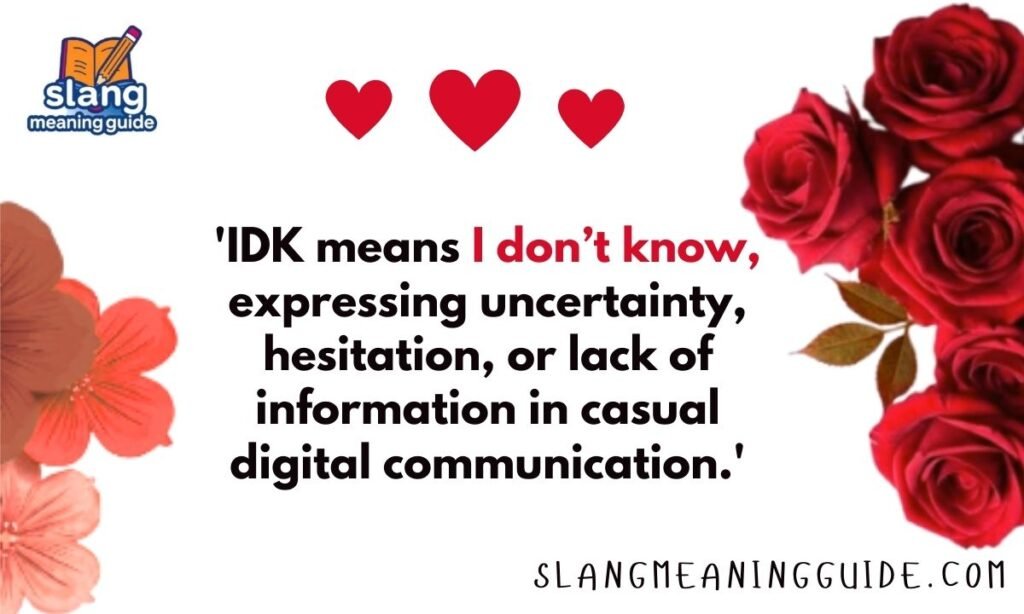
Idk meaning in texting is simply “I don’t know.” It is a short, casual abbreviation used to express uncertainty, lack of information, hesitation, or indecision. Its main function is speed and convenience, allowing people to reply quickly without typing full sentences.
In everyday texting, “idk” acts as a neutral placeholder when someone does not have a clear answer. It can signal honesty, uncertainty, or emotional distance depending on tone and context. Because texting is fast-paced, “idk” keeps conversations flowing without forcing long explanations.
Common texting examples include:
- “What time are we meeting?” → “idk yet.”
- “Do you like that movie?” → “idk, haven’t seen it.”
- “Should we go out tonight?” → “idk, maybe.”
In casual chats, “idk” often feels natural and friendly. It softens uncertainty and avoids sounding overly formal. It can also express emotional hesitation, especially in conversations involving decisions, relationships, or plans.
Formal vs Informal Use
The way idk meaning changes depends heavily on context. In informal communication, it is completely acceptable. In formal environments, it can appear careless or unprofessional.
Informal Use
In casual conversations, “idk” fits naturally. It reflects relaxed communication and quick responses. Friends, family members, classmates, and online communities commonly use it without thinking twice.
Informal usage examples include:
- “idk what to eat tonight.”
- “idk if I’ll be home early.”
- “idk why that happened.”
Here, “idk” communicates uncertainty while maintaining a relaxed tone. It keeps messages short and conversational, which is ideal for texting and social media.
Formal Use
In professional settings, such as emails, business messages, academic writing, or workplace communication, “idk” should usually be avoided. It can sound abrupt, lazy, or dismissive, even if that is not the intention.
Better formal alternatives include:
- “I’m not sure at the moment.”
- “I don’t have that information yet.”
- “Let me check and get back to you.”
Using complete phrases maintains clarity, professionalism, and respect. In formal contexts, full sentences show effort, responsibility, and engagement.
Common Misunderstandings
Despite its simplicity, “idk” is often misunderstood. People may interpret tone differently, especially in emotional conversations or sensitive situations.
One major misunderstanding is that idk means disinterest. In reality, it usually expresses uncertainty, not indifference. However, in emotionally charged situations, it can feel dismissive.
Frequent misconceptions include:
- “idk means I don’t care.”
- “idk means I’m ignoring you.”
- “idk means I’m lazy.”
In truth, “idk” usually reflects:
- Genuine lack of knowledge
- Indecision
- Hesitation
- Emotional uncertainty
Another misunderstanding is assuming “idk” always sounds casual or rude. Tone depends heavily on:
- Conversation context
- Emotional stakes
- Relationship between speakers
For example, in a playful chat, “idk 😂” feels light. In a serious emotional discussion, “idk” might sound distant or avoidant.
Comparisons With Similar Abbreviations
To fully understand idk meaning, it helps to compare it with similar abbreviations that appear in digital conversations. Each carries a slightly different tone and intention.
IDK vs Similar Abbreviations
| Abbreviation | Meaning | Tone | Common Usage |
| IDK | I don’t know | Neutral, uncertain | Lack of information |
| IDC | I don’t care | Dismissive | Disinterest |
| IMO | In my opinion | Thoughtful | Personal views |
| TBH | To be honest | Direct | Honest expression |
| IKR | I know, right | Agreement | Shared reaction |
IDK differs because it expresses uncertainty, not emotion or opinion. Confusing it with IDC is especially common and often leads to miscommunication.
Formal Alternatives to IDK
| Informal | Formal Alternative |
| IDK | I’m not sure |
| IDK yet | I don’t have that information yet |
| IDK rn | Let me check and confirm |
| IDK tbh | I’m uncertain at the moment |
These alternatives help maintain professionalism while preserving clarity.
Practical Examples
Understanding idk meaning becomes easier through real-life examples across different scenarios. These examples show how context shapes tone and interpretation.
Casual Chat Examples
- “idk what show to watch tonight.”
- “idk if I’ll have time tomorrow.”
- “idk, maybe later.”
In these situations, “idk” simply shows uncertainty without emotional weight.
Social Media Examples
- “idk why this made me laugh.”
- “idk what’s happening here 😭.”
- “idk but this feels relatable.”
On social platforms, “idk” often adds humor, irony, or relatability.
Dating and Emotional Conversations
- “Do you like me?” → “idk…”
- “What do you want from us?” → “idk right now.”
Here, “idk” may express emotional confusion, hesitation, or vulnerability. It carries deeper emotional meaning compared to casual usage.
Professional Messaging Examples
Instead of:
- “idk when the report will be ready.”
Use:
- “I’m not sure when the report will be ready, but I’ll update you soon.”
Tone shifts from casual uncertainty to professional accountability.
When to Avoid It
Even though “idk” is widely accepted, there are situations where it can weaken communication. Understanding when to avoid it improves clarity and tone.
Avoid using “idk”:
- In professional emails
- In academic writing
- In formal presentations
- In serious emotional conversations
In professional contexts, it may sound careless. In emotional discussions, it can feel dismissive or emotionally distant.
Better alternatives include:
- “I need time to think about this.”
- “I’m unsure right now, but I care.”
- “Let me reflect and get back to you.”
Replacing “idk” with more thoughtful phrasing can dramatically improve communication quality.
Frequently Asked Questions
What does idk mean in texting?
It means “I don’t know” and expresses uncertainty or lack of information.
Is idk rude?
No, but in emotional or professional contexts, it can sound dismissive.
Can idk be used professionally?
It is better replaced with formal alternatives like “I’m not sure.”
Does idk mean disinterest?
No, it usually signals uncertainty, not lack of care.
Is idk still popular?
Yes, it remains one of the most widely used texting abbreviations.
Final Thoughts
Understanding idk meaning goes beyond knowing its definition. It involves recognizing tone, context, emotional weight, and communication intent. While it literally stands for “I don’t know,” its impact shifts based on where and how it is used.
In casual texting, it feels natural and efficient. In professional communication, it risks sounding careless. While In emotional conversations, it can appear distant if not softened with clarity or empathy.
Used thoughtfully, “idk” becomes a flexible and useful tool in modern digital language. Mastering its usage helps you communicate more clearly, avoid misunderstandings, and adapt effortlessly to different social and professional environments.