
It looks simple, but tone hides inside it.
You’ll see it in texts, comments, and quick replies.
Sometimes it softens a message. Sometimes it distances the speaker.
Knowing how it works helps you read intent, not just words.
Core Meanings Explained
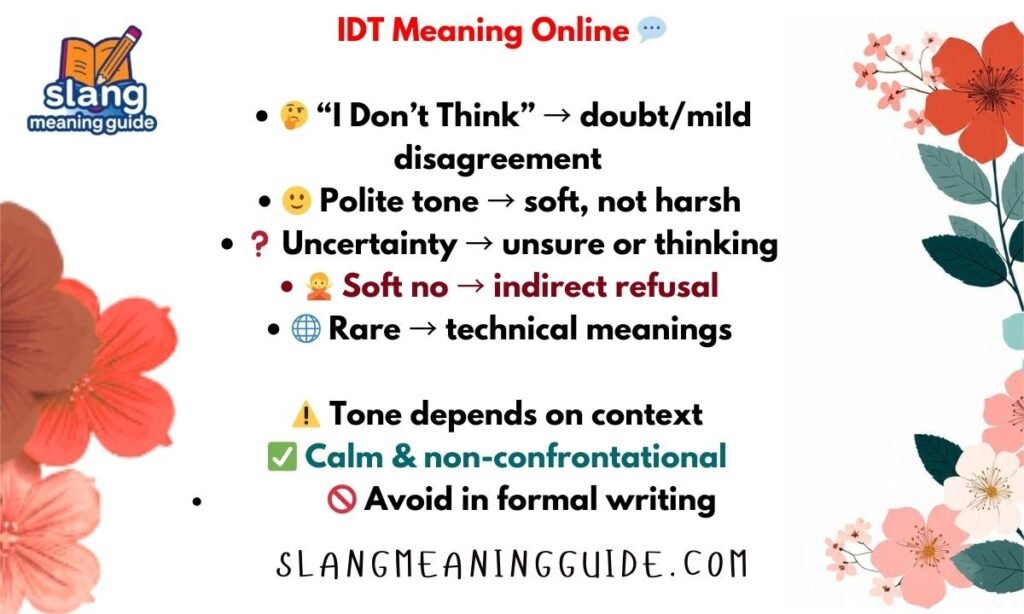
IDT = “I Don’t Think”
This is the primary meaning. It expresses doubt or mild disagreement.
It sounds softer than a direct “no.”
- “IDT that’s correct.”
- “IDT he’s coming today.”
- “IDT this will work.”
- “IDT that’s a good idea.”
- “IDT we agreed on that.”
IDT = Polite Disagreement
Here, IDT is used to challenge an idea without sounding harsh.
It keeps conversations calm and non-confrontational.
- “IDT that approach fits the plan.”
- “IDT this matches the requirements.”
- “IDT that solves the issue.”
- “IDT we should rush this.”
- “IDT that’s the best option.”
IDT = Expression of Uncertainty
In this sense, IDT signals hesitation rather than firm disagreement.
It shows the speaker is unsure or still thinking.
- “IDT I understand fully.”
- “IDT this is finalized yet.”
- “IDT we have enough data.”
- “IDT that’s confirmed.”
- “IDT I’ve seen this before.”
IDT = Soft Refusal
Sometimes IDT indirectly declines a suggestion or request.
It avoids sounding blunt while still saying no.
- “IDT I can make it tonight.”
- “IDT I’ll join that meeting.”
- “IDT I’m interested in that.”
- “IDT I have time for this.”
- “IDT I’ll be available.”
IDT = Rare Alternate Meanings
Outside casual chat, IDT has technical and formal meanings.
Context determines whether slang or technical usage applies.
- “IDT chip design” (Integrated Device Technology)
- “IDT telecom services” (IDT Corporation)
- “IDT military drills” (Inactive Duty Training)
- “IDT system structure” (Interrupt Descriptor Table)
- “IDT timezone” (Israel Daylight Time)
Origin + Evolution Timeline
IDT emerged during early mobile messaging when speed and brevity mattered. Character limits and slow keyboards pushed users toward compact expressions. Over time, IDT became a standard shorthand for soft disagreement across platforms.
| Term | Estimated Origin | Platform Where It Blew Up | Current Status |
|---|---|---|---|
| IDT | Late 1990s (SMS era) | AIM, MSN Messenger | Early adoption phase |
| IDT | Early 2000s | ICQ, chat forums | Common shorthand |
| IDT | 2010s | Social media, Reddit | Widely used |
| IDT | 2020s | TikTok, Twitter, DMs | Mainstream casual slang |
Common Misunderstandings
IDT often gets misinterpreted because it sounds neutral. In reality, tone depends on context. It can signal doubt, disagreement, or even quiet rejection.
- Mistaken as a firm “no” when it’s actually uncertainty
- Assumed to be weak language when it can be intentional politeness
- Misread as passive-aggressive in serious discussions
- Confused with lack of knowledge instead of disagreement
- Overused in place of clearer statements
Formal vs. Informal Uses
IDT fits casual communication. It helps keep tone light and indirect. In professional settings, clarity matters more, so full sentences are preferred.
| Term | Informal Use | Formal/Professional Equivalent |
|---|---|---|
| IDT | “IDT this is correct.” | “I don’t believe this is correct.” |
| IDT | “IDT we should proceed.” | “I recommend we reconsider proceeding.” |
| IDT | “IDT that works.” | “This approach may not be effective.” |
| IDT | “IDT he confirmed.” | “I don’t think he has confirmed.” |
| IDT | “IDT this meets criteria.” | “This does not appear to meet the criteria.” |
In casual chats, IDT saves time and reduces friction. While In professional writing, full phrasing improves precision and avoids ambiguity.
Comparisons With Similar Abbreviations
- IDK: Signals lack of knowledge, while IDT signals doubt
- IMO: Shares opinion directly, IDT softens disagreement
- TBH: Emphasizes honesty, IDT reduces bluntness
- NVM: Ends a topic, IDT continues discussion
- SMH: Shows frustration, IDT stays neutral
- BRB: Indicates absence, unrelated to opinion
- TBF: Adds fairness, IDT adds skepticism
- IDC: Shows indifference, IDT shows consideration
Frequently Asked Questions
What does IDT mean in texting?
It means “I Don’t Think,” used to express doubt or mild disagreement.
Is IDT rude?
No, it usually sounds polite and less confrontational.
Can IDT be used in professional writing?
It’s better to avoid it and use full sentences instead.
Where is IDT commonly used?
It appears in texts, social media, and casual online conversations.
Does IDT always mean disagreement?
Not always, it can also show uncertainty or hesitation.