

Someone dropped “IGL” in your chat and kept going like it was obvious. You nodded along. But now you’re here, and that means you need the real answer fast.
What Does IGL Mean in Text?
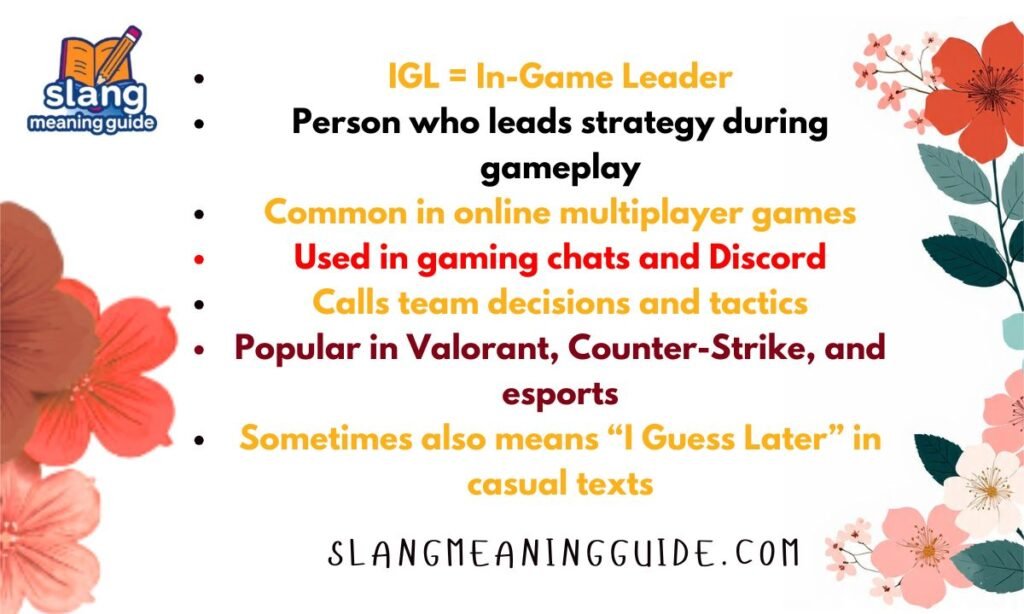
IGL most commonly stands for “In-Game Leader,” a term that started in competitive gaming and spread across online chats, Discord servers, and social media. It refers to the person who leads team strategy during active gameplay.
The Primary Meaning You Need to Know
“In-Game Leader” is the dominant meaning. An IGL is the player who calls the shots during a match, decides which strategy to run, and keeps everyone coordinated when things get chaotic and fast-moving.
“I Guess Later” is the secondary meaning. Some people use this version in casual texting when they cannot make a decision or want to postpone something. It is less common but does show up in non-gaming conversations occasionally.
Where Did IGL Come From?
IGL grew directly out of competitive gaming culture. Games like Counter-Strike, Valorant, and Call of Duty made team coordination essential, and someone had to be in charge of calling the plays.
How Gaming Culture Created This Term
Esports teams formalized the role first. Professional squads needed a designated strategist, someone whose job was not just to shoot well but to think faster than the other team and direct every move in real time.
Discord and streaming platforms spread it to casual players. Once competitive gaming went mainstream, everyday players started using the same language. IGL moved from pro team rosters into friend group chats and casual ranked lobbies naturally.
What an IGL Actually Does
The IGL role goes well beyond just talking the most during a game. It carries real responsibility and requires a specific mindset that not every player has.
The Core Responsibilities of an In-Game Leader
Strategy and calls are the foundation. The IGL decides what approach the team takes each round, whether that is playing slow and gathering information, rushing a specific location, or baiting the enemy into a bad position.
Mid-round adaptation is where good IGLs separate themselves. When the plan falls apart, the IGL reads what is happening and adjusts on the fly. They tell teammates when to push, when to pull back, and when to use their utility.
Morale management matters more than most people expect. A strong IGL keeps the team focused after a rough stretch, stops blame from spreading, and maintains the kind of calm energy that actually helps people perform under pressure.
How IGL Shows Up in Everyday Conversations
You do not need to be a professional esports player to see IGL in the wild. It turns up regularly in casual gaming chats, group texts, and social media posts about competitive play.
Real Examples Across Different Situations
Before a ranked match: “Who’s IGLing tonight?” Friends ask this before queuing so everyone knows who is taking charge of calling strategies for the session.
After a loss: “We lost because our IGL disconnected mid-game.” This explains why the team fell apart once the strategic leader was gone from the match.
Recognizing good leadership: “She’s calm under pressure, perfect IGL material.” Someone is spotting leadership qualities in a teammate and naming them clearly.
Not wanting the role: “I don’t want to IGL today, it’s exhausting.” Being the in-game leader takes real mental energy and people acknowledge that openly in chats.
In casual group settings: “You’re the IGL here, make the call.” People sometimes borrow this term outside gaming to describe anyone stepping up to lead a group decision.
IGL Compared to Similar Terms
Gaming and text culture both have plenty of leadership-related terms. IGL is specific in a way that others are not, and knowing the difference helps you use it correctly.
How IGL Stacks Up Against Related Words
Captain vs IGL is a common comparison. A captain is often an official title given outside of gameplay. An IGL is specifically the leader during active play, making live decisions as the game unfolds.
Coach vs IGL is an important distinction. A coach guides strategy from outside the game during breaks and review sessions. An IGL is actually in the match, making calls in real time with full pressure on.
Shot-caller vs IGL are often used interchangeably but shot-caller is more casual. IGL implies a more structured, recognized role within the team rather than just whoever speaks up the most.
| Term | Role | Active During Play |
| IGL | In-Game Leader, calls live strategy | Yes |
| Captain | Official team representative | Sometimes |
| Coach | Guides from outside the game | No |
| Shot-caller | Makes quick in-game decisions | Yes, but less formal |
| Commander | Used in military-style game contexts | Yes |
Common Misconceptions About IGL
People who are new to gaming culture often misread this term or apply it incorrectly. A few of these mistakes come up constantly.
Three Things People Usually Get Wrong
The IGL is not always the best player. Many top-performing IGLs are average at individual mechanics. Their value comes from reading the game and communicating well, not from having the highest kill count at the end of a match.
IGL does not mean bossy or controlling. Good in-game leaders listen, adapt, and build trust with teammates. A player who only barks orders without reading feedback rarely succeeds in the role long term.
IGL is not only for professional teams. Casual friend groups use the term all the time when someone steps up to organize strategy in a pickup game or a ranked session with no formal team structure at all.
Frequently Asked Questions
What does IGL mean in a text message?
It stands for “In-Game Leader,” the player who calls strategy during a multiplayer match.
Can IGL mean something else?
Yes. It sometimes means “I Guess Later” in casual non-gaming texts about postponing plans.
Is IGL only used in professional gaming?
No. Casual players use it constantly in friend group chats and online gaming communities.
Is IGL a positive term?
Generally yes. It implies leadership, responsibility, and strategic thinking.
Which games use IGL the most?
Valorant, Counter-Strike, and Call of Duty communities use it most frequently.
Can someone IGL without being the team captain?
Yes. The IGL role is about in-game calling, not an official title assigned outside the game.
Is IGL appropriate in professional settings?
Only if your audience understands gaming culture. Otherwise use “team lead” or “strategist” instead.
Conclusion
IGL is a specific, meaningful term that reflects real leadership inside competitive gaming. It captures the role of someone who thinks faster than the pressure around them and keeps a team moving in the right direction. Once you know what it means, you will spot it everywhere online and never have to pause mid-conversation again.