
You just got a text that ends with “IONK” and now you’re staring at your phone wondering if it’s a typo or something you should already know. You’re not the only one. This tiny four-letter combo is quietly taking over group chats, TikTok comments, and Discord servers everywhere. Before you reply with something awkward, let’s clear it up.
Core Meanings Explained
IONK is a phonetic slang abbreviation that captures a very familiar feeling: not knowing something. It’s short, punchy, and fits naturally into fast-moving conversations.
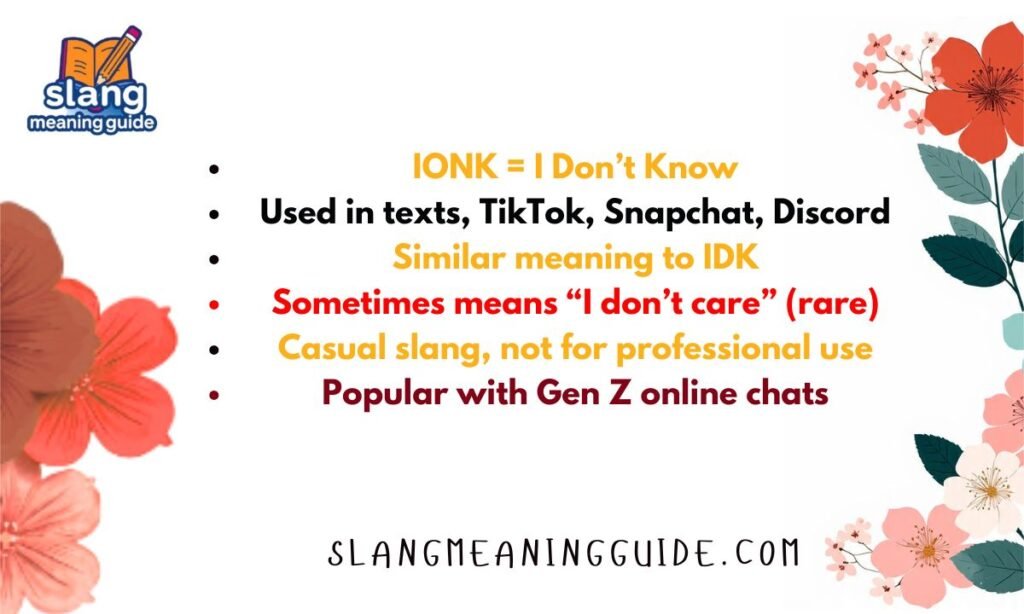
“I Don’t Know”
The most common and widely accepted meaning of IONK is “I don’t know.” It works exactly like IDK but sounds more playful and conversational. Younger users especially prefer it because it feels less robotic than the standard abbreviation.
Examples:
- “Who’s paying for dinner tonight?” / “IONK, flip a coin?”
- “Did she reply yet?” / “IONK, check yourself lol”
- “What time does it start?” / “IONK but probably 8?”
“I Don’t Care” (Less Common)
In some contexts, particularly on TikTok and Snapchat, IONK carries a slightly dismissive tone closer to “I don’t care.” Tone and context matter here. If someone uses it with a shrug emoji or a deadpan reply, they probably mean they’re indifferent, not just uninformed.
Examples:
- “Should I wear the red or blue one?” / “IONK honestly both are fine”
- “They changed the rules again.” / “IONK at this point”
- “She’s mad at me for that.” / “IONK what she expected”
Origin and Evolution Timeline
IONK grew out of the same culture that gave us IDK, SMH, and NGL. As texting sped up, abbreviations got more creative. IONK specifically took the phonetic sound of “I don’t know” and compressed it into something that reads almost like a word.
| Term | Estimated Origin | Platform Where It Blew Up | Current Status |
| IDK | Early 2000s | SMS / AIM | Universal, still active |
| ION | 2010s | Twitter, Tumblr | Common in AAVE-influenced spaces |
| IONK | Early 2010s | Snapchat, Kik | Growing on TikTok and Discord |
| Dunno | Pre-internet | Casual speech | Still widely used in text |
IONK likely evolved from “ION” (short for “I don’t” in AAVE and Gen Z slang) with a “K” added to complete the “know.” It wasn’t a planned invention; it just spread organically through informal conversations and eventually landed in meme culture.
Common Misunderstandings
Because IONK doesn’t follow standard abbreviation logic, people misread it constantly. Some assume it’s a typo. Others think it’s technical jargon. Neither is right.
| Slang | Common Misunderstanding | Correct Understanding |
| IONK | Typo for “ionic” | Slang for “I don’t know” |
| IONK | Same as ION | ION means “I don’t,” IONK means “I don’t know” |
| IONK | Made-up random letters | A phonetic shortening of a full phrase |
| IONK | Offensive or negative | Neutral and casual in most contexts |
The biggest confusion comes from people familiar with chemistry. “Ionic” is a real scientific term and IONK does look similar at a glance. But in any casual digital conversation, IONK is almost always the slang, not a misspelling of a chemistry concept.
Formal vs. Informal Uses
IONK belongs firmly in the informal category. It’s great for texts, captions, and comments. It has no place in a work email or a professional Slack channel.
| Term | Informal Use | Formal/Professional Equivalent |
| IONK | “IONK when it ships lol” | “I’m not certain of the shipping date.” |
| IONK | “IONK who’s leading that project” | “I don’t have visibility on that yet.” |
| IONK | “IONK, maybe ask her?” | “I’d recommend confirming directly with her.” |
| IONK | “IONK the answer rn” | “I’ll need to look into that and get back to you.” |
Using IONK at work won’t get you fired, but it can make you look careless. In any context where clarity and professionalism matter, spell it out. Save IONK for conversations where you’d also use a meme.
Comparisons With Similar Abbreviations
IONK isn’t alone. It sits in a crowded space of slang that all point toward uncertainty or indifference.
IDK is the closest equivalent. It’s older, more universal, and understood across generations. IONK is the younger, funkier version of the same idea.
ION means “I don’t” and often appears before another word, like “ION care” or “ION wanna.” IONK finishes the thought by adding “know.”
NGL (not gonna lie) sometimes shows up in similar situations where someone admits uncertainty or a hard truth. The vibe is different but the honesty is similar.
IK means “I know” and is basically the opposite of IONK. Confusing the two mid-conversation leads to some genuinely awkward moments.
Dunno is the spoken equivalent of IONK. It’s been around longer and crosses into older age groups, but both mean the same thing in different registers.
Frequently Asked Questions
What does IONK mean in a text message?
It means “I don’t know,” used casually to express uncertainty in informal conversations.
Is IONK the same as IDK?
They mean the same thing, but IONK is newer and more playful, popular with Gen Z in particular.
Can I use IONK at work?
No, keep it to personal chats. Use “I’m not sure” or “I’ll find out” in professional settings.
Is IONK offensive?
Not at all. It’s a neutral, friendly slang term with no negative or hidden meanings.
Where is IONK most popular?
It’s most common on TikTok, Snapchat, Discord, and Instagram among younger English-speaking users.
Final Words
IONK is one of those slang terms that makes perfect sense once you hear it out loud. It sounds exactly like “I don’t know” said quickly in casual speech. Now that you know what it means, you’ll start spotting it everywhere, and you’ll actually know how to use it without second-guessing yourself.