

Sometimes a single word captures a feeling that entire sentences cannot describe. You may see it in poetry, photography captions, or peaceful nature videos. At first glance it looks mysterious, soft, almost poetic.
That word is Komorebi—a Japanese term that quietly describes a moment many people notice but rarely name.
What Komorebi Means in Japanese and Everyday Language
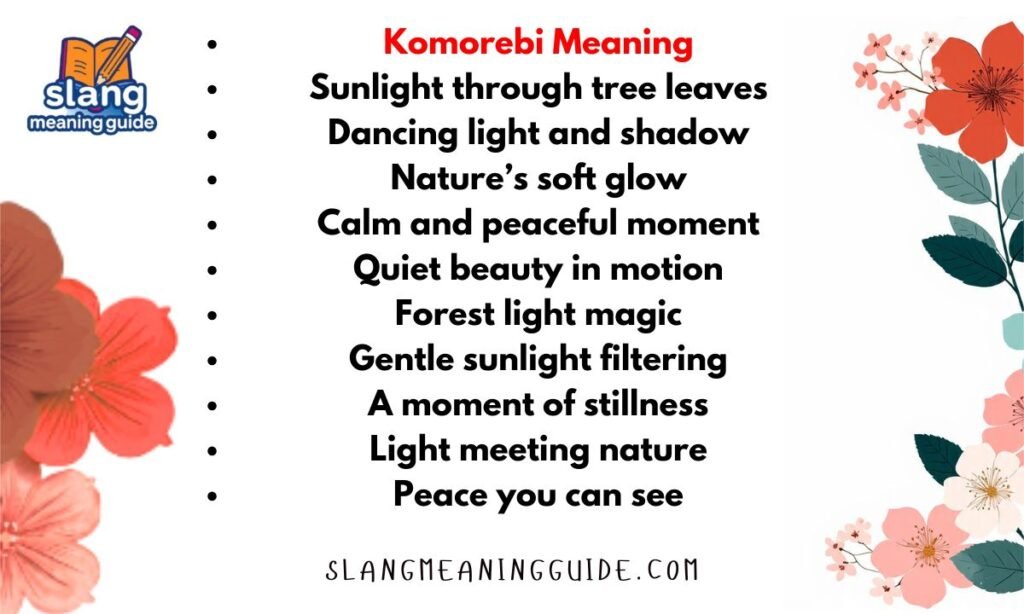
Komorebi is a Japanese word that describes sunlight filtering through the leaves of trees. It refers to the shifting patterns of light and shadow created when sunshine passes through branches and foliage.
The word combines several Japanese elements that together express this natural scene. Instead of simply meaning “sunlight,” it specifically highlights the interaction between sunlight and leaves. That is why it feels poetic and emotionally rich.
People around the world use the word today to express moments of calm in nature. You might see it used in captions, poetry, photography titles, or mindfulness discussions.
Examples of how people describe the moment:
- “The forest was glowing with komorebi in the morning.”
- “I stopped walking just to watch the komorebi through the trees.”
- “That photo perfectly captures the beauty of komorebi.”
- “Meditating under komorebi feels peaceful and grounding.”
In everyday conversation, the term is not slang in Japan. It is a normal descriptive word, but internationally it often feels artistic or poetic.
Core Meanings Explained
Komorebi as Sunlight Filtering Through Leaves
The most direct meaning of komorebi is the sunlight that passes through tree branches and leaves, creating moving patterns on the ground. This meaning focuses on a visual natural phenomenon that happens in forests, parks, and gardens.
Key usages:
- Nature writing and travel blogs
- Photography descriptions
- Mindfulness and meditation discussions
- Environmental storytelling
Examples:
- “Morning komorebi filled the park with golden light.”
- “The hikers walked slowly beneath soft komorebi.”
- “Komorebi made the forest look magical.”
- “The artist painted a scene full of komorebi.”
Komorebi as a Symbol of Peace and Calm
Over time, many people began using komorebi symbolically to represent calm, reflection, and quiet moments. Because the image of sunlight through leaves feels gentle and peaceful, it naturally became associated with emotional stillness.
Key usages:
- Wellness blogs
- Meditation quotes
- Lifestyle captions
- Inspirational writing
Examples:
- “Take a moment today to enjoy your own komorebi.”
- “Life feels calmer when you slow down and notice komorebi.”
- “Komorebi reminds us to appreciate small moments.”
- “Her journal entry described the peace of komorebi.”
Komorebi in Photography and Visual Art
In creative fields, komorebi is widely used to describe a specific lighting style. Photographers often aim to capture this effect because it creates depth, contrast, and emotion in images.
Key usages:
- Nature photography
- Landscape art
- Cinematography lighting descriptions
- Visual storytelling
Examples:
- “This photo captures perfect komorebi in the forest.”
- “The film scene uses soft komorebi lighting.”
- “Artists love painting komorebi effects.”
- “The photographer waited hours for the right komorebi.”
Komorebi in Social Media Culture
On platforms like Instagram, Pinterest, and TikTok, komorebi appears frequently in captions about nature and aesthetic living. The word fits perfectly with visual storytelling and peaceful lifestyle content.
Key usages:
- Aesthetic captions
- Travel posts
- Mindfulness reels
- Nature appreciation posts
Examples:
- “Morning walk under beautiful komorebi.”
- “Today’s mood: sunshine and komorebi.”
- “Nature therapy with a little komorebi.”
- “Chasing komorebi in the forest.”
Komorebi as a Concept of Untranslatable Words
Komorebi is often included in lists of “untranslatable words.” These are words that exist in one language but have no exact single-word translation in another. Because English normally needs a full phrase to describe the moment, komorebi gained attention worldwide.
Key usages:
- Language blogs
- Cultural discussions
- Vocabulary lists
- Educational articles
Examples:
- “Komorebi is one of the most beautiful untranslatable words.”
- “Learning words like komorebi expands your vocabulary.”
- “Many languages have poetic terms like komorebi.”
- “Writers love using komorebi in descriptive passages.”
Origin and Evolution of the Word Komorebi
The word itself comes from traditional Japanese language structure. It combines multiple components that describe the interaction between light and trees.
Key linguistic parts include:
- “Ko” (木) meaning tree
- “More” (漏れ) meaning to leak or filter
- “Bi” (日) meaning sunlight
Together they describe sunlight leaking through trees.
Origin + Evolution Timeline
| Term | Estimated Origin | Platform Where It Blew Up | Current Status |
| Komorebi | Traditional Japanese vocabulary | Photography blogs and language sites (2010s) | Widely recognized poetic term |
| Komorebi | Ancient linguistic roots | Instagram aesthetic culture | Popular in captions and art |
| Komorebi | Longstanding Japanese word | TikTok nature content | Trending aesthetic word |
Over time, global internet culture helped spread the word beyond Japan.
Key milestones in its global spread:
- Language blogs introduced the concept of “untranslatable words.”
- Photography communities adopted it for nature lighting effects.
- Social media aesthetics made the term widely recognizable.
- Today it appears in poetry, captions, and lifestyle writing.
How Komorebi Is Used in Real Conversations
Even though the word is poetic, people still use it naturally when describing nature. Writers and artists often prefer it because it captures a specific visual experience.
Common contexts include:
- Travel storytelling
- Meditation descriptions
- Photography discussions
- Literature and poetry
Examples:
- “We walked through the forest covered in komorebi.”
- “The campsite looked magical in morning komorebi.”
- “Her painting focuses on soft komorebi light.”
- “Komorebi filled the path during sunset.”
Using the word can make descriptions more vivid and expressive.
Common Misunderstandings About Komorebi
Many people misunderstand the word or simplify its meaning. Some assume it simply means “sunlight,” but the real meaning is more specific.
Common misconceptions include:
- Thinking it means general sunlight rather than filtered sunlight
- Assuming it is modern slang rather than a traditional word
- Believing it only refers to photography lighting
- Confusing it with other Japanese aesthetic terms
In reality, komorebi describes a very specific natural interaction between sunlight and tree leaves.
Formal vs Informal Uses
Komorebi can appear in both formal and informal contexts depending on how it is used.
In Japan, it may appear in literature or descriptive writing. Internationally it often appears in creative or aesthetic content.
Informal Uses
Examples:
- “Morning walk with beautiful komorebi.”
- “I love watching komorebi in the park.”
- “That forest photo shows perfect komorebi.”
- “Today feels like a komorebi kind of day.”
Formal Uses
Examples:
- Nature essays describing forest light
- Photography exhibition descriptions
- Literary writing about landscapes
- Cultural language studies
Examples in sentences:
- “The photograph highlights delicate komorebi lighting.”
- “The forest landscape is illuminated by komorebi.”
Comparisons With Similar Nature Words
Many languages have poetic nature words similar to komorebi.
These terms often describe specific atmospheric moments.
| Word | Language | Meaning | Similarity |
| Komorebi | Japanese | Sunlight through leaves | Direct phenomenon |
| Petrichor | English | Smell after rain | Nature sensory word |
| Hygge | Danish | Cozy atmosphere | Emotional environment |
| Shinrin-yoku | Japanese | Forest bathing | Nature wellness concept |
While petrichor describes a smell, komorebi describes a visual moment.
Cultural Importance of Komorebi
The concept reflects how Japanese culture often pays attention to small natural details. Nature appreciation plays a large role in art, literature, and daily life.
Reasons the word resonates globally:
- It captures a universal experience.
- It encourages mindfulness.
- It highlights beauty in simple moments.
- It enriches descriptive language.
This is why the word frequently appears in:
- poetry
- travel writing
- environmental storytelling
- meditation and wellness content
Frequently Asked Questions
What does komorebi mean?
Komorebi means sunlight filtering through tree leaves.
Is komorebi a slang word?
No, it is a traditional Japanese descriptive word.
Why is komorebi popular online?
It became popular through photography, aesthetic captions, and language blogs.
Can komorebi be used in English sentences?
Yes, many writers and photographers use it in English descriptions.
Is komorebi considered an untranslatable word?
Yes, because English normally needs a full phrase to express the same idea.