
You have probably seen the word “mewing” all over TikTok, Instagram, and Snapchat, often paired with jawline gestures and cryptic emojis. At first glance, it looks like just another weird internet trend. But behind the term is a mix of slang, health claims, social behavior, and online culture.
In this guide, we break down the real meaning of mewing, how Gen Z uses it, where it came from, and what it actually does, so you can understand it clearly and confidently.
Mewing Meaning in Texting and Online Slang
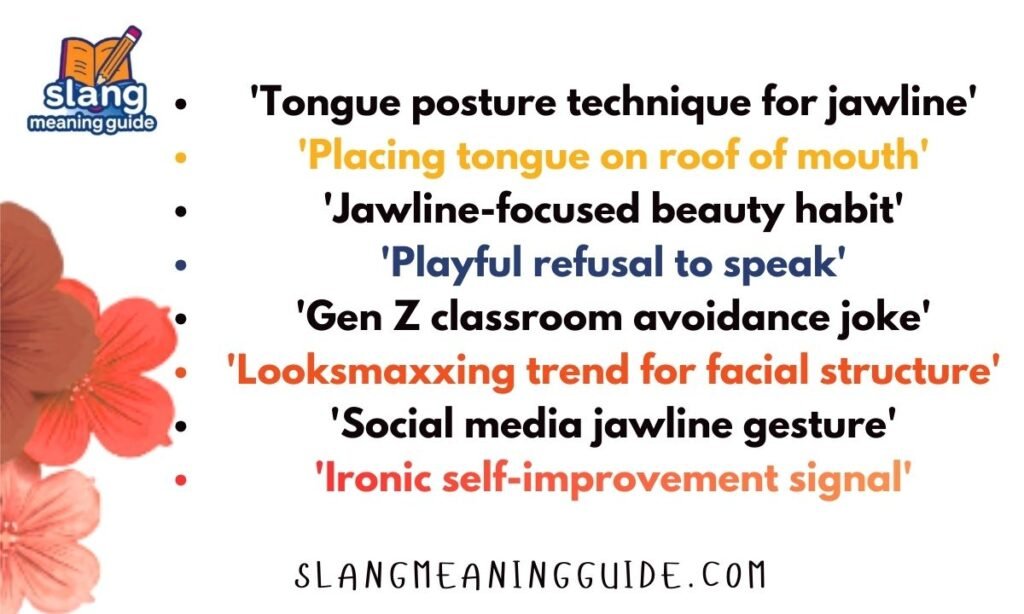
In texting and Gen Z slang, mewing refers to placing the tongue flat against the roof of the mouth to supposedly sharpen the jawline and improve facial structure. Over time, the word evolved beyond a physical technique into a cultural expression and playful gesture.
In casual conversation, “mewing” often signals that someone is busy focusing on their jawline or mockingly refusing to respond, especially in classroom or authority settings.
Key slang meanings include:
- Jawline exercise: positioning the tongue to improve facial aesthetics
- Gesture of avoidance: signaling “I can’t answer, I’m mewing”
- Social joke: playful deflection used mostly by teens
Text-based examples:
- Fitness focus: “Bro I’ve been mewing for months, trust the process.”
- Playful excuse: “Can’t talk, I’m mewing.”
- Joke response: “Teacher asked me, I just hit them with the mewing face.”
Over time, the slang meaning became just as important as the physical practice itself.
Mewing Origins
Mewing originated from the work of British orthodontist Dr. John Mew and his son Dr. Mike Mew, who promoted a facial posture technique focused on correct tongue placement, nasal breathing, and jaw alignment to support natural facial development. The term gained popularity in the late 2010s through YouTube, TikTok, and online fitness and aesthetics communities.
Social Media Usage on Snapchat, TikTok, and Instagram
Social media platforms fueled the popularity of mewing, especially TikTok. What started as jawline advice videos turned into viral memes, jokes, and classroom trends.
On TikTok, users show exaggerated jaw movements, finger tracing, and “shush + jawline” gestures. On Snapchat and Instagram, mewing appears in stories, captions, and comments.
Snapchat usage:
- Playful snaps: showing jawline with mewing gesture
- Chat jokes: responding to questions with “🤫🧏”
- Story trends: short clips demonstrating “mewing posture”
TikTok usage:
- Tutorial clips: explaining tongue placement
- Comedy skits: avoiding teachers by “mewing”
- Before-after videos: claiming jawline improvements
Instagram usage:
- Reels: mewing challenges
- Captions: “Trusting the mewing journey”
- Comments: “Bro said 🧏🤫 in class”
Common social examples:
- Funny clip: “Why are kids mewing in class now?”
- Transformation post: “Day 90 of mewing.”
- Reaction comment: “The mewing trend is wild.”
Social platforms transformed mewing from a niche orthodontic idea into mainstream youth culture.
Formal vs Informal Use of Mewing
The word “mewing” exists in both medical discussion and internet slang, but tone and context matter.
Formal usage refers to tongue posture techniques discussed in orthodontics, speech therapy, and dental health. Here, mewing is addressed cautiously and clinically.
Informal usage dominates social media and texting, where it functions as slang, humor, and cultural signaling.
Formal contexts:
- Dental consultations
- Orthodontic discussions
- Medical articles
- Speech therapy conversations
Informal contexts:
- TikTok trends
- Snapchat jokes
- Classroom humor
- Meme culture
Example contrast:
- Formal: “Proper tongue posture may influence facial development.”
- Informal: “Bro I’m mewing so I don’t have to answer.”
Knowing this difference helps avoid awkward misunderstandings.
Common Misunderstandings About Mewing
Mewing is surrounded by myths, exaggerated claims, and viral misinformation. Many misunderstand its purpose and realistic effects.
One major misunderstanding is believing that mewing can dramatically reshape adult facial structure. Scientific evidence does not strongly support this claim.
Another confusion is thinking mewing is harmless in all cases, when excessive or improper practice can strain jaw muscles and teeth alignment.
Frequent misconceptions include:
- Believing mewing permanently sharpens jawlines
- Thinking results appear within days
- Assuming everyone benefits equally
- Treating it as medically proven
Reality check examples:
- Expectation: “Mewing will give me a chiseled jaw.”
- Reality: “Changes, if any, are subtle and slow.”
Understanding limitations prevents disappointment and misuse.
Usage Tips and Emotional Context
Mewing functions both as a physical habit and a social signal. Understanding emotional context ensures appropriate use.
In humor, it expresses playful avoidance or exaggerated self-care. In health discussion, it refers to tongue posture awareness. Emotionally, it often signals confidence, irony, or teasing defiance.
Usage tips:
- Use playfully: with friends and peers
- Avoid seriousness: in professional settings
- Understand tone: mostly ironic and humorous
- Don’t overuse: excessive repetition feels forced
Emotional examples:
- Confidence: “Just mewing and trusting the process.”
- Avoidance: “Teacher caught me, I started mewing.”
- Sarcasm: “Mewing my way through life.”
Its emotional impact depends entirely on delivery and situation.
Comparisons With Similar Slang and Trends
Mewing belongs to the broader category of looksmaxxing slang, where physical optimization becomes social currency.
Comparison With Similar Slang Terms
| Slang | Meaning | Focus | Usage Context |
| mewing | tongue posture technique | jawline | beauty, humor |
| looksmaxxing | maximizing attractiveness | overall appearance | self-improvement |
| mogging | outshining others | dominance | social flex |
| glow-up | transformation | confidence | before-after trends |
| sigma | lone dominant male | personality | meme culture |
Mewing stands out because it blends physical practice, visual gesture, and humor.
Practical Examples in Real Conversations
Using “mewing” naturally depends on social context. It usually appears as either a joke or a self-improvement reference.
Friend group chat:
- “I can’t talk, I’m mewing.”
- “Bro thinks mewing will fix everything.”
Classroom humor:
- “Why don’t you answer?”
- “🤫🧏”
Social media comments:
- “He really hit them with the mewing.”
- “Mewing era unlocked.”
Fitness & beauty talk:
- “I’ve been mewing plus fixing posture.”
These examples show how flexible the term has become.
When to Avoid Using Mewing
Despite its popularity, mewing is not always appropriate. Certain situations require seriousness, respect, and clarity.
Avoid using “mewing” when:
- Someone is discussing medical concerns
- Addressing teachers or authority figures
- In professional conversations
- During serious discussions
Inappropriate usage examples:
- Doctor: “Any pain?”
- Response: “I’m mewing.”
Misuse can appear disrespectful, dismissive, or immature.
Scientific Perspective on Mewing
From a medical standpoint, proper tongue posture does matter for breathing and oral development, especially in children. However, claims about dramatic jawline restructuring in adults remain unproven.
Orthodontists generally agree:
- Proper posture supports oral health
- It does not radically reshape facial bones
- Excessive pressure may cause discomfort
Potential benefits:
- Improved nasal breathing
- Better posture awareness
- Reduced mouth breathing
Possible risks:
- Jaw tension
- Bite misalignment
- TMJ discomfort
Professional guidance is recommended before treating mewing as therapy.
Cultural Evolution of Mewing
Mewing originated from British orthodontists Dr. John Mew and Dr. Mike Mew. The term later gained traction in internet forums, fitness culture, and TikTok communities.
By 2024, it evolved into:
- A classroom meme
- A social media gesture
- A Gen Z inside joke
- A looksmaxxing trend
This evolution shows how health ideas can morph into cultural expressions.
Alternative Expressions to Mewing
Depending on tone, several slang phrases substitute or complement “mewing.”
Slang Alternatives Based on Context
| Context | Alternative | Example |
| Avoiding answer | “Can’t rn” | “Busy, can’t rn.” |
| Joking deflection | “bruh moment” | “Bruh moment fr.” |
| Beauty focus | “glow-up mode” | “In glow-up mode.” |
| Fitness focus | “self-improvement grind” | “On my grind.” |
These alternatives offer similar tone without the physical gesture.
Frequently Asked Questions
What does mewing mean in slang?
It means placing the tongue on the roof of the mouth or jokingly avoiding speaking.
Does mewing actually change your jawline?
Scientific evidence suggests results are minimal, especially for adults.
Is mewing safe?
Generally safe, but excessive practice can strain jaw muscles.
Why do teens mew in class?
As a joke to avoid answering teachers.
Where did mewing originate?
From orthodontists John and Mike Mew in the UK.
Final Thoughts
Mewing is a rare mix of health theory, beauty trend, and Gen Z humor. What started as a tongue posture technique transformed into a viral gesture and cultural meme.
Understanding its meaning, limitations, and social context allows you to interpret it correctly and use it naturally. Whether taken seriously or humorously, mewing reflects how online culture reshapes language, behavior, and self-image in modern digital spaces.