
You see “OC” in a Reddit post title, then spot it again in a Discord server about fan art, then again in a group chat about weekend plans. Same two letters, three completely different conversations. OC is one of those internet abbreviations that changes shape depending on where you find it. Knowing which meaning applies in which setting is the difference between fitting in and missing the entire point.
Core Meanings Explained
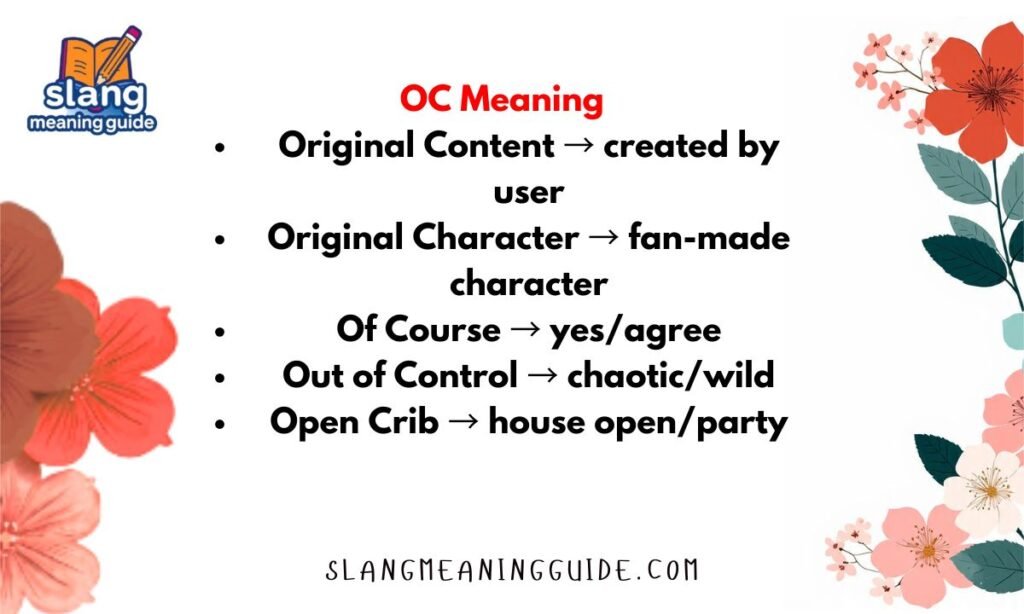
OC carries five distinct meanings across digital communication, fan culture, social media, and casual texting. Each one operates in its own context, and reading the room is the key to getting it right.
1. Original Content
This is the most widely recognized meaning of OC across mainstream social media. It tells the audience that a post, image, video, meme, or article was created by the person sharing it and was not copied, reposted, or lifted from someone else.
On platforms like Reddit, the [OC] tag carries real weight. Communities actively reward original contributions and treat the OC label as a mark of authenticity and creative ownership. Slapping it on recycled material is a quick way to lose credibility in any online space.
- A photographer posts a landscape shot with the caption “Shot this during my hike, OC.”
- A Reddit user tags a data visualization with [OC] to show they built the chart themselves.
- A meme creator writes “First meme I’ve ever made, OC!” in the comments.
- An Instagram artist adds #OC to a digital illustration to protect it from uncredited reposts.
2. Original Character
In fan fiction, role-playing communities, and gaming forums, OC stands for a character that a fan created entirely from their own imagination. This character does not exist in the official source material of any book, show, game, or film.
OCs are common in Harry Potter fan fiction, Star Wars stories, anime role-play, and gaming communities on platforms like DeviantArt and Archive of Our Own. Writers use them to expand a familiar universe with their own creative spin, adding characters that feel like they belong in the world without actually being part of the canon.
- “Meet my OC, she’s a Jedi from a planet never mentioned in the films.”
- “I spent two weeks designing my OC’s backstory for this RP group.”
- “Her OC art got featured on three different fan pages this week.”
- “This fanfic follows an OC who transfers to Hogwarts from a school in West Africa.”
3. Of Course
In casual texting and one-on-one chats, OC sometimes functions as a quick stand-in for “of course.” It is less dominant than the other meanings but appears often enough in informal messaging, particularly on Snapchat and WhatsApp, to be worth knowing.
The tone here is breezy and agreeable. It works the same way “ofc” does, though OC feels slightly more typed-out and deliberate. Context makes this one easy to spot because the surrounding conversation usually involves a simple confirmation or agreement.
- “Can you pick me up at 7?” — “OC, I’ll be there.”
- “You good with pizza tonight?” — “OC, just order what you like.”
- “Did you see what she posted?” — “OC, I already sent it to the group.”
- “You still coming to the gym?” — “OC, give me 20 minutes.”
4. Out of Control
This meaning has older roots in street slang, particularly in the DMV area covering Washington D.C., Maryland, and Virginia. It describes a situation, event, or person that has gone wild, chaotic, or beyond any reasonable limit.
Urban Dictionary first logged this definition in 2004, which means it likely predates the “Original Content” usage by several years. Today it still shows up in casual texts and social captions when someone wants to describe something as excessively intense, hilarious, or over the top.
- “Last night’s game went OC, I’ve never seen a crowd that loud.”
- “His reaction to the prank was fully OC, everyone lost it.”
- “The traffic this morning was OC, I sat for two hours.”
- “That party got OC around midnight when the DJ switched genres.”
5. Open Crib
Among teens and young adults, OC is shorthand for a situation where someone’s parents or guardians are away and the house is open for friends to come over. It signals that a gathering is happening and that the host’s place is available.
This meaning lives almost entirely in text messages, group chats, and social media stories. It is context-heavy and informal, and you would never see it in a public post on a brand account or a professional platform.
- “Hey, I’ve got an OC this Friday, who’s coming?”
- “Mom’s out of town all weekend, OC at mine Saturday night.”
- “He dropped an OC notice in the group chat and thirty people showed up.”
- “OC at Sam’s, starts at 8, bring your own food.”
Origin and Evolution Timeline
OC did not come from one single community or moment. It grew across multiple internet subcultures simultaneously, which is exactly why it ended up with so many different meanings.
| Term | Estimated Origin | Platform Where It Blew Up | Current Status |
| Original Character | Late 1990s (Usenet, early fan forums) | DeviantArt, Fanfiction.net, Tumblr | Dominant in fan, art, and gaming communities |
| Original Content | Early 2000s (message boards) | Reddit, Instagram, TikTok | Mainstream across all major platforms |
| Out of Control | Early 2000s (DMV street slang) | Urban Dictionary, early chat rooms | Fading but still active in informal texting |
| Of Course | 2010s (casual texting) | Snapchat, WhatsApp, iMessage | Casual and conversational, secondary meaning |
| Open Crib | 2010s (teen social culture) | Group chats, Snapchat stories | Informal, mostly teen and young adult use |
Quick timeline breakdown:
Late 1990s: Fan fiction writers on Usenet and early forums coin “OC” to label characters they invented for existing fictional universes.
Early 2000s: “Out of Control” enters online chat rooms from DMV street culture. Urban Dictionary records both meanings by 2004–2009.
Mid-2000s: The Fox TV show The O.C. briefly makes the abbreviation synonymous with Orange County in popular culture.
2010s: Reddit begins widely using [OC] to tag original user-generated posts, cementing “Original Content” as a mainstream definition.
2010s–present: Instagram, TikTok, and Discord expand both the “Original Content” and “Original Character” meanings into massive creator communities.
Present day: OC shifts meaning in real time based on platform, audience, and conversation topic.
Common Misunderstandings
The biggest problem most people have with OC is assuming it has one fixed meaning across every platform and conversation. It does not work that way. Someone who spends most of their time on Reddit will automatically read OC as “Original Content,” while a fan fiction writer on Archive of Our Own will just as automatically read it as “Original Character.”
Neither is wrong, they are just operating in different digital spaces. The two-letter combination is platform-dependent, audience-dependent, and entirely context-driven.
- OC does not always mean Original Content. In fan and gaming communities, Original Character is the dominant meaning.
- OC is not a geographic term in online conversations. Orange County associations faded after The O.C. left the pop culture spotlight.
- OC is not always creative. “Of Course” and “Open Crib” have nothing to do with art, writing, or content creation.
- OC is not interchangeable with OP. OP means Original Poster, the person who started a thread, not the content itself.
- OC is not always positive. “Out of Control” can describe chaos, not just excitement or creativity.
Formal vs. Informal Uses
OC lives firmly in the informal lane for most of its meanings. You would not use it in a client email, a school essay, or any document where clarity and professionalism matter.
Informal usage examples:
- “Just finished drawing my OC for the new fandom, tell me what you think.”
- “That fight at the game was fully OC, security couldn’t handle it.”
- “We’ve got an OC tonight, you should come through.”
- “OC I’ll cover for you, just owe me one.”
- “Posted some OC on Reddit and it hit the front page.”
Formal or semi-professional usage examples:
- In a content strategy document: “This campaign will rely on Original Content (OC) to build audience trust and drive organic engagement.”
- In a creative brief for a gaming studio: “The narrative team will introduce three original characters (OC) into the expansion storyline.”
- In a blog post about fan communities: “Original characters, commonly referred to as OC, are a central feature of fan creative culture.”
The simple rule is: if you are writing for a general or professional audience, spell out the full phrase first and place OC in parentheses. Only use the abbreviation alone in spaces where the audience already knows what it means.
Comparisons With Similar Abbreviations
OC gets confused with several other common internet abbreviations. This table breaks down what sets each one apart.
| Abbreviation | Full Form | Key Difference From OC |
| OP | Original Poster | Refers to the person who started a thread, not the content itself |
| OFC | Of Course | More widely used shorthand for “of course” than OC |
| CC | Content Creator | Describes a person’s role, not a specific piece of content |
| AU | Alternate Universe | A fan fiction setting, not a character creation term |
| Canon | Canon | Refers to official story content, the opposite of an OC |
| UGC | User-Generated Content | Broader term covering all original user content, not platform-specific |
Frequently Asked Questions
1. What does OC mean in a text message?
It most commonly means “Of Course,” “Original Content,” or “Out of Control” depending on the conversation.
2. What does OC mean on Reddit?
On Reddit, [OC] tags a post as Original Content created by the person sharing it.
3. What does OC mean in fan fiction?
It stands for Original Character, a fan-created fictional character not found in official source material.
4. Is OC formal or informal?
OC is informal and works best in digital spaces where the audience already understands the abbreviation.
5. What is the difference between OC and OP?
OC refers to original content or character, while OP refers to the original poster who started a discussion thread.
Conclusion
OC is two letters doing the work of five completely different phrases depending on where and how you use it. Understanding each meaning, from Original Content and Original Character to Of Course and Open Crib, gives you the ability to read any online conversation clearly and respond without confusion.
Context is everything with OC, and once you train yourself to check the platform and tone first, the right meaning almost always reveals itself immediately.