
Some phrases sound simple but carry layers of meaning depending on how and where people use them. “Pay the bills” is one of those expressions. You may hear it in daily conversation, see it in texts, or come across it on social media. Each setting gives the phrase a slightly different tone. The result is a term that feels familiar yet often gets misunderstood.
This guide explains the slang meaning of“pay the bills” in texting, its origin, how people use it on social media, and how its tone shifts across contexts. It also clarifies common misunderstandings and offers practical examples.
Pay the Bills Meaning Slang in Texting and Online Speech
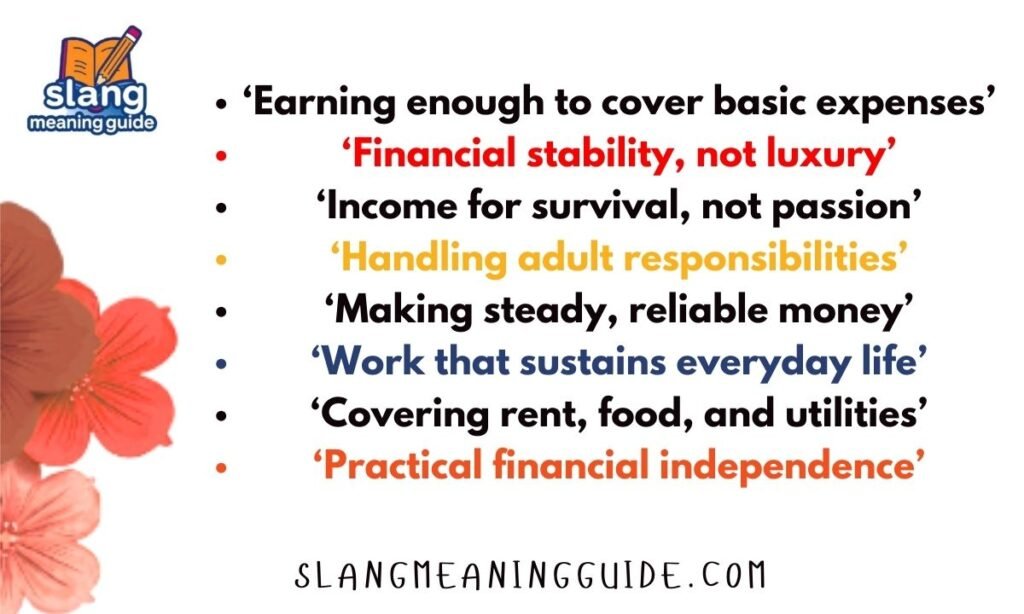
In texting slang, “pay the bills” usually means having enough income to cover basic living expenses. It suggests financial stability, self-sufficiency, and responsibility rather than wealth or luxury.
People often use it to describe a job, side hustle, or income stream that reliably supports everyday life. In casual conversations, it becomes shorthand for survival income rather than ambition-driven income.
Common texting meanings include:
- Financial stability: earning enough to meet essential expenses.
- Responsibility: handling personal obligations without outside help.
- Sufficiency: not rich, but not struggling to survive.
In short, when someone says, “This job pays the bills,” they usually mean the job meets their basic needs, even if it does not bring fulfillment or luxury. In slang form, it often carries emotional undertones about survival, practicality, and compromise.
Pay the Bills Origin and Linguistic History
The phrase “pay the bills” originates from traditional financial systems where service providers physically mailed invoices or statements. These paper bills listed the amount owed for utilities, rent, insurance, and other services.
As society shifted to electronic payments, the physical bill became less visible, but the phrase remained. Over time, it evolved into a metaphor for meeting essential life expenses.
Historical roots of the phrase:
- Latin origin: The word “bill” traces back to bulla, meaning a sealed document.
- Medieval use: Bills referred to written statements of money owed.
- Modern evolution: The phrase shifted from literal invoices to symbolic life expenses.
In slang and casual usage, “pay the bills” no longer requires physical bills. It simply means sustaining one’s lifestyle and responsibilities. This evolution reflects how language adapts to changing economic systems while preserving emotional meaning.
Social Media Usage on Snapchat, TikTok, and Instagram
On platforms like Snapchat, TikTok, and Instagram, “pay the bills” often appears in captions, comments, and short videos. Its meaning becomes broader and more expressive, blending financial realism with humor and identity.
Creators frequently use the phrase to describe work they do for survival rather than passion. It contrasts dreams versus obligations, highlighting the tension between what people love and what they must do.
Common social media contexts include:
- Career realism: “This job pays the bills, my passion pays my soul.”
- Side hustle culture: “Gotta grind so the bills stay paid.”
- Lifestyle humor: “This coffee addiction won’t pay the bills.”
In influencer culture, the phrase also signals authenticity. It reminds audiences that behind glamour, there is real financial pressure. As a result, “pay the bills” becomes both practical slang and emotional storytelling.
Formal vs Informal Use of “Pay the Bills”
The phrase appears in both formal and informal contexts, but its tone and purpose change dramatically.
In formal usage, “pay the bills” refers literally to financial obligations such as rent, utilities, insurance, and loans. It appears in contracts, budgeting discussions, and financial planning.
In informal slang, the phrase becomes symbolic. It expresses emotional attitudes toward work, responsibility, independence, and survival.
Key differences between formal and informal usage:
- Formal: literal financial obligation, invoices, expenses.
- Informal: emotional shorthand for earning enough to survive.
- Slang: identity marker for responsibility and adulthood.
In texting, the slang version dominates. People rarely mean actual paper bills. Instead, they refer to the entire system of adult financial survival.
Common Misunderstandings Around the Phrase
Many misunderstandings arise because people interpret “bills” too literally. Some assume it refers only to mailed invoices like electricity or internet. Others think groceries or rent do not count.
In reality, any recurring expense necessary for daily living qualifies as a bill. The phrase “pay the bills” refers to the total financial load required to maintain life stability.
Common misconceptions include:
- Thinking only utilities count as bills.
- Excluding rent, groceries, and insurance.
- Assuming bills must involve physical paperwork.
This confusion often appears in online forums where users debate what counts as a “bill.” The broader linguistic meaning includes all essential expenses, regardless of payment method.
Emotional Context and Social Implications
Emotionally, “pay the bills” often carries undertones of pressure, compromise, and responsibility. It reflects the reality that many people work jobs they do not love because survival requires income.
In conversation, the phrase can signal maturity, independence, and resilience. It can also express frustration, exhaustion, or resignation.
Emotional meanings include:
- Pride: self-sufficiency and independence.
- Stress: financial pressure and survival anxiety.
- Acceptance: realistic compromise between dreams and obligations.
Because of this emotional depth, the phrase resonates across age groups. Young adults associate it with independence, while older adults link it to stability and survival.
Comparisons With Similar Slang and Expressions
“Pay the bills” overlaps with several slang terms and idioms related to money and responsibility. Each carries a slightly different tone.
| Phrase | Meaning | Emotional Tone |
| Pay the bills | Cover essential expenses | Practical, realistic |
| Make ends meet | Barely survive financially | Strained, survival |
| Keep the lights on | Maintain operations or survival | Urgent, necessary |
| Breadwinner | Main income earner | Responsibility, pride |
| Get by | Survive with limited resources | Minimal, cautious |
Another group of related slang terms refers directly to money:
| Slang Term | Meaning |
| Bread | Money |
| Dough | Money |
| Moola | Money |
| Cash | Physical money |
| Bills | Banknotes or expenses |
These comparisons highlight how “pay the bills” occupies a space between literal finance and emotional expression.
Practical Examples in Daily Conversation
The phrase adapts easily across settings. Its meaning shifts slightly depending on emotional tone and context.
Everyday examples include:
- “This job isn’t exciting, but it pays the bills.”
- “I took the extra shift to make sure the bills stay paid.”
- “My art doesn’t pay the bills yet, but I’m hopeful.”
- “Side hustles help me pay the bills.”
Each example reflects the same core idea: earning enough to sustain life. Yet, the emotional tone varies from acceptance to optimism to frustration.
Usage Tips for Clear Communication
Using “pay the bills” effectively depends on tone, audience, and setting. In professional contexts, clarity matters. In casual contexts, emotional tone carries more weight.
Helpful usage tips include:
- Match tone to context: Keep it neutral in professional settings.
- Use emotionally in casual speech: Let it reflect realism or humor.
- Avoid sarcasm in sensitive situations: It can sound dismissive.
In texting, the phrase often becomes shorthand. People may simply write “bills paid” to signal financial security or relief.
When to Avoid Using the Phrase
Despite its popularity, “pay the bills” may sound dismissive in certain situations. Using it carelessly can minimize emotional concerns or professional ambitions.
Avoid using it when:
- Someone expresses career frustration.
- Financial stress is severe.
- Emotional support is needed.
In such cases, acknowledging emotional nuance rather than simplifying the situation improves communication.
Frequently Asked Questions
What does “pay the bills” mean in texting?
It means earning enough money to cover essential living expenses.
Is “pay the bills” formal or slang?
It functions as both, depending on context and tone.
Does “bills” include rent and groceries?
Yes, it includes all necessary living expenses.
Is the phrase negative or positive?
It is neutral but can carry emotional weight.
Can “bills” mean money itself?
Yes, in slang, “bills” can refer to banknotes.
Final words
“Pay the bills” is more than a financial phrase. In modern slang, especially in texting and online culture, it represents independence, responsibility, and survival. Its meaning adapts across contexts, blending literal expense coverage with emotional expression.
Understanding how people use it reveals broader social attitudes toward work, money, and adulthood. Whether used seriously, humorously, or reflectively, “pay the bills” remains one of the most enduring and relatable expressions in modern English.