
You’ve seen these words fly by in group chats, TikTok comments, and Instagram DMs. Some look like typos. Some sound like sounds. And yet somehow, everyone seems to understand them except you. Today we break down five Gen Z slang terms that are all over your screen right now — and exactly what they mean.
Core Meanings Explained
Ratchet
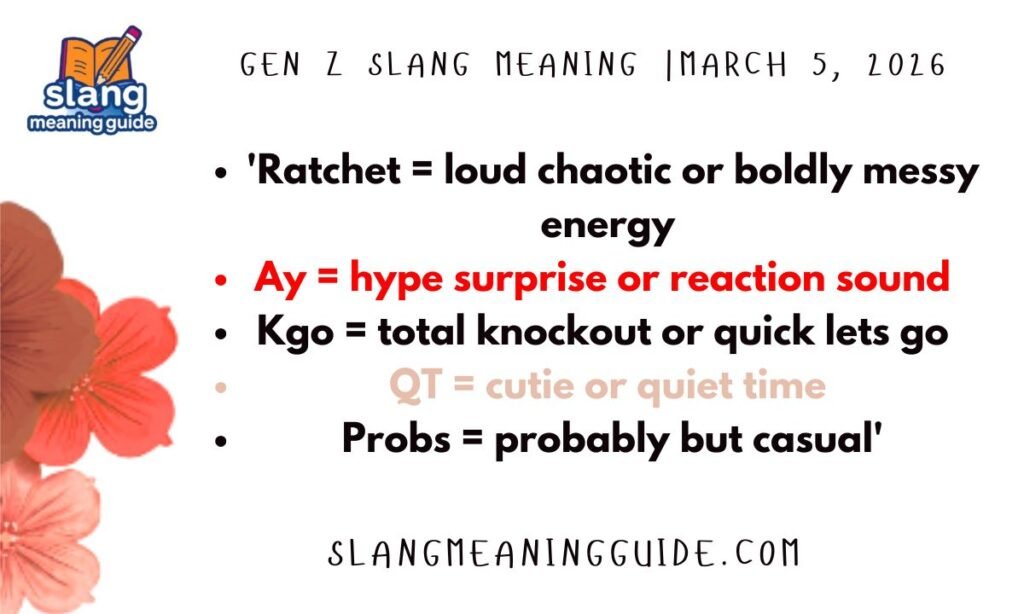
Ratchet describes someone or something that is loud, messy, over-the-top, or just straight-up chaotic. It started as an insult but has evolved into something people sometimes wear as a badge of honor — unapologetically bold and unbothered.
Key usages:
- Describing wild, dramatic behavior
- Calling out tacky fashion or poor decisions
- Used ironically to mean authentically chaotic
Examples:
- “That party was so ratchet, someone threw cake at the ceiling.”
- “She showed up in head-to-toe neon. Ratchet, but honestly iconic.”
- “Stop being ratchet and just apologize already.”
Ay
Ay is a flexible interjection that does a lot of emotional heavy lifting in one short sound. It expresses surprise, excitement, agreement, pain, or just fills space in a sentence when vibes need acknowledging. Context tells you everything with this one.
Key usages:
- Reacting to good or bad news
- Seeking agreement at the end of a statement
- Used in rap and music as a rhythmic filler
Examples:
- “Ay, that was actually fire.”
- “We’re going to the beach tomorrow, ay?”
- “Ay ay ay, I can’t believe he said that.”
Kgo
Kgo is a fast-texting shorthand, most likely a phonetic mashup of “KO” meaning knockout — or simply someone typing “let’s go” in a hurry and hitting the wrong keys. In gaming and sports conversations, it usually means someone got completely demolished.
Key usages:
- Describing a decisive win or defeat
- Used in gaming chats after a big move
- Occasionally just a fast, sloppy way to say “okay, go”
Examples:
- “He walked in, said two words, and KGO — she was done.”
- “Final round, absolute KGO. We destroyed them.”
- “Just kgo already, we’re waiting.”
QT
QT has two very different lives depending on who’s using it. In everyday texting, it means “cutie” — a low-key compliment for someone attractive or adorable. In more practical contexts, QT also stands for “quiet time,” used when someone needs space or a break.
Key usages:
- Complimenting someone’s appearance casually
- Asking for alone time or peace
- Used affectionately between friends or in flirty texts
Examples:
- “Omg she’s such a QT, introduce me.”
- “I need some QT tonight, don’t text me.”
- “Little cousin just did the funniest thing — total QT moment.”
Probs
Probs is simply “probably” with the unnecessary letters removed. It signals likelihood without full commitment. It’s casual, quick, and very British in origin — though it has spread globally through texting culture.
Key usages:
- Indicating something is likely but not certain
- Giving a low-effort yes or soft maybe
- Used in “no probs” to mean no problem
Examples:
- “I’ll probs come through around 9.”
- “That’s probs not the best idea, just saying.”
- “No probs, I’ll handle it.”
Origin and Evolution Timeline
These five slang terms didn’t all appear overnight. Each has its own backstory rooted in specific communities, regions, or platforms before going mainstream.
Ratchet came out of Louisiana hip-hop in the early 2000s and got a national boost through rap music and reality TV. Ay has roots in Spanish and Caribbean culture and found new life through social media and hip-hop.
Kgo is a product of the texting era where speed mattered more than spelling. QT migrated from 1980s informal speech into modern digital shorthand. Probs is distinctly British in origin, spreading through UK social media before crossing over into American digital communication.
| Term | Estimated Origin | Platform Where It Blew Up | Current Status |
| Ratchet | Early 2000s, Louisiana | Twitter, Reality TV | Widely used, still evolving |
| Ay | 1990s, Caribbean/Latin culture | Hip-hop, TikTok | Active and widespread |
| Kgo | 2010s, gaming/texting culture | Discord, gaming chats | Niche but growing |
| QT | 1980s informal speech | Instagram DMs, texting | Common, dual meaning |
| Probs | 2000s, UK slang | Twitter, WhatsApp | Mainstream globally |
Common Misunderstandings
Slang is easy to misread, especially when it travels across cultures and generations. Ratchet often gets used as a pure insult when many communities use it as a form of self-expression or identity.
Ay gets confused with “aye” meaning yes, but they’re not always interchangeable. QT trips people up constantly — some think it only means quiet time, others only know it as cutie, and both are right depending on context.
| Slang | Common Misunderstanding | Correct Understanding |
| Ratchet | Always a harsh insult | Can be affectionate or ironic depending on context |
| Ay | Same as “aye” meaning yes | Primarily an emotional interjection, not just agreement |
| Kgo | A TV station or typo | Usually means knockout or “let’s go” in fast text |
| QT | Only means quiet time | Also means cutie — context decides which one |
| Probs | Short for “problems” | Almost always means “probably” |
Formal vs. Informal Uses
None of these terms belong in a work email or a college application — but that doesn’t mean they lack structure or logic. Each one has a real-world equivalent that carries the same meaning in professional settings. Understanding both versions helps you switch registers smoothly depending on who you’re talking to.
| Term | Informal Use | Formal/Professional Equivalent |
| Ratchet | “That was so ratchet.” | “That behavior was inappropriate.” |
| Ay | “Ay, nice work!” | “Well done.” / “I agree.” |
| Kgo | “Absolute KGO.” | “A decisive defeat.” |
| QT | “She’s such a QT.” | “She’s quite charming.” |
| Probs | “I’ll probs be late.” | “I will likely be delayed.” |
Comparisons With Similar Slang Terms
Understanding slang is easier when you compare it to words that live in the same neighborhood.
- Ratchet vs. Messy — Both describe dramatic or out-of-control behavior, but ratchet leans into aesthetics and attitude while messy is purely about creating chaos or drama.
2. Ay vs. Oof — Both are emotional reactions, but ay signals surprise or hype while oof is almost always used for secondhand embarrassment or pain.
3. Kgo vs. Cooked — Both describe being completely finished or beaten, but kgo comes from the knockout framing of a decisive blow while cooked means you were slowly worn down with no way out.
4. QT vs. Slay — Both are compliments, but QT is soft and adorable while slay is bold and powerful. One says you’re sweet, the other says you’re unstoppable.
5. Probs vs. Lowkey — Both soften a statement and avoid full commitment, but probs hedges on likelihood while lowkey tones down intensity or signals something is being kept quiet.
Frequently Asked Questions
What does ratchet mean in texting?
It means someone or something is wild, messy, or over-the-top — sometimes as an insult, sometimes as a compliment.
Is “ay” the same as “aye”?
Not exactly — ay is an emotional interjection while aye specifically means yes or agreement.
What does KGO mean in slang?
It usually refers to a knockout or total defeat, borrowed from “KO” in sports and gaming.
Does QT mean cutie or quiet time?
Both — context tells you which meaning applies in any given conversation.
Where did “probs” come from?
It originated in British slang as a shortcut for “probably” and spread globally through social media and texting.