
Text slang moves fast, and some abbreviations can spark confusion, curiosity, or even surprise. One of the most commonly searched yet widely misunderstood terms is STFU. You might see it in chats, comments, gaming lobbies, or social media threads and pause for a second, unsure how to interpret it.
The meaning can feel obvious, but the tone and intention often depend on context. In this detailed guide, you will learn everything about STFU Meaning in Text, how people actually use it, what emotional signals it sends, and when it should absolutely be avoided.
Meaning in Texting: What Does STFU Meaning in Text Really Stand For?
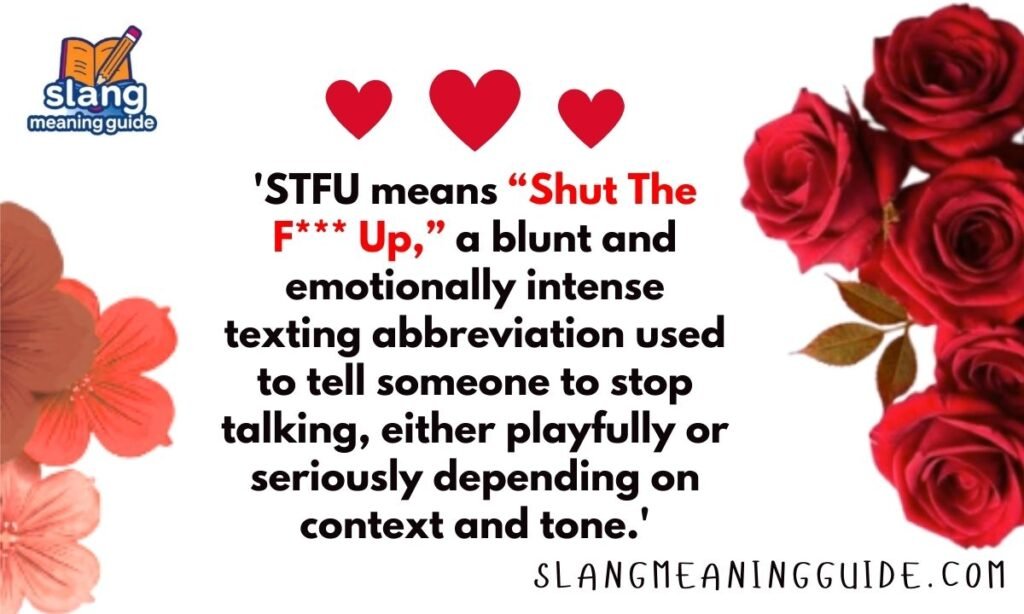
STFU Meaning in Text stands for “Shut The F*** Up” It is a blunt, direct, and often emotionally charged abbreviation used to tell someone to stop talking. While the phrase itself is strong, its meaning shifts depending on tone, relationship, and context.
In casual texting, STFU can range from playful teasing to serious frustration. Among close friends, it often appears in joking conversations where no offense is intended. In tense situations, however, it becomes a sharp expression of irritation or anger. Understanding this dual nature is critical for interpreting messages correctly.
Embedded examples:
- “STFU 😂 I can’t believe you actually did that.”
- “STFU, you’re being so loud right now.”
- “STFU! This argument is pointless.”
Social Media Usage of STFU Meaning in Text
On platforms like Instagram, TikTok, X, Reddit, and Facebook, STFU Meaning in Text shows up in comments, replies, memes, and DMs. Social media amplifies emotions, and STFU is often used for dramatic effect, humor, or exaggerated reactions.
In comment sections, STFU can express disbelief, sarcasm, or mock shock rather than direct hostility. In meme culture, it frequently appears as a humorous caption designed to exaggerate surprise or frustration. Still, tone can easily be misread, especially without emojis or context.
Embedded examples:
- “STFU, this video is unreal 😭”
- “STFU, no way that actually happened.”
- “STFU, you’re joking, right?”
Personal Chats and Private Conversations
In private chats, STFU Meaning in Text depends heavily on the relationship between sender and receiver. Among friends, siblings, or gaming teammates, it often functions as playful banter or exaggerated reaction. In more serious exchanges, it may signal genuine annoyance.
Because tone is harder to read in text, many people soften STFU with emojis, laughter markers, or extra words. This reduces the chance of misunderstanding and keeps the message lighthearted.
Embedded examples:
- “STFU 😂 you’re too funny.”
- “STFU, stop spoiling the movie!”
- “STFU, I’m trying to concentrate.”
Formal vs Informal Use of STFU Meaning in Text
STFU is strictly informal slang and should never appear in professional, academic, or formal communication. Its explicit nature and aggressive tone make it unsuitable for workplaces, schools, or official settings.
In professional environments, even joking use of STFU can harm credibility, cause offense, or escalate conflicts. Clear, respectful alternatives should always be chosen.
Comparison examples:
- Informal: “STFU, I’m busy right now.”
- Professional: “Please hold on, I’m tied up at the moment.”
- Academic: “Let’s pause this discussion for now.”
Common Misunderstandings About STFU Meaning in Text
One of the biggest misconceptions is assuming STFU always means anger or hostility. While it can express frustration, it is often used jokingly among close friends. Without tone indicators like emojis, the same message can be read in completely different ways.
Another misunderstanding is thinking STFU is harmless slang. In reality, its strong wording can easily offend, especially when used with strangers or in sensitive discussions.
Frequent misunderstandings:
- Assuming all STFU messages are jokes
- Thinking STFU is acceptable in professional chats
- Underestimating its emotional impact
Usage Tips for STFU Meaning in Text
Using STFU safely requires social awareness, emotional intelligence, and contextual judgment. When used carefully, it can add humor or emphasis. When misused, it can quickly damage relationships.
Smart usage tips:
- Use only with people who understand your humor.
- Pair with emojis to soften tone.
- Avoid during serious discussions.
- Never use in professional or academic settings.
Embedded examples:
- “STFU 😂 that plot twist was insane.”
- “STFU, I can’t stop laughing.”
- “STFU, you’re unbelievable.”
Emotional Context of STFU Meaning in Text
Emotionally, STFU carries strong intensity. It can express amusement, shock, disbelief, frustration, anger, or playful teasing. The emotional interpretation depends entirely on surrounding cues such as emojis, punctuation, and relationship history.
Because of this emotional range, STFU is powerful but risky. It can strengthen bonds through humor or damage them through perceived disrespect.
Emotional signals often conveyed:
- Playful disbelief
- Friendly teasing
- Sharp irritation
- Emotional overwhelm
Embedded examples:
- “STFU 😭 I’m crying laughing.”
- “STFU, that’s enough.”
- “STFU… seriously?”
Comparisons With Similar Abbreviations
Understanding similar slang helps clarify where STFU Meaning in Text fits within digital communication.
| Abbreviation | Full Form | Tone | Typical Usage |
| STFU | Shut The F*** Up | Blunt, emotional | Telling someone to stop talking |
| GTFO | Get The F*** Out | Aggressive | Shock, disbelief, anger |
| SMH | Shaking My Head | Mild disapproval | Disappointment or disbelief |
| LOL | Laugh Out Loud | Light, humorous | Amusement |
| FFS | For F***’s Sake | Frustrated | Impatience |
Key distinction: STFU directly commands silence, making it more confrontational than most abbreviations.
Practical Examples of STFU Meaning in Text
Real-life examples help illustrate how tone shifts meaning.
Friend chat:
- “STFU 😂 that story is wild.”
Sibling banter:
- “STFU, stop taking my snacks.”
Gaming lobby:
- “STFU and focus on the objective.”
Social media comment:
- “STFU, that ending shocked me.”
Argument context:
- “STFU, I’m done explaining.”
When to Avoid Using STFU Meaning in Text
There are many situations where STFU should not be used under any circumstances. Its bluntness can escalate tension, create misunderstandings, and harm reputations.
| Situation | Why to Avoid |
| Workplace messaging | Unprofessional and offensive |
| Emails | Violates professional tone |
| Academic settings | Disrespectful and inappropriate |
| Customer service chats | Damaging to brand image |
| Conversations with strangers | Easily misinterpreted |
Safer alternatives:
- “Please stop.”
- “Let’s pause this.”
- “Can we change the topic?”
Frequently Asked Questions
What does STFU Meaning in Text stand for?
It stands for “Shut The F*** Up”, used to tell someone to stop talking.
Is STFU always rude?
No, it can be playful among friends, but it is rude in formal or unfamiliar contexts.
Can STFU be funny?
Yes, when paired with humor or emojis, it often expresses playful disbelief.
Should STFU be used at work?
No, it is inappropriate for professional communication.
What is a polite alternative to STFU?
Use phrases like “please be quiet,” “let’s pause,” or “hold on a moment.”
Conclusion
Understanding STFU Meaning in Text is essential for navigating modern digital conversations. While the abbreviation can be humorous, playful, or expressive among friends, it also carries strong emotional weight and potential for offense. Context, tone, and relationship always determine how it will be received.
Used wisely, STFU can add humor and emphasis. Used carelessly, it can damage relationships and create unnecessary conflict. By understanding its meaning, emotional impact, and proper usage, you can communicate more clearly, confidently, and responsibly in today’s fast-moving digital world.