
Three letters. Endless confusion. One abbreviation that means completely different things depending on who sends it and when. TM quietly dominates digital conversations, yet most people only know half its story. Ready to finally crack the code?
Core Meanings Explained
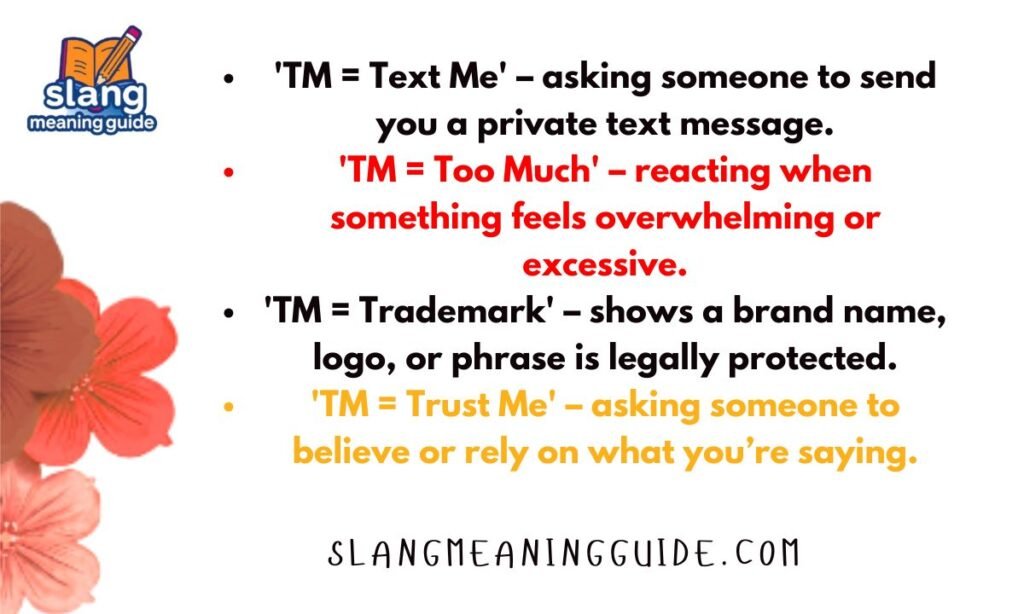
TM Means “Text Me”
“Text me” is the most popular meaning of TM in everyday casual texting. People drop it when they want someone to reach out privately instead of chatting in a group or public space. It feels direct, quick, and personal without being demanding.
- “I have something to tell you — TM when you’re free.”
- “Don’t reply here, just TM later.”
- “TM your address and I’ll head over.”
TM Means “Too Much”
“Too much” is another widely used meaning, especially when reacting to overwhelming information or dramatic behavior. You use it to signal that something has crossed a line or flooded your senses. It keeps the reaction short while still landing the point clearly.
- “That plot twist was TM for me honestly.”
- “She said TM in one message, I couldn’t keep up.”
- “Bro, TM information at once — slow down.”
TM Means “Trademark”
In legal and business contexts, TM stands for trademark, signaling that a name, logo, or phrase is legally protected intellectual property. You see it appear after brand names and product titles across websites, packaging, and marketing content. This usage is formal and universal across all industries.
- “Nike™ owns that swoosh logo outright.”
- “You can’t use that phrase — it has a TM attached.”
- “Always add TM after your brand name before filing officially.”
Origin + Evolution Timeline
TM started its digital life in early internet forums and SMS culture, where character limits forced people to compress language fast. “Text me” exploded in popularity when smartphones made texting the default communication method around 2007–2010.
Meanwhile, the trademark meaning predates digital culture entirely, rooted in 19th-century intellectual property law before migrating naturally into online business conversations.
| Term | Estimated Origin | Platform Where It Blew Up | Current Status |
| TM (Text Me) | Early 2000s SMS | iMessage & WhatsApp | Actively used |
| TM (Too Much) | Mid-2000s online forums | Twitter/X & Reddit | Widely used |
| TM (Trademark) | 1800s legal system | Business websites & LinkedIn | Universal use |
| TM (Trust Me) | Late 2000s texting | Snapchat & Instagram | Occasionally used |
Common Misunderstandings
The biggest trap with TM is assuming it always means “text me” when the sender might actually mean “too much” or “trust me.” Without reading the surrounding conversation, replies can go completely off track and confuse both sides. Paying attention to tone and topic eliminates the guesswork immediately.
| Slang | Common Misunderstanding | Correct Understanding |
| TM | Always refers to trademark | In texting, it usually means “text me” or “too much” |
| TM | Same as DM | DM means direct message; TM means text me specifically |
| TM | Only used in business contexts | TM is heavily used in casual everyday conversations |
| TM | Means “trust me” in all situations | “Trust me” is a less common usage depending on context |
Formal vs. Informal Uses
TM shifts personality completely depending on the setting you use it in. In a casual chat, it feels breezy and natural, but drop it into a professional email and it either signals a trademark or creates confusion. Matching the right version of TM to the right environment protects both your message and your credibility.
| Term | Informal Use | Formal/Professional Equivalent |
| TM (Text Me) | “TM when you land!” | “Please send me a message upon arrival.” |
| TM (Too Much) | “That’s TM info at once.” | “This exceeds the scope of our current discussion.” |
| TM (Trademark) | “That’s their TM logo.” | “That name is a registered trademark.” |
| TM (Trust Me) | “TM, it works every time.” | “Based on prior results, I’m confident this will work.” |
Comparisons With Similar Abbreviations
TM vs. DM — Both invite private conversation, but DM (direct message) applies to social media platforms while TM (text me) specifically points toward phone-based messaging.
HMU vs. TM — HMU (hit me up) is a broader, more casual invitation for any type of contact, while TM is more specific and expects a text message response directly.
TM vs. NGL — NGL (not gonna lie) builds into honesty before a statement, while TM used as “trust me” demands that trust upfront without offering any supporting context first.
TMI vs. TM — TMI (too much information) is the full spelled-out version with a specific oversharing connotation, while TM as “too much” applies more broadly to any overwhelming situation.
TM vs. LMKW — LMKW (let me know when) requests a timed update passively, while TM takes a more direct and immediate approach by asking for contact right away.
Frequently Asked Questions
What does TM mean in a text message?
TM most commonly means “text me” or “too much” depending on the conversation context.
Does TM mean trademark in texting?
Only in business or legal discussions — in casual texting, trademark is rarely the intended meaning.
Is TM the same as DM?
No — DM means direct message on social media, while TM specifically refers to sending a text message.
Can TM mean “trust me” in a conversation?
Yes, though less commonly — “trust me” appears in informal chats but is far less frequent than “text me.”
Is TM appropriate to use professionally?
Only the trademark meaning fits professional settings — “text me” and “too much” stay strictly casual.