

Have you ever seen “TTY” at the end of a message and paused for a second, wondering what the sender actually meant? In fast-moving digital conversations, short forms appear everywhere, and their meanings can shift depending on context. Some are obvious, others less so. TTY is one of those abbreviations that looks simple but carries layers of meaning, history, and usage that are worth understanding.
What Does TTY Mean in Text?
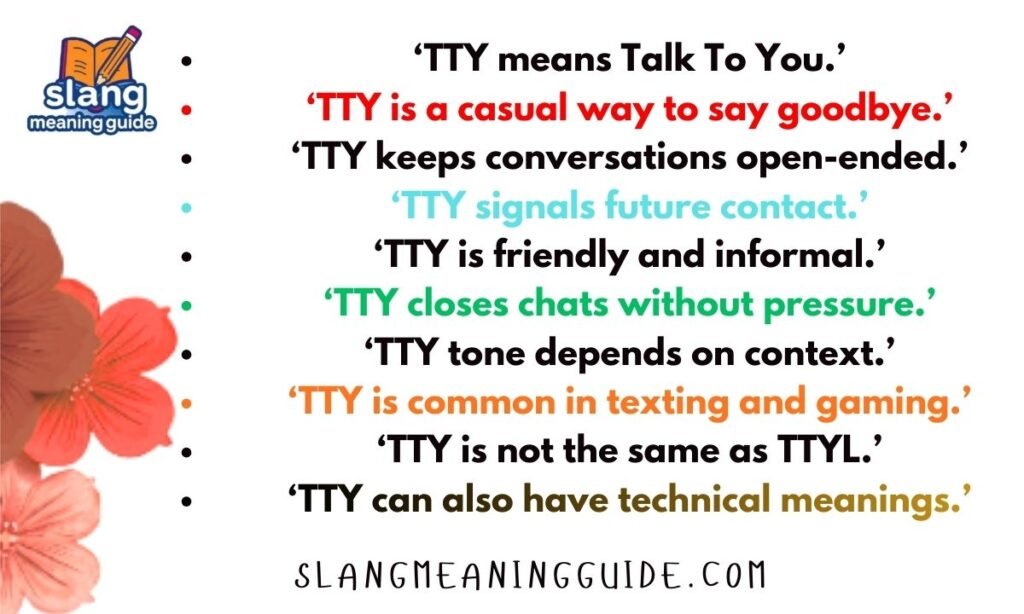
TTY most commonly stands for “Talk To You.”
It is used as a friendly and informal way to end a conversation while signaling the intention to reconnect later.
In everyday texting, TTY works as a polite sign-off. It keeps the tone warm, casual, and open-ended. Unlike more specific phrases, it does not commit to a particular time. It simply implies future contact.
Key idea: TTY = Talk To You, a relaxed way to say goodbye for now.
Simple Examples
- “Got to jump into a meeting, TTY!”
- “Heading out now. TTY soon.”
- “That sounds good. TTY.”
In each case, TTY communicates closure without finality.
TTY Origin, History, and Meaning
TTY has a layered history that spans more than a century, evolving from mechanical communication devices into modern digital slang. Its meaning depends heavily on context, ranging from assistive technology and computing to everyday texting.
Origin of TTY
The term TTY originally comes from “Teletypewriter,” a mechanical device developed in the early 1900s to transmit typed messages over electrical wires. These machines functioned like typewriters connected to telegraph systems, allowing people to send and receive written messages across long distances.
Early teletypewriters were widely used by:
- News agencies for rapid information sharing
- Government offices for secure communication
- Military organizations for strategic messaging
- Businesses for internal communication
Over time, TTY became the standard abbreviation for these machines.
Key line: The original meaning of TTY was purely technical and had nothing to do with texting or slang.
TTY and Accessibility History
In the 1960s and 1970s, TTY technology was adapted to help people who were deaf, hard of hearing, or speech-impaired communicate over standard telephone lines. This version became known as TDD (Telecommunications Device for the Deaf) but was still widely called TTY.
These devices allowed users to:
- Type messages during phone calls
- Communicate through relay services
- Access emergency and customer support systems
This development marked a major step forward in communication accessibility and inclusivity.
TTY in Computing History
As computers advanced, the term tty was adopted into Unix and Linux operating systems to describe text-based terminal sessions. These virtual terminals acted as modern equivalents of physical teletypewriters.
In computing, tty refers to:
- Command-line interfaces
- Virtual consoles
- Terminal sessions for system control and troubleshooting
This technical meaning remains common in programming, networking, and system administration today.
Emergence of TTY in Text Slang
In the late 1990s and early 2000s, TTY gained a new meaning in digital communication: “Talk To You.”
This shift happened because:
- SMS character limits encouraged abbreviations
- Typing on mobile keypads was slow
- Online chat platforms favored speed
Users naturally shortened common phrases, and “talk to you” became TTY for quick, friendly sign-offs.
Important insight: Modern texting slang reused the same letters but gave them a completely new meaning.
Modern Meaning of TTY
Today, TTY most commonly means “Talk To You” in texting, social media, and online chat. It is used as a polite, informal way to end a conversation while signaling future contact.
However, in technical, medical, and accessibility contexts, TTY still retains its original meaning related to teletypewriters and assistive communication devices.
Summary of TTY Evolution
- Early 1900s: Teletypewriter for wired communication
- 1960s–70s: Assistive device for the deaf and speech-impaired
- 1980s–Present: Unix/Linux terminal sessions
- 1990s–Present: Text slang meaning “Talk To You”
TTY’s journey reflects how language and technology evolve together, reshaping old terms to fit new forms of communication.
Why TTY Became Popular
The Rise of Texting Culture
Abbreviations like TTY grew popular in the late 1990s and early 2000s, when:
- SMS messages had strict character limits.
- Typing on numeric keypads was slow.
- Online chat platforms favored speed and brevity.
Users began shortening common phrases to save time and effort. Over time, these shortcuts became part of everyday digital language.
Influence of Chat Rooms and Instant Messaging
Early chat services such as AOL Instant Messenger and IRC rooms played a major role in spreading shorthand expressions. Fast-paced group chats made quick sign-offs necessary, and TTY fit that need perfectly.
Continued Relevance Today
Even with modern keyboards and voice input, abbreviations remain popular because:
- They feel casual and friendly.
- They reflect digital culture.
- They speed up communication.
TTY has survived because it is simple, intuitive, and emotionally neutral.
How TTY Is Used in Everyday Conversations
Casual Texting
In everyday messages with friends and family, TTY feels natural and warm.
Examples:
- “Busy right now, but TTY later!”
- “Let’s catch up soon, TTY.”
This usage keeps conversations light and friendly without sounding abrupt.
Social Media and Online Chat
TTY often appears in:
- Instagram DMs
- Snapchat messages
- Twitter replies
- Discord chats
It helps close conversations smoothly, especially in fast-moving environments.
Example:
- “Great talking with you! TTY 😊”
Work and Professional Chats
TTY can be used in informal workplace communication, such as Slack or Microsoft Teams, when the tone is relaxed.
Example:
- “I’ll review the file and TTY after lunch.”
However, in formal emails, it is usually better to use full phrases like:
- “I will follow up shortly.”
- “Let’s reconnect later.”
Gaming Communities
Gamers often use TTY when logging off or switching matches.
Examples:
- “Good game! TTY tomorrow.”
- “Got to bounce. TTY, squad.”
In gaming, it signals both courtesy and continuity.
Understanding the Tone Behind TTY
Tone matters in text-based communication, where voice and facial cues are missing. TTY is generally neutral and polite, but its emotional tone depends on context.
Friendly and Warm
- “Had fun chatting. TTY soon!”
Neutral and Practical
- “Meeting starting now. TTY.”
Slightly Distant (Depending on Context)
- “Okay. TTY.”
This last example can sound brief or cold if not supported by prior context. Emojis or extra words often soften the tone.
TTY vs Similar Abbreviations
TTY vs TTYL
- TTY: Talk To You
- TTYL: Talk To You Later
Difference:
TTYL explicitly suggests a later time, while TTY remains more open-ended.
TTY vs TTYS
- TTYS: Talk To You Soon
TTYS implies a quicker follow-up, often within the same day.
TTY vs TTFN
- TTFN: Ta-Ta For Now
TTFN is more playful and carries a British tone.
TTY vs BRB
- BRB: Be Right Back
BRB suggests a temporary pause, while TTY indicates a longer break.
Important line: TTY closes a conversation gently without locking in a timeline.
Common Misunderstandings About TTY
“TTY Means Text To You”
This is incorrect.
TTY stands for Talk To You, not “text to you.”
“TTY Is Rude or Dismissive”
While TTY itself is neutral. The surrounding words determine the tone.
- “Busy now, TTY later!” feels polite.
- “Ok. TTY.” can feel abrupt without context.
“TTY Is Outdated”
While older, TTY remains widely used across platforms, especially in casual settings.
Context-Dependent Meanings of TTY
Although “Talk To You” is the dominant meaning, TTY can also carry technical or niche interpretations.
Teletypewriter and Accessibility Context
TTY historically refers to Teletypewriter, also known as TDD (Telecommunications Device for the Deaf).
These devices allow individuals with hearing or speech impairments to communicate by typing messages over phone lines.
Key uses include:
- Accessibility services
- Emergency communication
- Relay-based phone conversations
In healthcare, customer support, and government services, TTY still appears in accessibility notices.
Unix and Linux Computing Context
In computing, tty refers to a terminal session in Unix-based operating systems.
Examples:
- Virtual consoles
- System-level terminals
- Debugging environments
In this context, tty has nothing to do with texting slang.
Gaming Slang Variations
In some gaming communities, tty may occasionally appear as shorthand for phrases like “toxic try hard.”
This usage is:
- Rare
- Informal
- Community-specific
Most of the time, in gaming chats, TTY still means “Talk To You.”
How to Respond to TTY
Responding appropriately depends on context and tone.
Casual Replies
- “Sounds good! TTY!”
- “Cool, catch up later.”
Friendly or Playful Replies
- “Don’t forget me 😄 TTY!”
- “Alright, talk soon!”
Professional Replies
- “Understood. I will follow up.”
- “Thanks, speak later.”
Tip: Mirror the sender’s tone for smoother communication.
TTY in Online Dating and Social Apps
TTY is common in dating apps such as Tinder, Bumble, and Hinge.
Why It Works Well
- Polite ending
- Keeps the conversation open
- Avoids awkward silence
Example:
- “This was fun chatting. TTY soon 😊”
In dating, TTY signals interest without pressure.
Cultural and Regional Usage
English-Speaking Countries
TTY is most common in:
- United States
- United Kingdom
- Canada
- Australia
Non-English Regions
TTY appears less frequently, as local languages use different shorthand systems. However, English texting slang is spreading through social media and gaming communities.
Is TTY Appropriate for Professional Use?
When It Works
- Informal team chats
- Quick internal messages
- Friendly workplace environments
When to Avoid It
- Formal business emails
- Client communications
- Official documents
Professional alternatives:
- “I will follow up shortly.”
- “Let’s reconnect later today.”
Psychological Role of Abbreviations Like TTY
Short forms do more than save time. They also shape emotional tone.
They Reduce Social Friction
TTY helps end conversations without sounding abrupt.
They Maintain Social Warmth
Even brief closings feel polite and considerate.
They Reflect Group Belonging
Using common shorthand signals familiarity with digital culture.
Linguistic Evolution of Text Abbreviations
Texting shorthand follows natural language patterns:
- Long phrases become shortened.
- Short forms become normalized.
- Some disappear, others persist.
TTY survived because:
- It is intuitive.
- It mirrors spoken language.
- It carries emotional neutrality.
TTY in Comparison With Other Digital Sign-Offs
| Term | Meaning | Tone |
|---|---|---|
| TTY | Talk To You | Friendly, neutral |
| TTYL | Talk To You Later | Casual, relaxed |
| TTYS | Talk To You Soon | Warm, positive |
| BRB | Be Right Back | Temporary pause |
| GTG | Got To Go | Urgent exit |
This shows how TTY occupies a middle ground between casual warmth and practical closure.
Best Practices for Using TTY
- Use it in informal settings.
- Avoid it in formal writing.
- Pair it with friendly words if tone matters.
- Do not overuse it in professional contexts.
Important reminder: Clarity always beats convenience in professional communication.
Frequently Asked Questions
What does TTY mean in texting?
It means “Talk To You,” a casual way to end a conversation politely.
Is TTY rude or dismissive?
No, its tone depends entirely on the surrounding message.
Can TTY be used in professional chats?
Yes, but only in informal work conversations, not formal emails.
Is TTY the same as TTYL?
No, TTYL specifically means “Talk To You Later,” while TTY is more open-ended.
Does TTY have technical meanings?
Yes, it can refer to teletypewriters or Unix terminal sessions in technical contexts.
Final Thoughts
TTY may look like a small, simple abbreviation, but it plays a meaningful role in modern communication. It softens goodbyes, keeps conversations friendly, and reflects the speed of digital interaction. Understanding its tone, context, and alternatives helps you communicate more clearly and confidently. Whether in casual chats, gaming sessions, or light workplace messaging, using TTY correctly keeps conversations smooth and natural.