
It appears simple. Just a small pause in text.
Yet it often says more than a full sentence.
Sometimes it signals hesitation. Other times, discomfort.
So what does “uhm” really mean when someone types it?
What Does “Uhm” Mean in Texting?
“Uhm” is a text-based hesitation sound. It reflects a moment where someone pauses before speaking or responding.
In digital conversations, it often signals uncertainty, awkwardness, or careful thinking. Unlike direct replies, it softens the tone and adds a human feel.
- It can show hesitation → “Uhm… I’m not sure.”
- It can signal awkwardness → “Uhm… that’s weird.”
- It may express doubt → “Uhm, really?”
- It can soften a response → “Uhm, maybe later.”
- It sometimes delays a direct answer
Because it mimics real speech, it makes messages feel more natural.
Core Meanings Explained
Hesitation Before Speaking
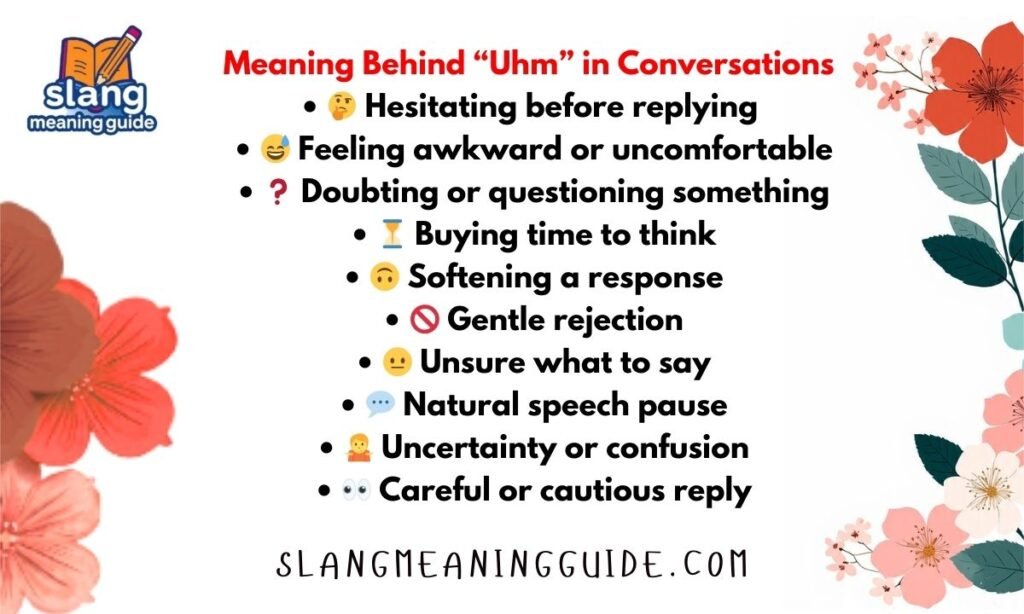
This is the most common use of “uhm.” It indicates a pause before giving a response. It often appears when someone is unsure or needs time to think.
- “Uhm… I need to check that.”
- “Uhm, give me a second.”
- “Uhm… I’m thinking.”
- “Uhm, let me see.”
This version is neutral and natural.
Uncertainty or Doubt
“Uhm” frequently shows that the person is not fully convinced. It softens disagreement without sounding harsh.
- “Uhm… are you sure?”
- “Uhm, I don’t think so.”
- “Uhm… that seems off.”
- “Uhm, maybe not.”
It keeps the tone polite.
Awkwardness or Discomfort
In some situations, “uhm” signals social discomfort. It often appears in unexpected or slightly tense moments.
- “Uhm… that’s awkward.”
- “Uhm, what just happened?”
- “Uhm… okay then.”
- “Uhm… I didn’t expect that.”
This use reflects emotional reaction.
Soft Rejection
“Uhm” is often used to decline something gently. It avoids sounding too direct or harsh.
- “Uhm… I can’t make it.”
- “Uhm, maybe another time.”
- “Uhm… I’ll pass.”
- “Uhm, not today.”
It helps maintain politeness.
Delaying or Buying Time
Sometimes “uhm” is used just to delay a response. It gives the speaker a moment to think or decide.
- “Uhm… let me think.”
- “Uhm, I’ll get back to you.”
- “Uhm… not sure yet.”
- “Uhm, give me a minute.”
This keeps the conversation flowing.
Origin + Evolution Timeline
“Uhm” comes from natural spoken language. People have used hesitation sounds like “um” and “uh” for centuries. With the rise of texting, these sounds moved into written communication to preserve conversational tone.
Timeline Overview
| Term | Estimated Origin | Platform Where It Blew Up | Current Status |
| Um/Uh | Spoken language (ancient) | Everyday speech | Universal |
| Uhm | Early texting (2000s) | SMS, MSN Messenger | Common |
| Umm | Chat culture expansion | WhatsApp, Facebook | Widely used |
| Uhhhh | Social media era | TikTok, Twitter/X | Expressive variation |
Today, “uhm” remains a widely used informal expression across all messaging platforms.
Common Misunderstandings
“Uhm” is often misunderstood because it lacks clear intent. People may interpret it differently depending on mood and context.
- It may sound rude when it is just hesitation
- It can feel awkward even when neutral
- It may seem dismissive without meaning to
- It can be mistaken for sarcasm
- It sometimes appears passive-aggressive
Context and tone always shape its meaning.
Formal vs. Informal Uses
“Uhm” is primarily informal and rarely used in professional communication. In formal settings, clear and direct language replaces hesitation sounds.
Usage Comparison Table
| Term | Informal Use | Formal/Professional Equivalent |
| Uhm | “Uhm… not sure.” | “I am uncertain.” |
| Uhm… | “Uhm… let me think.” | “Let me consider this.” |
| Umm | “Umm, maybe.” | “Possibly.” |
| Uhm okay | “Uhm okay.” | “Understood.” |
| Uhm? | “Uhm?” | “Could you clarify?” |
Clear wording improves professionalism and reduces confusion.
Comparisons With Similar Abbreviations
Understanding “uhm” becomes easier when compared with similar expressions.
- Uhm vs. Hmm — Uhm shows hesitation, while hmm shows thinking or reflection.
- Uhm vs. Uh — Uhm is softer and more polite, while uh feels abrupt.
- Uhm vs. Um — Both mean the same, but uhm looks more expressive in text.
- Uhm vs. Eh — Uhm shows uncertainty, eh signals indifference.
- Uhm vs. Oh — Uhm shows hesitation, oh shows realization.
These differences affect tone and interpretation.
When to Use “Uhm” Effectively
Using “uhm” correctly depends on the situation. It works best in casual and friendly conversations.
- Use it to soften responses
- Use it when you need time to think
- Use it to avoid sounding too direct
- Avoid overusing it in serious discussions
- Avoid using it in professional communication
Balance ensures clarity and tone.
When to Avoid “Uhm”
There are situations where “uhm” can create confusion. Clear communication becomes more important in these cases.
- Work emails and formal chats
- Important decisions
- Serious discussions
- Conflict situations
- Professional presentations
Direct language is always better here.
Psychological Meaning of “Uhm”
“Uhm” reflects natural human thinking patterns. It shows a pause between thought and speech.
It can indicate:
- Cognitive processing
- Emotional hesitation
- Social politeness
- Uncertainty
- Mild discomfort
This makes conversations feel more human and relatable.
Frequently Asked Questions
What does “uhm” mean in texting?
It shows hesitation, uncertainty, or a pause before responding.
Is “uhm” rude?
No, but it can feel awkward depending on context.
What is the difference between “uhm” and “um”?
They mean the same, but “uhm” often feels more expressive.
Can “uhm” be used professionally?
No, it is best avoided in formal communication.
Why do people use “uhm” in texts?
To mimic natural speech and soften their responses.
Conclusion
“Uhm” may look small, but it carries subtle meaning. It adds tone, hesitation, and emotion to digital conversations. Used wisely, it improves communication.