
You’ve seen it in a text, a DM, maybe even a caption. Three letters, no punctuation, sent like it’s obvious. But if you had to explain it right now — could you? Most people can’t. And that gap between seeing a word everywhere and actually knowing how to use it is exactly where confusion lives.
Let’s fix that.
What Does WYS Mean?
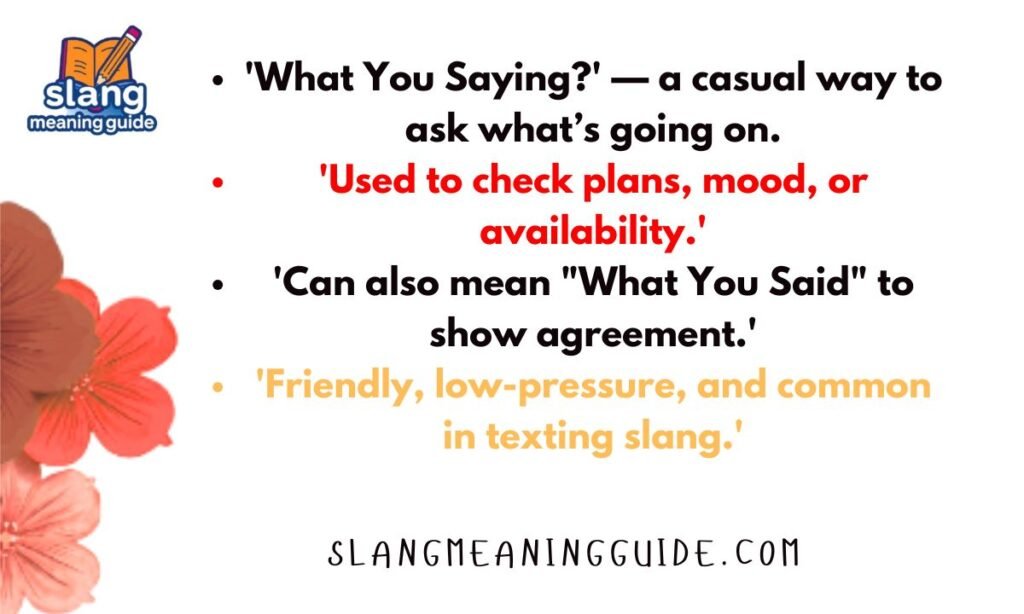
WYS stands for “What You Saying?” — a casual way of asking someone what’s going on, what their plans are, or whether they’re down for something. It’s the text equivalent of leaning over to a friend and saying, “So, what’s the move?”
In most contexts, WYS works as both a greeting and a question. It’s short, low-effort, and signals that the conversation is meant to be relaxed. You’re not asking for a detailed report. You’re just checking in.
There’s also a secondary meaning worth knowing: “What You Said” — used when someone is confirming or agreeing with a point that was just made. This version is less common but does appear, particularly in comment sections and casual back-and-forth threads.
Quick breakdown:
- Primary meaning: What You Saying? (checking in, asking about plans)
- Secondary meaning: What You Said (agreement or confirmation)
- Tone: Casual, friendly, low-pressure
When used as “What You Said,” it’s usually written as a statement — not a question — and depends heavily on context. Without tone or punctuation, it can be misunderstood.
WYS Examples in Real Conversations
Seeing slang in context is the fastest way to understand it. Here’s how WYS actually shows up in everyday chats.
WYS with Friends
Jake: Yo wys tonight?
Mia: Nothing yet, might go to the mall. You?
Jake: Pull up, we linking at 8.
Here, WYS replaces “what are you doing tonight?” It’s quicker and more natural among people who talk regularly.
WYS in a Flirty Context
Alex: Haven’t heard from you in a while… wys?
Jordan: Lol nothing much, just been thinking about you tbh
In this case, WYS opens the door without being too forward. It’s a low-stakes way to restart a conversation with someone you’re interested in.
WYS as Agreement
Person A: That movie was actually fire, way better than the first one. Person B: WYS, exactly what I told everyone.
This is the “What You Said” version — agreeing with something and echoing it back.
WYS vs Similar Slang: What’s the Difference?
A lot of short slang overlaps in meaning. Here’s how WYS compares to similar terms you’ve probably seen.
| Slang | Stands For | Meaning | Tone |
| WYS | What You Saying? | Checking in / asking plans | Casual, friendly |
| WYD | What You Doing? | Similar to WYS, more direct | Neutral to flirty |
| WYA | Where You At? | Asking location | Urgent or casual |
| WYO | What You On? | What are you up to / what’s your vibe | Very casual, Gen Z |
| WTF | What The F*** | Shock, confusion, frustration | Strong reaction |
The difference between WYS and WYD is subtle but real. WYD asks what you’re literally doing right now. WYS is broader — it’s asking what you’re saying about your plans, your mood, your situation And leaves more room for conversation to go anywhere.
WYS Origin and Popularity
Some trace its roots to early-2000s British youth slang — before texting abbreviations made it global.
While WYS grew out of Black American slang and spread through social media and texting culture, following the same path as most internet shorthand. It became more visible around the mid-2010s as texting abbreviations got shorter and more clipped.
By the time TikTok took off, WYS was already embedded in how younger people texted. Comment sections, Snapchat, and Instagram DMs kept it alive. Urban Dictionary has multiple entries for it, with the earliest definitions pointing to the “What You Saying?” meaning.
Interestingly, WYS also has regional weight in UK slang, where “what you saying?” was already a common phrase in London street talk before it crossed over into American digital culture. Some researchers trace it back to British youth culture from the early 2000s, long before it went online.
In Pakistan and South Asian diaspora communities, WYS has also picked up as a borrowed phrase, mostly through social media influence. It doesn’t carry a local-origin meaning there — it’s used the same way it’s used globally, just absorbed into how people text in Urdu-English mixed conversations (sometimes called “Urdish”).
How to Use WYS Correctly
WYS is simple to use, but context matters. Get this wrong and it lands awkward.
Use WYS when:
- You’re checking in casually with a friend
- You want to ask about plans without sounding too formal
- You’re restarting a conversation after a gap
- You want to express agreement with something someone said (secondary use)
Avoid WYS when:
- You’re messaging someone professionally or semi-formally
- You’re talking to someone older who might not know the term
- You want a specific answer — WYS can be too vague and get a vague response back
Tips for Using It Naturally
Don’t overthink it. WYS works best when it’s spontaneous. If you’re crafting a message around it, it stops feeling casual. Just drop it the way you’d say it out loud.
Also, pay attention to who you’re sending it to. WYS signals familiarity. Sending it cold to someone you barely know can feel presumptuous, or worse, confusing. Save it for people you already have a relaxed dynamic with.
If you’re using it for agreement (“WYS, exactly”), make sure the context makes it clear — otherwise the person might think you’re asking them a question when you’re actually agreeing with them.
Final Words
WYS is three letters doing a lot of social work. It asks “what’s going on?” without demanding an answer. It restarts conversations and confirms agreement. And depending on your circle, it might just be the most natural opener you can send.
Now you know what it means, where it came from, and exactly how to use it. Go ahead — drop it in a chat and see what happens.