
You’ve probably seen IDT pop up in a text, comment, or group chat and paused for a second. It looks simple, yet its meaning can shift with tone, context, and platform. Understanding it properly can instantly make your digital conversations smoother and more natural.
In this in-depth guide, we’ll explore what IDT means in texting, how it’s used across platforms, when it works, when it doesn’t, and how to respond confidently. Whether you’re new to texting slang or just want a clearer understanding, this article gives you everything you need.
IDT Meaning in Texting
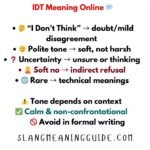
IDT slang meaning: I Don’t Think.
In texting, IDT is a short and casual way to express doubt, uncertainty, or mild disagreement. Instead of typing the full phrase “I don’t think,” people shorten it to IDT to save time and keep conversations flowing naturally.
It often appears when someone wants to soften a negative response or avoid sounding too blunt. Compared to a direct “no,” IDT feels lighter, more polite, and more conversational.
In everyday messaging, IDT works as a quick reaction, a gentle refusal, or a thoughtful hesitation. Its simplicity makes it ideal for fast-paced chats where clarity and speed matter.
Examples in natural texting:
- “IDT I can make it tonight, I’m exhausted.”
- “IDT that plan will work.”
- “IDT so, but let’s see.”
In all of these, IDT helps express uncertainty without sounding harsh or dismissive. This balance is one of the main reasons it remains popular in texting culture.
IDT Meaning on Social Media
On social media, what does IDT mean in texting expands slightly in tone and expression. While the meaning stays the same, its emotional nuance becomes more flexible.
On platforms like Instagram, TikTok, X (Twitter), Snapchat, and Facebook, IDT is often used to:
- Share opinions
- Express doubt politely
- React to trends or opinions
- Softly disagree in comment threads
Because social media is public and tone-sensitive, IDT is useful for disagreeing without triggering arguments. It allows users to share a skeptical view while maintaining a friendly or humorous tone.
Social media examples:
- “IDT this trend is for me, but it’s funny.”
- “IDT that movie deserves the hype.”
- “IDT they meant it that way.”
Here, IDT acts as a social softener. Instead of challenging someone aggressively, it gently presents an alternative viewpoint.
IDT Meaning in Personal Chats
In personal conversations, IDT becomes even more expressive. It reflects mood, emotion, and subtle social cues. People often use IDT in one-on-one chats to avoid sounding cold, dismissive, or overly direct.
This is where emotional tone matters most. IDT can signal:
- Hesitation
- Polite disagreement
- Thoughtful doubt
- Emotional sensitivity
In close friendships, IDT often communicates hesitation without emotional tension. For example, if someone invites you out and you reply with “IDT I can,” it signals regret rather than rejection. This keeps the relationship warm while still being honest. The abbreviation softens the message, making it sound considerate instead of abrupt.
In emotional or relationship-based conversations, IDT allows room for vulnerability. Saying “IDT I’m ready for that yet” feels more reflective than firm. It opens space for understanding rather than confrontation. This is why IDT has become so common in personal texting. It fits naturally into modern communication where tone matters just as much as content.
Personal chat examples:
- “IDT I’m in the mood today.”
- “IDT that’s what he meant.”
- “IDT I’m ready for that step yet.”
Formal vs Informal Usage of IDT
IDT is primarily informal. It works well in casual texting, social media, and friendly workplace chats, but it should be avoided in formal communication.
In professional emails, academic writing, official reports, or client communication, abbreviations like IDT may appear unprofessional or unclear. In these settings, it’s better to use the full phrase or a more polished alternative.
Instead of:
- “IDT this is correct.”
Use:
- “I don’t believe this is correct.”
- “I’m not certain this is accurate.”
This keeps your tone professional, respectful, and clear.
Usage Safety Table
| Context | Is IDT Appropriate? | Recommendation |
| Casual texting | Yes | Use freely |
| Social media comments | Yes | Use with tone awareness |
| Personal chats | Yes | Ideal usage |
| Gaming chats | Yes | Common and effective |
| Workplace team chats | Sometimes | Use based on company culture |
| Professional emails | No | Use full sentences |
| Academic writing | No | Avoid slang |
Common Misunderstandings About IDT
One of the biggest misconceptions is that IDT means “I Didn’t Think.” While grammatically possible, this is not the accepted slang meaning. In modern texting, IDT almost always stands for “I Don’t Think.”
Another misunderstanding is confusing IDT with IDK. While both express uncertainty, they are not interchangeable.
- IDT expresses doubt or opinion.
- IDK expresses lack of knowledge.
There is also a misconception that IDT sounds rude. In reality, it often softens disagreement. However, when used without context or tone indicators, it may feel abrupt.
For example:
- “IDT.” by itself can seem dismissive.
- “IDT so 😅” feels friendly and light.
Tone, emojis, and context help shape how IDT is received.
Usage Tips for IDT in Everyday Communication
Using IDT effectively depends on clarity, context, and emotional tone. Here are practical guidelines:
- Add context to avoid sounding abrupt
- Use emojis when tone may be unclear
- Avoid using IDT alone without explanation
- Match the emotional tone of the conversation
Bullet-point style examples:
- Friendly: “IDT so, but maybe tomorrow 😊”
- Neutral: “IDT that’s the right option.”
- Playful: “IDT you’re ready for that challenge 😂”
- Gentle refusal: “IDT I can tonight, I’m wiped.”
These variations help maintain natural flow while keeping communication respectful.
Emotional Context Behind Using IDT
IDT is more than just shorthand. It carries emotional weight. It allows speakers to express doubt while remaining empathetic.
In emotionally sensitive conversations, people often avoid absolute statements. IDT provides emotional flexibility. It suggests uncertainty rather than firm opposition, which makes responses feel less confrontational. This is particularly important in relationships, friendships, and group dynamics where tone directly affects harmony.
In moments of hesitation, vulnerability, or reflection, IDT communicates emotional awareness. Saying “IDT I’m ready” feels introspective and considerate. It opens dialogue instead of closing it. This emotional nuance is why IDT remains widely used even as texting language continues to evolve.
Comparisons With Similar Abbreviations
IDT is part of a broader ecosystem of texting slang. Understanding how it compares to similar abbreviations helps you choose the right one.
| Abbreviation | Meaning | Emotional Tone | Best Use |
| IDT | I Don’t Think | Thoughtful doubt | Expressing uncertainty |
| IDK | I Don’t Know | Neutral uncertainty | Lack of knowledge |
| IMO | In My Opinion | Confident perspective | Sharing viewpoints |
| TBH | To Be Honest | Direct honesty | Truthful reactions |
| IDC | I Don’t Care | Indifference | Disinterest |
Each abbreviation carries a distinct emotional tone. IDT is unique because it balances uncertainty with politeness.
Practical Examples of IDT in Real Conversations
Here are real-life scenarios showing how IDT fits naturally into modern communication.
Casual texting:
- A: “You think it’ll rain?”
- B: “IDT so, the sky’s clear.”
Social media:
- “IDT this update actually fixed the issue.”
Gaming:
- “IDT we’ll win without better gear.”
Friendly disagreement:
- “IDT that’s the best approach, but I see your point.”
These examples show how flexible and practical IDT is across different platforms and contexts.
When to Avoid Using IDT
Despite its usefulness, IDT is not always appropriate. Avoid using it when:
- Writing professional emails
- Communicating with clients or supervisors
- Submitting academic assignments
- Discussing sensitive or serious topics
In such situations, full sentences offer clarity and professionalism. Replacing IDT with complete phrases ensures your message is taken seriously and understood correctly.
Frequently Asked Questions
What does IDT mean in texting?
It means “I Don’t Think.”
Is IDT considered slang?
Yes, it’s informal texting and online slang.
Can IDT sound rude?
Rarely, but tone and context matter.
Is IDT acceptable at work?
Only in casual internal chats, not formal communication.
Does IDT have other meanings?
In technical contexts, it can mean different things, but in texting it almost always means “I Don’t Think.”
Conclusion
IDT is a simple yet powerful piece of modern digital language. It stands for “I Don’t Think” and allows people to express uncertainty, doubt, and mild disagreement in a natural, friendly way. From texting and social media to gaming chats and casual workplace conversations, IDT fits seamlessly into everyday communication.
Understanding IDT slang meaning helps you interpret messages accurately, respond confidently, and maintain the right emotional tone. When used thoughtfully, IDT enhances clarity, reduces conflict, and keeps conversations flowing smoothly.
As texting culture continues to evolve in 2026 and beyond, abbreviations like IDT remain essential tools for fast, expressive, and human digital communication.