
You’ve seen it pop up in texts, tweets, and TikTok captions — but do you really know what it means? It’s one of those abbreviations that slips into conversation so naturally, most people never stop to question it. Stick around, because understanding this term might change the way you communicate forever.
IRL Meaning in Texting
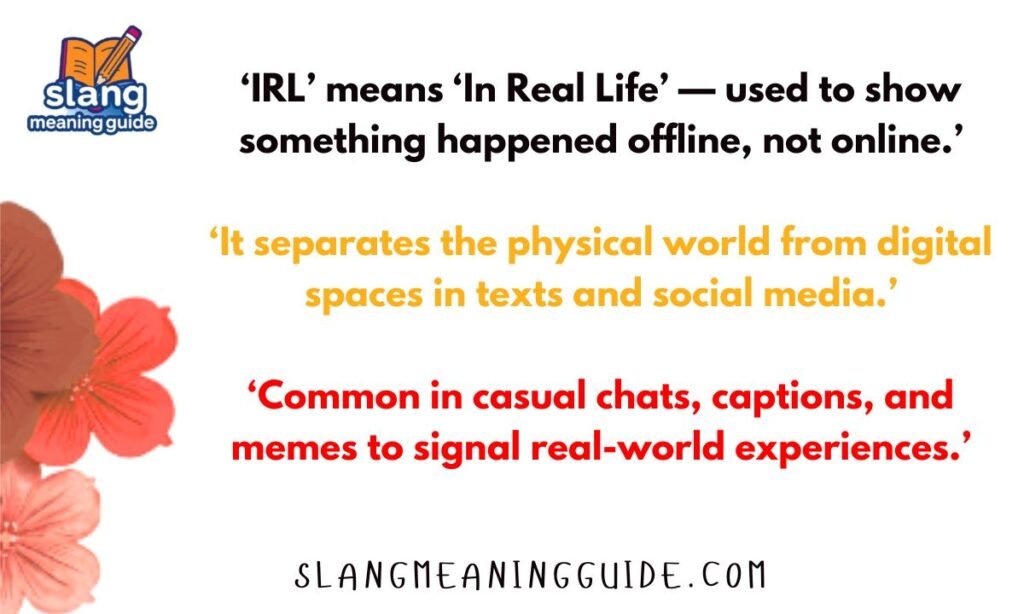
IRL stands for “In Real Life.” It’s a shorthand expression used in digital communication to distinguish between the physical, offline world and the virtual or online space. When someone says they met a friend IRL, they mean the encounter happened face-to-face, not through a screen or digital platform.
The term carries significant weight in modern communication because it acknowledges the growing divide between our digital identities and our physical existence.
Texters use IRL to ground conversations in reality, signal authenticity, or contrast online behavior with how someone actually acts in person. It’s short, punchy, and immediately understood across generations.
| Term | Full Form | Context |
| IRL | In Real Life | Offline, physical world |
| URL | Uniform Resource Locator | Online web address |
| AFK | Away From Keyboard | Temporarily offline |
| IRL meet | In-person meeting | Face-to-face encounter |
The Origin of IRL in Text Slang
The abbreviation IRL emerged in the early days of the internet, specifically within online forums, IRC (Internet Relay Chat) channels, and bulletin board systems during the late 1980s and early 1990s. As digital communities began forming, users needed a quick way to refer to their offline lives, and IRL filled that gap perfectly. It was a natural linguistic response to the rise of a parallel digital existence.
By the early 2000s, IRL had migrated from niche tech communities into mainstream internet culture. With the explosion of social media, smartphones, and text messaging, the term became a staple of everyday digital conversation. Its simplicity — just three letters — made it perfect for the fast-paced, character-limited world of texting and early Twitter posts.
Social Media Usage: Snapchat, TikTok, and Instagram
IRL appears constantly across social platforms, but its tone and usage shift slightly depending on where you are. Here’s how it breaks down across the major platforms:
Snapchat: Users write captions like “This happened IRL 😂” to validate funny or surprising moments as genuine, not staged.
TikTok: Creators use IRL in video titles and comments to signal that content was filmed in real life rather than simulated, edited, or fictional. The phrase “IRL streamer” has become its own content genre on TikTok and Twitch.
Instagram: Influencers caption posts with “IRL vs. online” to create relatable content around the gap between curated online aesthetics and real-world appearance.
Twitter/X: Users tweet things like “I cannot believe this happened IRL” to express disbelief about real-world events mirroring online absurdity.
Reddit: Subreddits use IRL in post titles to distinguish personal anecdotes from hypothetical or fictional discussions.
Each platform adds a layer of cultural nuance to IRL. On TikTok, it signals raw authenticity. On Instagram, it often carries a self-deprecating or humorous tone. Understanding the platform context helps you use IRL with precision and social fluency.
Formal vs. Informal Use of IRL
IRL is firmly rooted in informal communication. You would not use it in a business email, academic paper, or professional report. Its natural habitat is text messages, social media captions, online gaming chats, and casual group conversations. Using it in formal writing signals a lack of professional awareness.
That said, IRL has begun appearing in semi-formal digital spaces like internal workplace messaging apps (Slack, Teams) or startup culture communications where informal language is normalized. In these contexts, it reads as casual and approachable rather than unprofessional. The key is knowing your audience and reading the communication culture of the environment you’re in.
| Context | Use IRL? | Alternative |
| Professional email | ❌ No | “In person” or “face-to-face” |
| Text to a friend | ✅ Yes | N/A |
| Social media caption | ✅ Yes | N/A |
| Academic writing | ❌ No | “In the physical world” |
| Slack with colleagues | ⚠️ Depends | “Offline” or “in person” |
| Online gaming chat | ✅ Yes | N/A |
Common Misunderstandings About IRL
One of the most frequent misunderstandings is people confusing IRL with a judgment — as if calling something “IRL” implies that online experiences are less real or less valid. That’s not the intent.
IRL simply differentiates the physical domain from the digital one, without assigning greater importance to either. Online relationships, communities, and events are real — they just exist in a different space.
Another misconception is thinking IRL is outdated or only used by older internet users. In fact, younger Gen Z users have actively reclaimed and reinvigorated the term through TikTok’s IRL streaming trend, meme culture, and platform-specific humor. The term continues to evolve rather than fade, proving its staying power in digital language.
Usage Tips and Emotional Context
The emotional weight behind IRL can vary significantly based on how it’s used. In some cases, it carries excitement — “We finally met IRL!” — suggesting a meaningful transition from online friendship to physical connection. In other cases, it carries irony or humor — “Imagine acting like that IRL” — poking fun at online behavior that wouldn’t fly in person.
Here are practical tips for using IRL effectively:
- Pair it with contrast: IRL lands best when you’re drawing a clear line between online and offline — “She’s totally different IRL.”
- Use it for validation: “This actually happened IRL” adds credibility to surprising stories.
- Avoid ambiguity: In complex sentences, spell out “in real life” to prevent confusion for audiences unfamiliar with the abbreviation.
- Match platform tone: Use IRL freely on TikTok and Snapchat; use it cautiously on LinkedIn or formal community boards.
Comparisons With Similar Abbreviations
IRL belongs to a broader family of internet abbreviations that help users navigate the line between digital and physical reality. Understanding where IRL fits alongside these terms sharpens your overall digital communication vocabulary.
AFK (Away From Keyboard): Signals a temporary offline absence, unlike IRL which references the offline world broadly.
OG (Original/Original Gangster): Used to describe something authentic but doesn’t reference physical vs. digital space.
TBH (To Be Honest): Signals candor, sometimes overlapping with IRL when someone is being raw and unfiltered.
IMO/IMHO: Expresses opinion rather than physical reality.
F2F (Face to Face): A direct synonym for IRL in the context of physical meetings, though less commonly used today.
Practical Examples of IRL in Sentences
Seeing IRL in context makes it far easier to use correctly and confidently. The term slots into sentences naturally once you understand its function as a spatial or experiential marker.
- “I’ve been talking to her online for months — we’re finally meeting IRL next weekend.”
- “His personality is so much better IRL than on his profile.”
- “This meme is funny, but imagine if this happened IRL.”
- “I learned coding online, but applying it IRL was a different challenge.”
- “Their friendship started in a game but turned into something real IRL.”
When to Avoid Using IRL
Avoid IRL in any professional, academic, or formal context where abbreviations undermine credibility. If you’re writing a cover letter, submitting a report, or communicating with someone outside your generational or digital peer group, default to “in person” or “in the real world” instead. Not everyone recognizes the term, and confusion breaks communication.
Also avoid IRL when discussing emotionally sensitive topics where clarity matters more than brevity. Saying “I struggle with this IRL” in a support group setting might feel flippant or vague. In those moments, full sentences demonstrate respect, empathy, and seriousness — values that three-letter abbreviations simply can’t convey.
Frequently Asked Questions
What does IRL mean in texting?
IRL means “In Real Life” — used to refer to the offline, physical world as opposed to online spaces.
Is IRL only used by young people?
No — IRL is used across age groups, though it’s especially common among millennials and Gen Z online.
Can IRL be used in professional settings?
Generally no — opt for “in person” or “face-to-face” in formal or professional communication.
Where did IRL come from?
IRL originated in internet chat rooms and forums during the late 1980s and early 1990s.
Is IRL the same as F2F?
They overlap — both reference physical, in-person interaction — but IRL is broader and far more commonly used today.