
You just received a message that says “SYM” — and now you’re stuck. Does it mean something rude? A friendly goodbye? Or something else entirely? This guide breaks down every meaning of SYM in text, so you never misread it again.
What Does SYM Mean in Text?
SYM is a text abbreviation with more than one meaning. The correct interpretation depends entirely on who sent it and what the conversation was about. In 2026, SYM meaning in text ranges from casual farewells to sharp comebacks — and knowing the difference matters.
SYM Basic Definition in Online Chat
SYM most commonly stands for “Shut Your Mouth” in online chat. It is used as a quick, punchy response — either jokingly between friends or harshly during an argument.
The abbreviation became part of digital language in the early 2000s, when SMS messaging pushed people to shorten everything. Phrases like “shut your mouth” were already common in spoken English, so trimming them into three letters felt natural and fast.
SYM in Messaging Apps and Social Media
On platforms like WhatsApp, Instagram, Snapchat, and TikTok, SYM travels across millions of conversations every day. Some users use it as a quick jab. Others drop it as a casual goodbye or a playful tease.
The same three letters can carry completely different energy depending on the platform, the emoji attached, and the relationship between the two people texting. A message with “SYM 😂” reads very differently from one that just says “SYM.” full stop.
Why People Use SYM in Text
People use SYM because digital communication rewards speed. Three letters replace an entire phrase, and the tone gets filled in by context. It is punchy, brief, and flexible — which is exactly what modern chat culture demands.
Younger users especially prefer short-form slang because it keeps conversations moving fast. SYM fits perfectly into that style, whether it is landing a punchline or wrapping up a conversation.
Most Common SYM Text Meanings in 2026
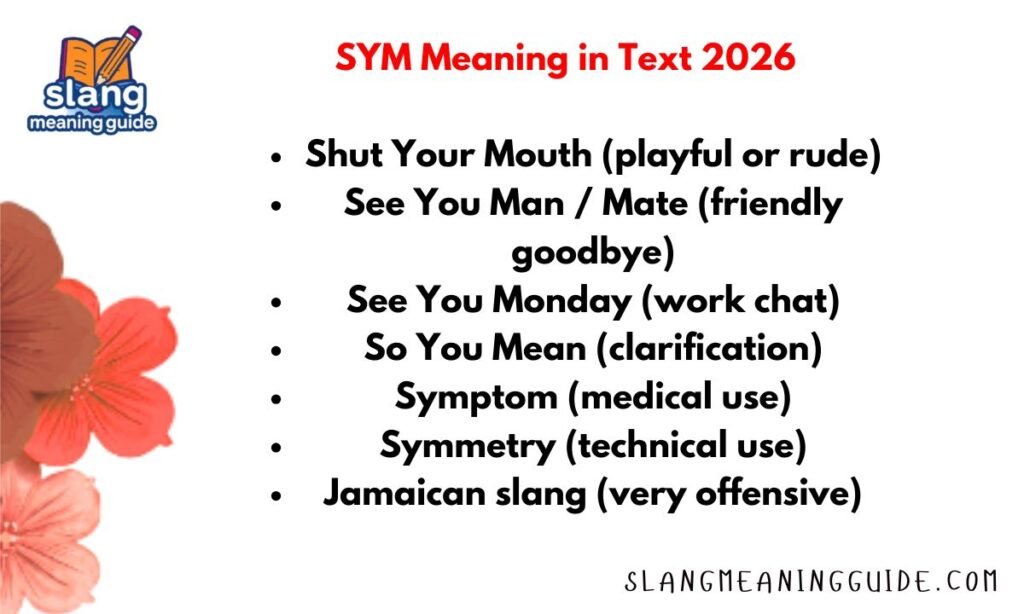
SYM does not have just one meaning. In 2026, several interpretations circulate across different platforms and communities. Understanding each one helps you decode the message correctly — and respond without embarrassing yourself.
SYM Meaning 1: “Shut Your Mouth”
This is the most widespread meaning of SYM in text and on social media. It carries a tone of silencing someone — playfully or seriously, depending on context.
Between close friends, it works as light teasing. Someone brags, the other fires back “SYM.” It lands as a joke. But in a heated argument or with a stranger, the same three letters can come across as rude and disrespectful. Always read the room before using this one.
SYM Meaning 2: “See You Man” or “See You Mate”
SYM also works as a casual goodbye. “See You Man” or “See You Mate” are both common uses, especially in British English texting culture and informal group chats among friends.
This version of SYM carries zero aggression. It is warm, quick, and friendly. If someone wraps up a conversation with “SYM 👋,” they are almost certainly saying goodbye — not telling you to be quiet.
SYM Meaning 3: “See You Monday” or “So You Mean”
In workplace chats and school group threads, SYM sometimes stands for “See You Monday.” It works as a quick sign-off at the end of the week, especially on Friday afternoons.
“So You Mean” is a less common but still relevant interpretation. People use it to ask for clarification in a conversation — essentially asking someone to confirm or explain what they just said.
SYM as “Shut Your Mouth” — Slang Use Explained
“Shut Your Mouth” is the version of SYM most people encounter first. It is direct, emotionally charged, and loaded with tone.
The way it lands depends almost entirely on how it is delivered and who is saying it.
When SYM Means “Shut Your Mouth”
SYM lands as “Shut Your Mouth” most often when someone says something shocking, embarrassing, or overly dramatic. A friend reveals a wild secret — you reply “SYM, no way!” It feels funny. It feels right.
The abbreviation also appears in arguments when someone wants to shut down a conversation fast. In those situations, it is not playful at all. It carries the full weight of the phrase it represents.
Playful vs. Offensive: Reading the Tone
The line between playful and offensive is thin with SYM. Emojis make a massive difference. “SYM 😂” reads as a joke. “SYM.” with nothing else reads as cold and dismissive.
The relationship between the people involved matters just as much. Close friends can toss SYM back and forth without anyone flinching. Between strangers or in formal settings, the same word can cause real offense.
How to Respond to SYM as “Shut Your Mouth”
If someone sends you SYM as a joke, lean into the humor. Reply with something like “okay fine 😅” or match their energy with your own comeback.
If the message feels aggressive or disrespectful, stay calm. You can ask directly: “Why are you telling me to shut up?” Setting a clear boundary is always the right move. Do not escalate unless you are certain it was intended as a joke.
SYM as a Friendly Farewell
Not every SYM comes loaded with attitude. A large portion of SYM usage in text is simply someone saying goodbye.
This version of SYM is warmer, lighter, and carries a completely different energy from the “Shut Your Mouth” interpretation.
SYM as “See You Man” or “See You Mate”
“See You Man” and “See You Mate” are both friendly, informal farewells. They feel personal. They signal that the sender values the conversation and plans to continue it later.
This version is popular in British, Australian, and Caribbean texting culture. It adds a touch of camaraderie that a simple “bye” lacks. If the conversation has been positive, this is almost certainly the meaning behind the SYM.
SYM as “See You Monday” for Work Chats
In professional but informal settings — think Slack channels, team WhatsApp groups, or coworker texts — SYM often means “See You Monday.” It wraps up the end-of-week chat with efficiency.
It is still casual. Nobody sends SYM in a formal email or a work report. But in a quick group thread with colleagues you actually like, it fits perfectly as a Friday afternoon sign-off.
SYM as “So You Mean” in Conversation Replies
When someone wants to confirm or clarify something, SYM sometimes acts as shorthand for “So You Mean.” It pops up in the middle of a conversation rather than at the end.
Think of it as a quick way to paraphrase back what someone said. “SYM you want to meet at 6, not 7?” It seeks confirmation without writing out the full phrase. This meaning is less common but worth knowing.
Context Matters: How to Know What SYM Means
The same abbreviation carries completely different meanings depending on context. There is no universal decoder for SYM — you have to read the situation.
Fortunately, there are reliable signals that point you in the right direction almost every time.
Look at the Relationship and Tone
Start with who sent the message. A close friend, a coworker, or a stranger all have different communication styles. A close friend using SYM almost certainly means it playfully. A stranger doing the same deserves more caution.
Also look at the overall tone of the conversation. Has it been light and funny? SYM is probably a joke or a goodbye. Has it been tense or argumentative? SYM might be aggressive.
Check Previous Messages Before SYM
Read the messages that came just before the SYM. If someone was sharing good news and then got “SYM,” it is likely a playful reaction. If someone was making a serious point and got “SYM” in return, that is probably dismissive.
Context does not just mean the relationship — it means the actual flow of the conversation in the moments leading up to the abbreviation.
SYM in Group Chats vs. Direct Messages
In group chats, SYM tends to be more performative. People use slang to entertain the group, not just communicate with one person. “Shut Your Mouth” in a group chat often plays to the crowd.
In a direct message, SYM carries more personal weight. It is a one-on-one exchange, so the tone feels more direct and deliberate. A DM with SYM deserves more careful interpretation than the same word tossed into a noisy group thread.
Is SYM Formal or Slang? Tone and Appropriateness
SYM is internet slang — full stop. It does not belong in formal writing, professional emails, or official documents. But within casual communication, it operates on a wide spectrum.
Knowing where the line sits helps you avoid using it at the wrong moment.
SYM as Internet Slang
SYM emerged from the same wave of abbreviations that gave us LOL, BRB, and SMH. It lives in the world of casual digital communication. On TikTok, Instagram, Discord, and WhatsApp, it feels at home.
Like most internet slang, SYM shifts meaning across communities and cultures. What feels playful in one group can feel offensive in another. That flexibility is exactly what makes it slang rather than standard language.
SYM in Professional Communication
Using SYM at work is risky. In informal team chats among people who know each other well, it might pass. But in any communication with a manager, client, or colleague you do not know personally, SYM meaning in text could easily be misread.
Stick to clear, professional language when there is any doubt. The potential for misunderstanding is simply not worth it.
Other Possible Meanings of SYM in Text and Online
Beyond the most common interpretations, SYM carries additional meanings in specific communities and professional fields.
Being aware of these saves you from confusion when SYM appears in an unexpected context.
SYM as a Prefix in English
The prefix “sym-” comes from Greek and means “together” or “with.” It appears in everyday words like symmetry, sympathy, and symphony. While this is not a texting meaning, it helps explain why SYM can double as shorthand in academic or scientific writing.
Understanding the root also makes it easier to recognize when SYM is being used in a technical sense rather than a slang sense.
SYM in Medical and Scientific Terms
Healthcare professionals sometimes use SYM as shorthand for “symptom” in clinical notes or documentation. A doctor might write “SYM: fever, fatigue” to summarize a patient’s reported issues quickly.
In physics, SYM can represent “symmetry” — a concept describing balance in equations, forces, and particles. In engineering and aviation, it sometimes stands for “symmetrical” when describing design features or system components.
SYM in Jamaican Patois and Vulgar Forms
In Jamaican Patois, SYM carries a vulgar meaning that is considered one of the harshest insults in that linguistic community. It is used aggressively to dismiss or curse at someone.
This usage appears on platforms like TikTok and Urban Dictionary. If you encounter SYM in a conversation involving Caribbean slang or Jamaican culture, the meaning is likely very different from the standard text abbreviations covered above. Approach with caution.
Quick Reference: SYM Meanings at a Glance
| Meaning | Context | Tone |
| Shut Your Mouth | Casual chat, social media | Playful or aggressive |
| See You Man / See You Mate | Friendly farewells | Warm, informal |
| See You Monday | Work or school chats | Casual, professional-ish |
| So You Mean | Mid-conversation clarification | Neutral |
| Symptom | Medical documentation | Technical |
| Symmetry | Physics / engineering | Technical |
| Jamaican Patois (vulgar) | Caribbean slang culture | Extremely offensive |
Frequently Asked Questions
What does SYM mean in text messages?
The Most Common Answer
SYM most often means “Shut Your Mouth” in casual text messages.
But It Depends on the Conversation
Context shifts the meaning — it can also mean “See You Man,” “See You Monday,” or “So You Mean.”
Is SYM considered rude?
When Used as “Shut Your Mouth”
SYM can be rude, but tone and relationship determine whether it lands as a joke or an insult.
When Used as a Goodbye
As “See You Man” or “See You Mate,” SYM is entirely friendly and carries no offense.
What does SYM mean on TikTok and Instagram?
Platform-Specific Usage
On TikTok and Instagram, SYM most frequently appears as “Shut Your Mouth” used humorously in comments and reactions.
Jamaican Patois Version
On these platforms, SYM also appears in Jamaican cultural content with a completely different and explicitly vulgar meaning.
Can SYM be used in professional settings?
Generally No
SYM is internet slang and does not belong in formal emails or professional documents.
Exception in Informal Work Chats
Among close colleagues on platforms like Slack or WhatsApp, “See You Monday” is an acceptable casual use.
How is SYM different from SMH?
Different Actions, Different Meanings
SYM tells someone to stop talking; SMH (“Shaking My Head”) expresses disappointment or disbelief.
Similar Category, Different Energy
Both are informal text abbreviations, but SMH is passive while SYM is more direct and commanding.
Conclusion
SYM meaning in text is not one-size-fits-all — it shifts based on tone, platform, and relationship. The most common meaning in 2026 is “Shut Your Mouth,” but “See You Man,” “See You Monday,” and technical uses all exist alongside it. Read the context first, respond accordingly, and you will never misread a SYM again.