
You’ve seen it pop up in a text, a comment section, or maybe a DM — and you paused. Three letters, zero context. What does MYB actually mean, and why are people throwing it around so casually? Before you send the wrong reply or completely misread the tone of a conversation, you need to know exactly what this abbreviation carries with it. The answer might surprise you more than you think.
MYB Meaning in Texting
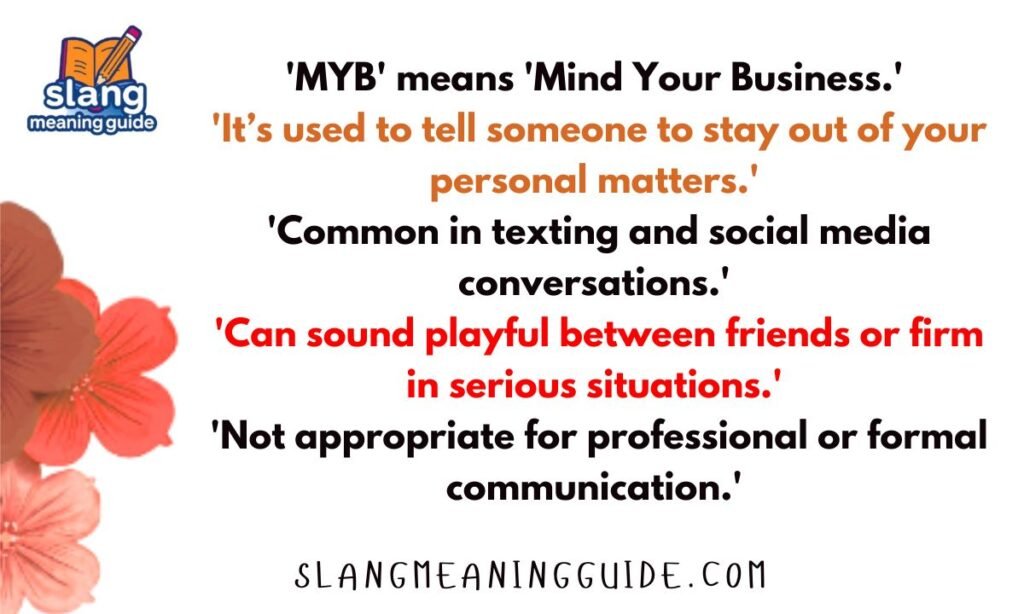
MYB stands for Mind Your Business. It’s a direct, punchy way of telling someone to stay out of your personal affairs without writing out the full phrase. People use it in casual text conversations when they feel someone is being nosy, overstepping, or asking questions that aren’t their concern.
The abbreviation packs a confident, assertive tone into three letters. It can land as playful banter between close friends or as a sharp, serious boundary-setting response depending on the context. Understanding the tone behind MYB is just as important as knowing what the letters stand for.
Examples in texting:
- “Why are you always asking about my plans? MYB.”
- “I’m handling it. MYB and let me figure it out.”
- “She literally texted MYB when I asked about her relationship 😭”
The Origin of MYB in Text Slang
MYB grew out of the broader internet culture of abbreviating common phrases to save time and typing effort. The phrase “mind your business” has been part of everyday English for centuries, but its shortened form became popular alongside the rise of SMS texting in the early 2000s, when character limits made brevity essential.
As smartphone use expanded and platforms like Twitter introduced character restrictions, short-form language exploded. MYB became part of a wider family of attitude-driven slang abbreviations designed to express personality and emotion quickly.
It sits alongside phrases like MYOB (Mind Your Own Business), which predates it and was common in office and written communication as far back as the 1950s.
MYB on Social Media: Snapchat, TikTok, and Instagram
MYB thrives on social media where tone is stripped from voice and reactions happen in real time. Each platform uses it a little differently.
- Snapchat: Used in snaps and chats when someone is prying into another person’s life or asking about streaks, relationships, or drama.
- TikTok: Appears in comment sections when creators or viewers feel someone is making unsolicited judgments about their choices or lifestyle.
- Instagram: Common in DMs and comment replies, especially when someone responds to a story with a question the poster considers intrusive.
- Twitter/X: Used as a clapback in replies, often paired with emojis to either soften or sharpen the message.
Social media also amplifies MYB because posts invite public commentary by default. When someone feels a comment crosses a line, MYB is a fast, recognizable way to push back without writing a paragraph. It’s become a staple response in online boundary-setting culture.
Formal vs. Informal Use of MYB
| Context | Appropriate? | Notes |
| Text message to a friend | Yes | Casual and widely understood |
| Social media comment reply | Yes | Common and expected in informal spaces |
| Work email or Slack | No | Comes across as rude and unprofessional |
| Customer service chat | No | Avoid entirely |
| Dating app conversation | Situational | Depends on rapport and tone |
| Group chat with family | Situational | Can cause offense if misread |
MYB belongs in informal, personal communication. In professional environments, the same sentiment should be expressed as “I’d prefer to keep that private” or “That’s outside the scope of what I can share.” Using MYB at work risks damaging your credibility and professional relationships.
In personal conversations, even among friends, delivery matters. A lighthearted “MYB 😂” lands very differently than a blunt “MYB.” sent without context. The punctuation and presence or absence of an emoji can completely shift how the recipient reads it.
Common Misunderstandings About MYB
Many people confuse MYB with MYOB, but there’s a subtle difference. MYOB (Mind Your Own Business) is older and more formal, while MYB is newer, shorter, and carries a slightly sharper, more modern edge. Some people also mistakenly read MYB as “maybe” in fast typing, which can cause genuine confusion in a conversation.
Another misunderstanding involves intent. Not every use of MYB is hostile. Between close friends, it often functions as playful teasing rather than a genuine boundary statement. Context, relationship, and surrounding messages are everything when interpreting this abbreviation.
Common misread scenarios:
- Someone reads MYB as aggressive when it was meant as humor
- Auto-correct changes MYB to “my b” (my bad), shifting the meaning entirely
- Non-native English speakers may not recognize it and feel confused or dismissed
Comparisons With Similar Abbreviations
| Abbreviation | Full Phrase | Tone | Common Use |
| MYB | Mind Your Business | Direct, assertive | Texting, social media |
| MYOB | Mind Your Own Business | Slightly more formal | Text, older internet slang |
| NMY | None of My Business | Humble, self-aware | Self-referencing moments |
| NOYB | None of Your Business | Blunt, firm | Confrontational replies |
| GOMB | Get Off My Back | Frustrated, fed up | Casual venting |
MYB is the most streamlined of these options. It’s faster to type than MYOB, less aggressive than NOYB, and more universally recognized than GOMB. If you want to set a boundary without escalating a conversation, MYB hits the right balance in most casual settings.
Practical Examples of MYB in Conversation
Seeing MYB in action is the fastest way to understand how it works across different dynamics.
Friend to friend:
- “Are you still talking to Jake?” → “MYB lol, we’re just friends.”
Social media comment:
- “Why would you quit your job like that?” → “MYB and let people live 🙄”
Sibling text:
- “Mom says you came home late again.” → “Tell mom MYB 😭”
Group chat:
- “Who did you vote for?” → “MYB, that’s private.”
These examples show how MYB shifts from playful to serious depending on the relationship and surrounding context. The same three letters serve entirely different emotional purposes in each scenario.
When to Avoid Using MYB
Avoid MYB whenever the relationship or setting calls for measured, respectful communication. Using it with someone older, in a professional context, or during a sensitive conversation can come across as dismissive or rude even if that’s not your intention.
Also avoid MYB if you’re trying to de-escalate a conflict. It tends to close conversations down rather than open them up, which is useful sometimes but harmful when someone genuinely needs dialogue. Choose your words based on the outcome you want from the exchange.
Frequently Asked Questions
What does MYB mean in a text?
MYB means “Mind Your Business” — a quick way to tell someone to stay out of your personal affairs.
Is MYB rude?
It can be, but between friends it often reads as playful rather than hostile.
What’s the difference between MYB and MYOB?
MYOB is slightly older and more formal; MYB is shorter and carries a sharper, more modern tone.
Can MYB be used positively?
Yes — in the right friendship dynamic, it functions as lighthearted banter rather than a serious rebuke.
Should I use MYB at work?
No — it’s inappropriate in professional settings and should be replaced with polite, clear language.