
You saw it in a message, blinked, and moved on. But now it’s bothering you. Three letters, no context, and the person who sent it has moved on to the next topic. Before you reply with “what?”, let’s break down exactly what TMP means, where it came from, and how to use it without looking out of the loop.
What TMP Means in Texting
The most common meaning of TMP in everyday texting is “Text Me Please.”
It’s a short, low-pressure way of asking someone to reach out. Instead of saying “hey, send me a message when you’re free,” you just drop TMP and keep it moving.
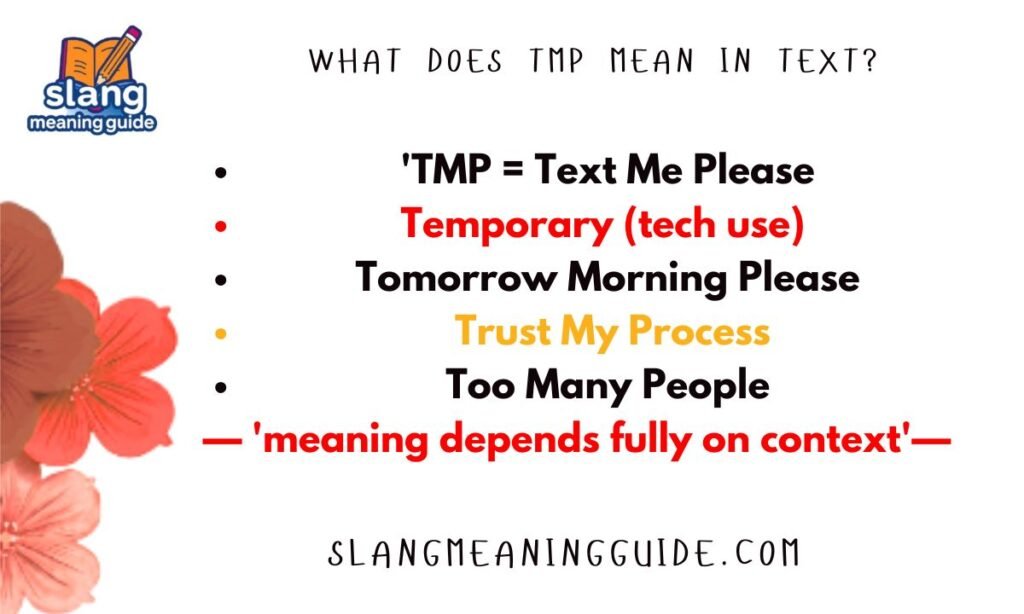
But that’s not the only meaning. Context changes everything with this one:
- Text Me Please – “I’m driving, TMP later.”
- Temporary – Used in tech and gaming contexts.
- Tomorrow Morning Please – Common in work chats.
- Trust My Process – Popular in fitness and motivation communities.
- Too Many People – Used when a place or event is overwhelmed.
The default assumption, unless the conversation says otherwise, is always “Text Me Please.”
Where TMP Came From
TMP doesn’t have a single founder or origin moment. It evolved gradually across SMS, forums, and instant messaging platforms in the early 2000s when shorter was faster and faster was better.
The “text me” generation needed ways to signal availability and contact preference without typing full sentences. TMP fit that gap naturally. It didn’t go viral overnight. It spread quietly, user by user, the way most digital shorthand does.
The technical meaning of TMP, short for temporary files, has roots in programming and has existed far longer than the slang version. The two meanings simply coexist today because context keeps them from colliding most of the time.
How TMP Is Used on Social Media Platforms
TMP shows up across multiple platforms, and the meaning shifts slightly depending on where you are.
- Used in DMs and story replies
- Almost always means “Text Me Please”
- Example: “Loved your post, TMP ❤️”
Snapchat
- Appears in quick replies and streaks
- Often flirty or friendly in tone
- Example: “I’ll be free at 6, TMP”
TikTok
- Seen in comment sections responding to creators
- Can mean “text me” or sometimes “too many people” on crowded events
- Example: “Live event looks insane, TMP if you’re going”
WhatsApp and iMessage
- Most personal and direct use
- Used between close contacts who already understand each other’s shorthand
- Example: “Can’t talk right now, TMP later”
The platform doesn’t change the core meaning much, but the relationship between the people messaging does.
Formal vs. Informal Use of TMP
Understanding when TMP is appropriate is just as important as knowing what it means.
| Context | Use of TMP | Better Alternative |
| Texting friends | ✅ Totally fine | — |
| DMs with influencers | ✅ Acceptable | — |
| Work Slack (casual team) | ⚠️ Depends on company culture | “Message me later” |
| Professional email | ❌ Avoid | “Please reach out at your convenience” |
| Academic writing | ❌ Never | “Contact me directly” |
| Client communication | ❌ Avoid | “Feel free to send a message” |
In casual conversation, TMP is efficient and natural. In formal settings, it looks unprofessional and can confuse anyone not familiar with current texting shorthand.
Common Misunderstandings About TMP
People get TMP wrong more often than you’d think. Here’s what most people assume versus what it actually means:
| Misunderstanding | What People Think | What It Actually Means |
| TMP = Temperature | Weather or tech data | Not a common text meaning |
| TMP = Time | Asking about time | Not standard in texting |
| TMP = Too Much Pressure | Emotional overwhelm | Rare; usually “Too Many People” |
| TMP = Team Member | Work shorthand | Not a recognized text abbreviation |
| TMP = Template | Document contexts | Only in very niche settings |
The biggest mistake is assuming context when there isn’t enough of it. If you’re not sure which TMP someone used, just ask. It’s faster than guessing wrong.
How TMP Compares to Similar Abbreviations
TMP sits in a family of shorthand that all revolves around messaging and contact. Here’s how they compare:
- TMP vs. HMU – Both mean “reach out to me,” but HMU (Hit Me Up) is more casual and social. TMP is softer and more neutral.
- TMP vs. DM Me – DM Me specifies a platform. TMP is channel-agnostic and works across any messaging app.
- TMP vs. LMK – LMK (Let Me Know) asks for a response. TMP asks for the conversation to happen at all.
- TMP vs. TBH – These are completely different. TBH is an honesty opener, TMP is a contact request. They get confused occasionally because of similar letter patterns.
- TMP vs. TMR – TMR means “tomorrow.” TMP is not time-specific unless it stands for “Tomorrow Morning Please,” which requires context to confirm.
When to Use TMP and When to Avoid It
Using TMP well means knowing its limits.
Use TMP when:
- You’re texting someone you know well
- You want a low-effort way to stay connected
- The platform is casual and conversational
- You’re too busy to talk but want the conversation to continue
Avoid TMP when:
- You’re messaging someone professionally for the first time
- The other person is older and not familiar with texting shorthand
- Clarity is more important than speed
- You’re writing anything that will be read by more than one person
The emotional context of TMP is usually warm. When someone sends it, they’re not shutting down the conversation. They’re leaving the door open and handing you the key.
Real Examples of TMP in Conversations
Casual between friends:
A: “You free tonight?” B: “In class right now, TMP when I’m out.”
Flirty context:
A: “Had fun today 😊” B: “Same, TMP later tonight.”
Fitness motivation:
A: “You’ve been at this for weeks and nothing’s changed.” B: “I know it’s slow, but TMP.”
Tech context:
A: “Where should I save the test files?” B: “Drop them in the TMP folder for now.”
Work chat:
A: “Need the report before the meeting.” B: “On it. TMP by 9am.”
Each of these uses a different meaning of TMP, and every single one is readable because the context does the heavy lifting.
The Bottom Line on TMP
TMP is a small word with a flexible meaning. In most text conversations, it means “Text Me Please.” And In tech and programming, it means temporary. In motivational circles, it means trust the process. In office chats, it can flag a tomorrow morning deadline.
The key is always context. Read the conversation before the TMP, and the meaning usually becomes obvious. If it doesn’t, asking is always the right move. Shorthand is only useful when both people are reading it the same way.
Now you know. TMP someone about it.