
You’ve read it in tweets, group chats, and captions. It slips into sentences so naturally that most people never stop to question it. But PPL carries more layers than you’d expect — and knowing exactly what it means changes how you read every message that contains it.
Core Meanings Explained
PPL Means “People”
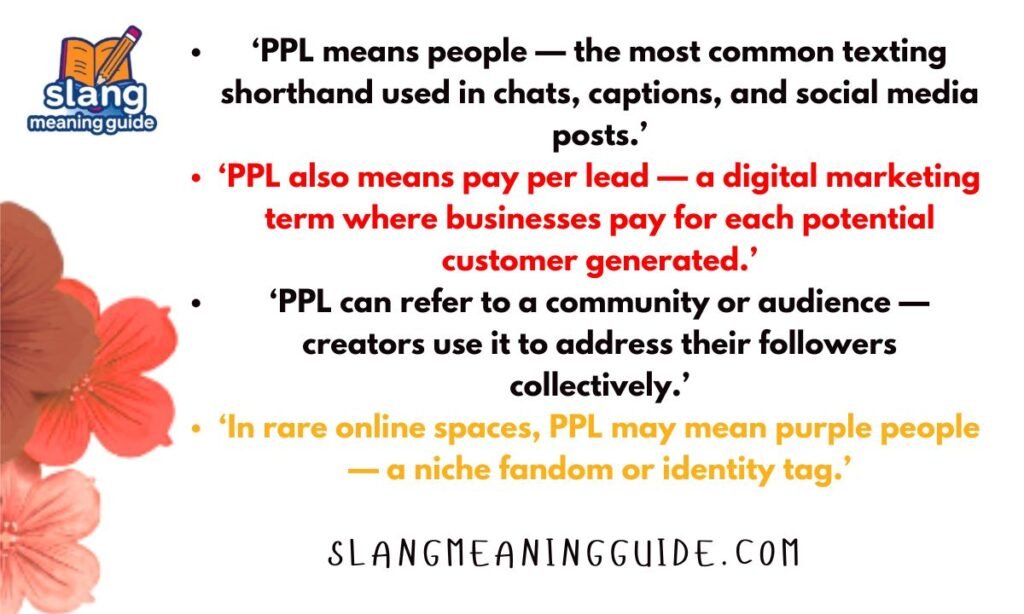
“People” is the overwhelmingly dominant meaning of PPL across all texting platforms. It replaces the full word to save time while keeping the sentence completely natural and readable. You’ll find it in casual observations, complaints, compliments, and everything in between.
- “Why do ppl always text late at night?”
- “Some ppl just don’t get it and never will.”
- “The ppl at that party were actually so cool.”
PPL Means “Pay Per Lead”
In digital marketing and business conversations, PPL stands for “pay per lead,” a pricing model where advertisers pay for each potential customer generated. Marketers, freelancers, and agency professionals use this version regularly in professional chats and emails. It feels completely out of place in casual texting but dominates business communication channels.
- “Our PPL campaign is generating strong results this quarter.”
- “The client wants a PPL model instead of flat fee.”
- “PPL rates dropped after we refined the target audience.”
PPL Means “Purple People” or Community Tags
In niche online communities, gaming spaces, and fandom groups, PPL sometimes functions as a community identifier or shorthand tag for a specific group. Streamers and content creators use it to reference their audience collectively. It builds a sense of belonging and shared identity within digital communities.
- “Shoutout to my PPL watching from the UK tonight.”
- “PPL in the comments — what should I play next?”
- “My PPL always show up when it counts, love you all.”
Origin + Evolution Timeline
PPL as a shorthand for “people” traces back to early 2000s AOL Instant Messenger and SMS culture, where every saved character mattered on tiny screens and numeric keypads. The abbreviation spread naturally through MySpace, then exploded on Twitter where character limits made short forms essential for fitting ideas into 140 characters.
Today PPL flows freely across every platform without anyone blinking, while its business meaning developed independently inside marketing and sales industries throughout the 2010s.
| Term | Estimated Origin | Platform Where It Blew Up | Current Status |
| PPL (People) | Early 2000s AIM & SMS | Twitter & Facebook | Universal everyday use |
| PPL (Pay Per Lead) | Mid-2000s digital marketing | LinkedIn & marketing forums | Standard business term |
| PPL (Community tag) | Late 2010s streaming culture | Twitch & YouTube comments | Active in creator spaces |
| PPL (Purple People) | Niche fandom communities | Tumblr & Discord servers | Limited niche use |
Common Misunderstandings
The most common trap with PPL is reading it as a marketing term when someone just casually means “people” in a text message. A friend venting about “ppl at work” is not discussing a pay-per-lead advertising model. Context resolves everything — casual conversation almost always means people, while business threads almost always mean pay per lead.
| Slang | Common Misunderstanding | Correct Understanding |
| PPL | Could mean pay per lead in any context | PPL means “pay per lead” only in business or marketing discussions |
| PPL | Too informal to appear in professional settings | PPL as pay per lead is completely standard in marketing communication |
| PPL | Only used by teenagers online | PPL spans all age groups and professional industries equally |
| PPL (People) | Sounds uneducated or lazy | It’s efficient shorthand, not a reflection of writing ability |
Formal vs. Informal Uses
PPL as “people” belongs entirely in casual, informal communication and would look out of place in any professional document or formal email. However, PPL as “pay per lead” flips the script completely — it belongs in boardrooms, proposals, and campaign reports. Using the wrong version in the wrong setting creates confusion and undermines credibility instantly.
| Term | Informal Use | Formal/Professional Equivalent |
| PPL (People) | “Why do ppl always do this?” | “Many individuals tend to respond this way.” |
| PPL (People) | “I love the ppl in this group.” | “The members of this group are exceptional.” |
| PPL (Pay Per Lead) | “PPL model worked great!” | “The pay-per-lead structure delivered strong ROI.” |
| PPL (Community) | “My PPL came through again.” | “Our audience engagement exceeded expectations.” |
Comparisons With Similar Abbreviations
PPL vs. PPL (repeated) — Both look identical but live in completely separate worlds — one belongs to casual friendship texts, the other to marketing spreadsheets, and mixing them up embarrasses you in both settings.
PPL vs. TBH — TBH (to be honest) introduces a personal opinion or confession, while PPL describes a group and sets up an observation about collective human behavior rather than individual feeling.
IDK vs. PPL — IDK (I don’t know) expresses personal uncertainty, while PPL often introduces a generalized statement about others, shifting the focus outward from self to the wider group around you.
PPL vs. SMH — SMH (shaking my head) reacts to something disappointing, and PPL frequently appears right before it — “ppl smh” is practically its own standalone phrase expressing group-directed frustration.
PPL vs. NGL — NGL (not gonna lie) softens an honest opinion about yourself or a situation, while PPL sets up a broader social observation, making it more outward-facing and less personally vulnerable.
Frequently Asked Questions
What does PPL mean in a text message?
PPL almost always means “people” in casual texts, group chats, and social media posts.
Does PPL have a professional meaning?
Yes — in marketing and business, PPL stands for “pay per lead,” a common advertising pricing model.
Is PPL slang or standard English?
PPL is informal slang in texting but functions as standard industry terminology in digital marketing.
Why do people write PPL instead of people?
It saves time and fits naturally into the fast, abbreviated rhythm of digital communication.
Can PPL mean something else on social media?
Yes, content creators sometimes use PPL as a community tag to address their audience collectively.