
You’re mid-conversation and someone fires back with “SMFH.” You read it twice. You’re not sure if they’re annoyed, joking, or genuinely upset. Getting it wrong could make the whole exchange awkward. Here’s everything you need to know before you reply.
What SMFH Actually Stands For
Most people encounter this abbreviation before they ever look it up. It shows up fast, it hits hard, and it’s rarely explained.
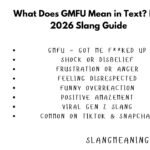
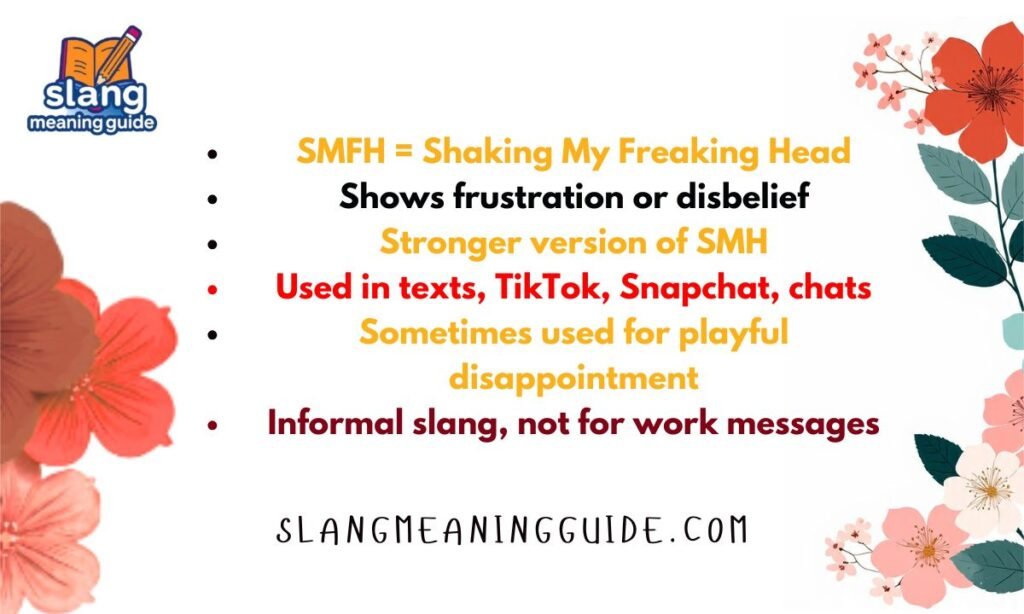
SMFH stands for “Shaking My Freaking Head” (sometimes the stronger version with an expletive). It expresses frustration, disbelief, or disappointment in a compact, punchy way. It’s not random letters. It’s a full emotional reaction compressed into four characters.
Core Meanings Explained
Primary Meaning: Disbelief and Frustration
The main use is reacting to something that feels unbelievable or just plain stupid. Someone does something baffling, and SMFH is the digital equivalent of literally shaking your head at them.
- “He forgot his password for the third time today… SMFH.”
- “They cancelled the event an hour before it started. SMFH.”
- “She believed that scam? SMFH.”
The intensity is what separates it from its calmer cousin SMH. When regular head-shaking isn’t enough, people reach for SMFH. The added word signals that whatever happened crossed a line.
Secondary Meaning: Playful Disappointment
Not every use of SMFH carries serious anger. Among close friends, it often functions more like sarcastic teasing than genuine frustration.
- “You wore that to the party? SMFH 😂”
- “Bro you called her by the wrong name. SMFH.”
- “You’re still rooting for that team? SMFH.”
Tone does all the heavy lifting here. The same four letters can mean two very different things depending on what’s around them, including emojis, punctuation, and the conversation’s general vibe.
Origin and Evolution
SMFH didn’t appear overnight. It grew out of a longer tradition of shortening emotional reactions for faster typing.
| Term | Estimated Origin | Platform Where It Blew Up | Current Status |
| SMH | Early 2000s | AIM, early forums | Universal, still active |
| SMFH | Mid-2000s | Twitter, Facebook | Mainstream across all platforms |
| SMDH | 2010s | Tumblr, Reddit | Common in AAVE-influenced spaces |
| SMHF | Recent | Niche texting circles | Rarely seen, mostly a variant |
The shift from SMH to SMFH happened naturally as internet culture pushed for more expressive reactions. People wanted something that hit harder. Adding that middle word gave the phrase a stronger emotional punch without requiring more effort to type.
Common Misunderstandings
People misread SMFH all the time. Some think it’s always aggressive. Others use it in situations where it clearly doesn’t fit.
| Slang | Common Misunderstanding | Correct Understanding |
| SMFH | Always means extreme anger | Often casual or even playful |
| SMFH | Same as SMH | SMFH carries noticeably more intensity |
| SMFH | Only used by teens | Used across Gen Z and Millennials broadly |
| SMFH | Highly offensive in all contexts | Mild among friends, context-dependent |
The biggest mistake people make is treating it as purely aggressive. In reality, context controls the temperature. Used with a laughing emoji, it reads as lighthearted. Used alone after something serious, it reads as genuinely frustrated.
Formal vs. Informal Uses
SMFH belongs in casual spaces only. It has no business showing up in professional communication.
| Term | Informal Use | Formal/Professional Equivalent |
| SMFH | “You did that again? SMFH.” | “This is a recurring issue worth addressing.” |
| SMFH | “Prices went up again… SMFH.” | “The recent price increase is concerning.” |
| SMFH | “He really said that? SMFH.” | “That comment was surprising and inappropriate.” |
| SMFH | “SMFH they cancelled it.” | “The cancellation is disappointing.” |
Using it at work won’t necessarily cause a crisis, but it undermines your professionalism. Stick to full sentences in emails, Slack messages, or any client-facing communication. Save SMFH for your personal group chats.
Comparisons With Similar Abbreviations
SMFH sits inside a whole family of reaction-based slang. Knowing the differences helps you read tone more accurately.
- SMH vs. SMFH — SMH is the lighter version. If SMH is a mild sigh, SMFH is a loud exhale. Use SMH for minor annoyances and SMFH when something genuinely crosses a line.
- WTF vs. SMFH — WTF leans more toward shock and confusion. SMFH leans toward resigned disappointment. They can overlap, but WTF is sharper and more confrontational in tone.
- OMG vs. SMFH — OMG covers a wide range including excitement, surprise, and disbelief. SMFH is strictly negative or sarcastic. You’d never use SMFH to react to good news.
- ISTG vs. SMFH — “I Swear To God” adds a layer of personal exasperation. SMFH is more observational, directed outward at someone else’s behavior. ISTG often turns inward.
- BRUH vs. SMFH — BRUH is shorter and vaguer. It covers confusion, disappointment, and disbelief all at once. SMFH is more specific. It signals that you’re reacting with visible, physical-style frustration.
Frequently Asked Questions
What does SMFH mean in a text message?
It means “Shaking My Freaking Head,” used to express frustration, disbelief, or disappointment.
Is SMFH always negative?
Mostly yes, though among friends it can read as playful sarcasm depending on tone.
Can I use SMFH at work?
No, it’s informal slang. Use professional language in workplace communication.
What’s the difference between SMH and SMFH?
SMFH is more intense. It carries stronger emotion than the milder SMH.
Is SMFH considered a bad word?
The “F” refers to a mild expletive or “freaking,” so it’s not formal. Avoid it in sensitive contexts.
Conclusion
SMFH is one of those abbreviations that looks small but carries real emotional weight. It tells you someone is frustrated, disbelieving, or at minimum doing a slow head-shake at whatever just happened.
Once you understand the context behind it, you stop second-guessing the tone and start reading conversations more clearly. That’s the real value in knowing your slang.