
Why do those tiny moon symbols keep appearing in messages and calendars? They’re not just cute icons—they mean something about the Moon’s shape. Think you know the 🌓️ or 🌕 icons? There’s more to them than meets the eye. Let’s unravel the mystery of moon phase emojis and find which one matches tonight’s lunar look.
Astronomical Moon Phases
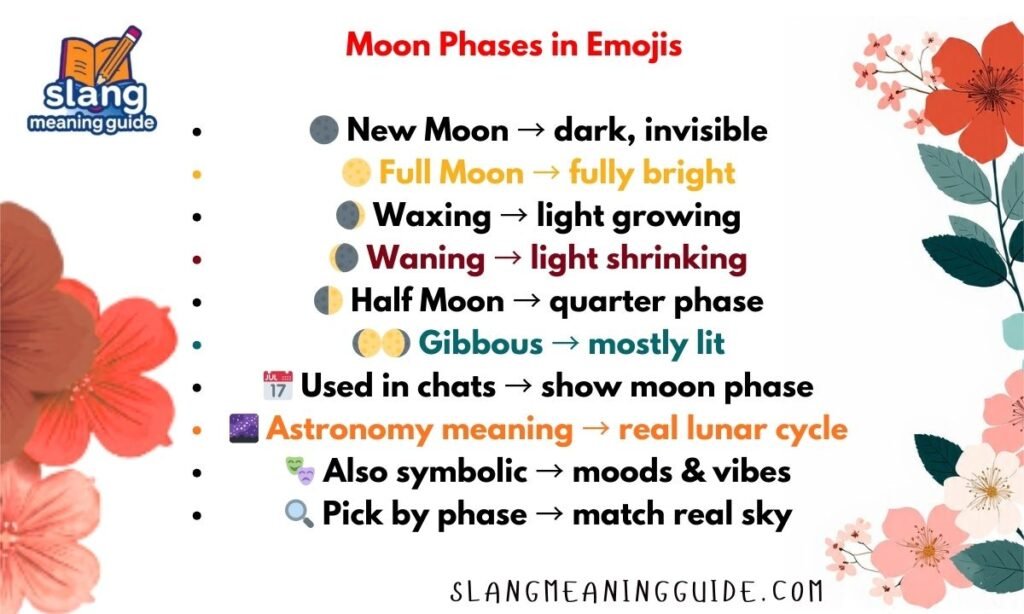
Scientists recognize eight moon phases that repeat each lunar month. These range from New Moon (invisible from Earth) to Full Moon (fully lit) and back. Phases depend on how much of the Moon’s sunlit side we see.
Major Phases: New, Full, and Quarters
The New Moon is when the Moon is between Earth and Sun, so its lit side is hidden. We can’t see it at all. As the Moon moves, it reaches First Quarter about a week later, appearing half-lit on its right side.
Two weeks from new, we get the Full Moon, fully illuminated. After that, the Third (Last) Quarter arrives, half-lit on the left. These four are the major landmarks of the cycle. New and Full Moons are opposites (dark vs. bright), and the Quarter phases each show half the Moon’s face.
Minor Phases: Crescents and Gibbous
Between the majors are Waxing and Waning phases. Waxing means growing (more light each night), waning means shrinking. After new comes the Waxing Crescent (a slim crescent on the right), then Waxing Gibbous (mostly lit, left edge dark).
After full, Waning Gibbous (mostly lit, right edge dark) and Waning Crescent (slim crescent on left) complete the cycle. Each minor phase shows a recognizable shape. NASA sums it up: “waxing crescent phase is a thin crescent on the right”, “waning crescent is a thin crescent on the left”.
Moon Phase Emojis
Unicode includes eight moon emojis, one for each phase. Each one is a little icon showing that shape of Moon (a cratered circle with part shaded). For example, 🌑 is the New Moon (completely dark) and 🌕 is the Full Moon (fully bright). These pictographs are universally supported by platforms, from Apple to Android.
Emoji Mapping Table
| Emoji | Phase | Description |
|---|---|---|
| 🌑 | New Moon | Moon not visible (new) |
| 🌒 | Waxing Crescent | Slim crescent lit on right |
| 🌓 | First Quarter | Half lit on right |
| 🌔 | Waxing Gibbous | Mostly lit (right side has small dark edge) |
| 🌕 | Full Moon | Fully lit, bright circle |
| 🌖 | Waning Gibbous | Mostly lit (left side has small dark edge) |
| 🌗 | Last Quarter | Half lit on left |
| 🌘 | Waning Crescent | Slim crescent lit on left |
Each emoji shows a cartoon Moon with appropriate shading. They’re often used to talk about the Moon, night sky, or even metaphorically (e.g. mystery or space). For example, Emojipedia notes moon emojis can mean night or astronomy. The small differences (gold vs silver tinge) depend on platform, but the general shape is clear.
Using These Emojis in Text
People use phase emojis to share what the Moon looks like or to mark dates (like “🌕 on Friday!”). You can pick today’s emoji to match the lunar phase. For instance, if the Moon is new, you’d use 🌑. If it’s full, use 🌕. Since they’re part of Unicode, they’re recognized everywhere. They can also convey mood or theme: a waxing crescent 🌒 might hint at something just beginning.
Current Phase and Matching Emoji
As of March 19, 2026, the Moon is in the New Moon phase. The night sky is dark because only 1% is illuminated. This means the correct emoji for tonight’s Moon is 🌑 (New Moon).
Moon Phase on 2026-03-19
According to moon data, March 19 shows the Moon at 1% illumination, just turning New Moon. NASA explains that at New Moon the Sun and Moon share the same sky longitude, making the Moon invisible. Observers see no bright disk – only darkness. This matches exactly when we’d use the New Moon emoji.
Choosing the Right Emoji
To pick an emoji, match the Moon’s illumination. On 3/19/2026 it’s 0–1%, so 🌑 fits. The site Today’s Date Now confirms New Moon on March 19 (they list a table of phases, showing 🌑 at 1.6% illumination on 3/19). (The percentage and emoji align: low illumination = 🌑.) After midnight, as the Moon grows (4% on March 20), one would switch to 🌒 (Waxing Crescent). But for March 19, use 🌑.
Emoji Appearance by Platform
Moon emojis look slightly different on each platform but retain the same meanings. Apple’s version is glossy and golden, Google’s is silvery, and Samsung’s sometimes shows stars around it. However, all show the same lit portion. Platforms label them with Unicode names like “New Moon” or “Waxing Gibbous Moon Symbol”.
Apple vs. Google, etc.
On Apple devices, 🌑 is a dark grey disc; on Google’s Android it’s a flat black circle with a bit of shine. Samsung’s 🌑 sometimes had stars around it (though designs update over time). Full Moon 🌕 is bright yellow or gold on most platforms. These style differences don’t change the meaning, but users might notice colors or art style. Emojipedia documents each vendor’s art for comparison.
Social Media and Messaging Apps
Major apps support these emojis too. Twitter, Facebook, and WhatsApp use their own designs (often similar to Apple’s). So if you send a 🌑 emoji in a tweet or WhatsApp, your friend sees the New Moon symbol from their platform’s set. The key: all agree which part of the Moon is lit. For example, on Twitter 🌔 still shows the right side mostly bright. This cross-platform consistency means the meaning is evergreen.
Frequently Asked Questions
What does 🌑 (New Moon) signify?
It represents a new moon phase – the Moon is not visible (completely dark).
How can I tell which emoji to use tonight?
Check the Moon’s age or illumination. Tonight (Mar 19, 2026) is New Moon, so use 🌑.
Do all phones show the same moon emoji?
No. Apple, Google, Samsung, etc., each draw it their way. But the core shape (lit portion) stays accurate.
What does waxing vs. waning mean in emojis?
“Waxing” means the lit area is growing; “waning” means shrinking. These terms indicate which side light is on.
Can moon emojis be used metaphorically?
Yes. People use 🌑, 🌕, etc., to symbolize phases, night, space, or moods (e.g. new beginnings for new moon).
Conclusion
The Moon phase emojis are a fun way to share lunar info. Each symbol matches a scientific phase, from invisible 🌑 (new) to bright 🌕 (full). By knowing today’s phase – new moon on March 19, 2026 – we pick the 🌑 emoji. Next time you send a moon emoji, you’ll know exactly what lunar shape it means, no mystery.