
Three letters. Zero obvious meaning on first read. You have probably seen YFM pop up in a text, a comment, or a group chat and had no idea whether it was a question, a statement, or something entirely else. The context felt clear to the person who sent it — but not to you. Before you reply with the wrong tone or guess the wrong meaning, here is everything you actually need to know about what YFM means, where it came from, and exactly how people use it today.
Core Meanings of YFM Explained
YFM carries more than one meaning depending on who is using it and in what setting. Most people only know one version — which is exactly where the confusion begins. Here are the five main meanings in active use today.
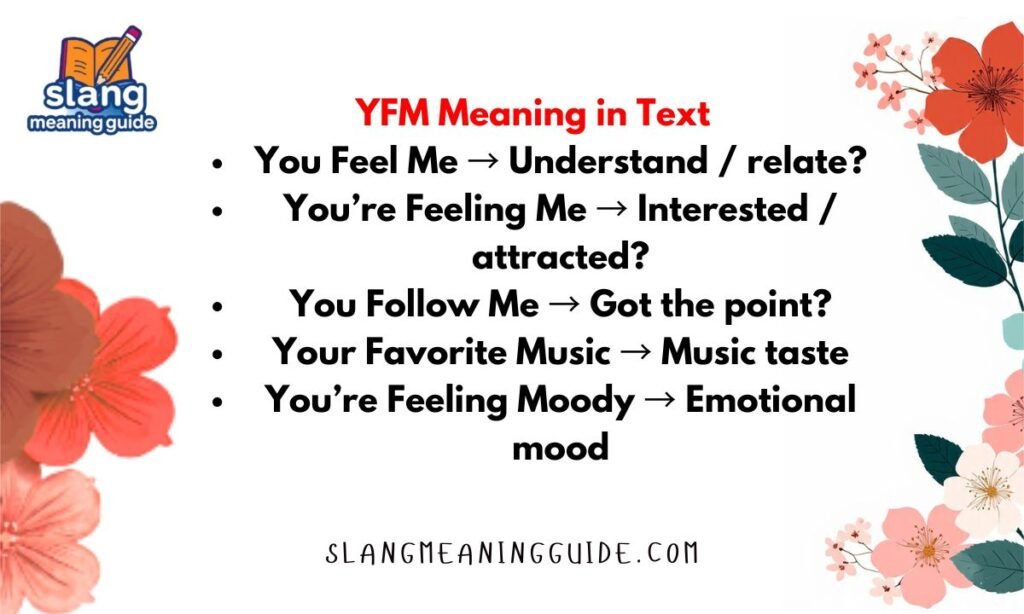
1. You Feel Me?
Definition: The most common meaning. It is a casual check-in asking “Do you understand me?” or “Do you relate to what I’m saying?” Used to seek agreement or emotional validation at the end of a statement.
- “It’s been a long week and I just need a break, YFM?”
- “I’m not upset — I just need space sometimes, YFM?”
- “Life’s too short to spend it on people who drain you, YFM?”
- “I didn’t even want to go but felt obligated, YFM?”
2. You’re Feeling Me?
Definition: A flirtier, more confident variation asking whether someone is attracted to or interested in the speaker. Common in casual romantic texting and social media DMs among younger users.
- “I see the way you look at me — YFM?”
- “Don’t play dumb, you know YFM.”
- “We’ve been talking every day — YFM or nah?”
- “Just admit it already, YFM.”
3. You Follow Me?
Definition: Used to confirm that the other person is keeping up with an explanation or a chain of logic. Similar to “you with me?” or “does that make sense?” Common in longer texts or when explaining something complex.
- “So first you log in, then go to settings, then disable it — YFM?”
- “The whole plan depends on timing, YFM?”
- “I’m not saying he’s wrong, just that he reacted badly, YFM?”
- “Step three is the hardest part of the process, YFM?”
4. Your Favorite Music
Definition: In music-heavy communities and some social media circles, YFM stands for “Your Favorite Music” — used when sharing playlists, recommending songs, or asking someone about their taste. Less common than the other meanings but consistent in niche spaces.
- “Send me your YFM playlist — I want to know your vibe.”
- “YFM says a lot about who you are.”
- “What’s YFM right now? I need new music.”
- “My YFM changes every season honestly.”
5. You’re Feeling Moody
Definition: An informal, affectionate observation that someone seems emotionally off or in a particular mood. Used lightly in close friendships and group chats, not in serious or professional conversations.
- “You good? YFM today.”
- “Don’t take it personally — she’s just YFM lately.”
- “YFM or is something actually wrong?”
- “We all have those days where we’re just YFM. Rest up.”
Origin and Evolution Timeline
YFM grew out of African American Vernacular English (AAVE) and hip-hop culture, where “you feel me” was a common verbal expression of solidarity and understanding long before texting existed. As SMS culture shortened everyday speech into abbreviations, “you feel me” became YFM naturally.
Its digital spread accelerated through hip-hop forums, early social media, and then exploded on Twitter and Instagram in the 2010s. The romantic and music-related meanings developed later as different communities adopted the abbreviation for their own conversational needs.
- Late 1990s–early 2000s: “You feel me” established in spoken AAVE and hip-hop lyrics.
- Mid-2000s: Moves into early text messaging as YFM among younger users.
- 2010–2015: Twitter and Tumblr accelerate the spread; romantic usage emerges.
- 2016–present: TikTok and Instagram Reels normalize it across broader demographics.
| Term | Estimated Origin | Platform Where It Blew Up | Current Status |
|---|---|---|---|
| You Feel Me? | AAVE / hip-hop, late 1990s | Twitter, Instagram | Active — dominant meaning |
| You’re Feeling Me? | Early 2010s texting | Instagram DMs, Snapchat | Active — informal/romantic |
| You Follow Me? | Mid-2000s SMS culture | Group chats, iMessage | Active — explanatory use |
| Your Favorite Music | Early 2010s music forums | Music subreddits, Discord | Niche — music communities |
| You’re Feeling Moody | Informal group chats, 2015+ | Close-friend group chats | Emerging — very informal |
Common Misunderstandings
The biggest mistake people make with YFM is treating it as a question when it is actually a statement — or reading a romantic intent when the sender simply meant “do you understand me?” The meaning shifts fast based on tone and context, and without a clear read on the conversation, it is easy to respond in exactly the wrong register.
- Treating all YFM as romantic. Most of the time it just means “do you understand me?” — not flirting.
- Ignoring tone. A flirty YFM and a frustrated YFM look identical in text — the surrounding sentences do all the work.
- Using it in professional communication. YFM is casual slang and has no place in work emails, formal messages, or client communication.
- Assuming it is universally known. Older contacts or people outside texting-heavy communities may not recognize it at all.
Formal vs. Informal Uses
YFM belongs entirely in informal communication. There is no professional equivalent that uses the abbreviation — if you need to check comprehension at work, you write it out. Below are the informal uses alongside their formal alternatives.
- Informal: “That’s the whole point, YFM?” → Formal: “Does that make sense to you?”
- Informal: “I’m just tired of trying so hard, YFM?” → Formal: “I wanted to check whether you understand my perspective.”
- Informal: “Step one sets everything up, YFM?” → Formal: “Please confirm you are following the instructions.”
- Informal: “She’s just YFM today — give her space.” → Formal: “She seems to need some time to herself today.”
Comparisons With Similar Abbreviations
| Abbreviation | Meaning | Similarity to YFM | Key Difference |
|---|---|---|---|
| YKW | You Know What | Same casual check-in energy | Statement, not a question |
| IKR | I Know Right | Both signal agreement and relatability | IKR is a response; YFM seeks one |
| IYKYK | If You Know You Know | Both assume shared understanding | IYKYK is exclusive; YFM invites agreement |
| NGL | Not Gonna Lie | Both precede or follow a candid thought | NGL is a honesty signal, not a check-in |
| TBH | To Be Honest | Both used in personal, emotional texting | TBH makes a statement; YFM asks for feedback |
Frequently Asked Questions
What does YFM mean in texting?
It most commonly means “You Feel Me?” — asking if the other person understands or relates to what you said.
Is YFM romantic?
It can be, but only in flirty contexts — most uses simply mean “do you follow me” or “do you agree.”
Where did YFM come from?
It originated in AAVE and hip-hop culture before moving into digital texting in the mid-2000s.
Can you use YFM in professional messages?
No — it is informal slang and does not belong in work emails or formal communication.
How do you know which meaning of YFM someone is using?
Read the surrounding conversation — tone and context almost always make the intended meaning obvious.
Conclusion
YFM is simple on the surface but carries real nuance depending on who sends it and why. Most of the time it is just a casual “do you get me?” — but it shifts meaning fast in the right context. Read the conversation, match the tone, and you will never misread a YFM again.