
You open a message and see just two letters: “HU.” No punctuation, no emojis, nothing else to guide you. It feels like it should be obvious, but the meaning is not always clear. Is it a greeting, a question, or something else entirely?
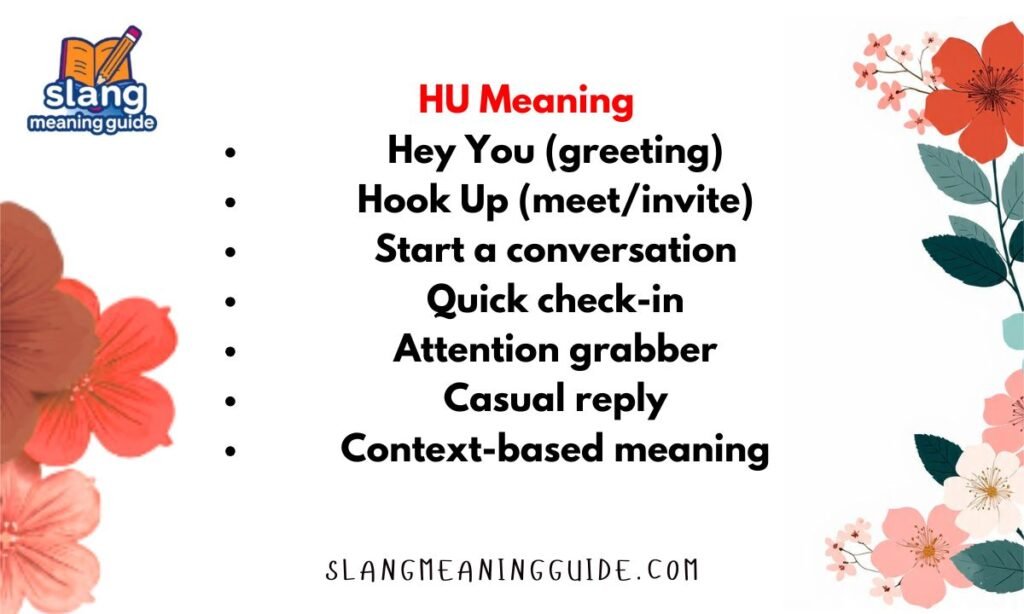
In texting, “HU” most commonly means “Hey You” or “Hook Up,” depending on the context. It can be a casual greeting or a more direct invitation to meet or connect. The exact meaning depends on tone, relationship, and situation.
What HU Means
“HU” is a short slang abbreviation used in text messages, chats, and social media. It is not as universally recognized as other slang terms, which is why it can feel confusing at first. The meaning changes based on how and where it is used.
In most casual conversations, “HU” stands for “Hey You.” It works as a quick, friendly way to get someone’s attention. However, in dating or more personal contexts, it can also mean “Hook Up,” which refers to meeting up, often with a romantic or physical implication.
Because “HU” has multiple meanings, understanding the surrounding message is important. The tone, emojis, and relationship between people usually make the intention clear.
Core Meanings Explained
HU as “Hey You”
A casual greeting used to get someone’s attention.
Usage: This is the most common and harmless meaning. It feels friendly and slightly personal.
Examples:
- HU, how are you?
- HU, long time no talk.
- HU, what are you doing?
- HU, I miss our chats.
- “HU 😊 just checking in.”
- “HU, you free today?”
HU as “Hook Up”
An invitation to meet, often with a romantic or physical meaning.
Usage: Used mostly in dating contexts or private conversations.
Examples:
- Wanna HU tonight?
- We should HU sometime.
- HU later?
- Let’s HU this weekend.
- “Are you free to HU?”
- “Been a while, let’s HU.”
HU as a Quick Check-In
A short way to start a conversation or check on someone.
Usage: Used when someone wants to reconnect without writing a full message.
Examples:
- HU, everything okay?
- HU, just wanted to talk.
- HU, are you busy?
- HU, call me when free.
- “HU, need your help.”
- “HU, quick question.”
HU in Group Chats or Casual Threads
A short attention-grabber in group conversations.
Usage: Used to call out to someone or start a topic.
Examples:
- HU guys, listen up.
- HU everyone, meeting at 7.
- HU, who’s joining?
- HU, check this out.
- “HU team, update needed.”
- “HU friends, plan tonight?”
HU as a Minimal Response
A very short reply that keeps the conversation going.
Usage:
Sometimes used lazily or when someone is busy.
Examples:
- HU… what’s up?
- HU, yeah I’m here.
- HU, okay.
- HU, got it.
Bullet examples:
- “HU, tell me more.”
- “HU, I’m listening.”
Origin and Evolution
“HU” evolved from the need for faster communication in texting. As messaging platforms grew, people shortened words and phrases to save time. Similar abbreviations became popular alongside it.
Unlike more standardized slang, “HU” never had one fixed meaning. Instead, it developed multiple uses based on context, tone, and community.
Timeline Table
| Term | Estimated Origin | Platform Where It Became Popular | Current Status |
| Hey You (HU) | Early 2000s | SMS/Text Messaging | Still used casually |
| Hook Up (HU) | Early 2000s | Dating chats, forums | Common in dating context |
| HU abbreviation | Mid 2010s | Instagram, Snapchat | Moderately used |
| HU in group chats | Late 2010s | WhatsApp, Messenger | Niche but active |
Today, “HU” is less common than some slang terms but still appears in informal chats.
How People Use HU in Conversations
People use “HU” because it is quick and easy. It fits perfectly into fast conversations where typing full sentences feels unnecessary. It is often the first message sent to start a chat.
In social media, “HU” may appear in captions, comments, or DMs. It feels casual and slightly personal, which is why it is popular among friends and younger users.
Examples in real usage:
- “HU, are you awake?”
- “HU, let’s talk later.”
- “HU, I saw your post.”
- “HU, I need advice.”
More casual examples:
- “HU 😂 guess what happened”
- “HU, call me asap”
- “HU, don’t forget!”
- “HU, I’m outside”
Common Misunderstandings
Because “HU” has multiple meanings, it is easy to misinterpret. Someone might think it is romantic when it is just a greeting, or vice versa.
Common incorrect interpretations:
- Assuming it always means “Hook Up”
- Thinking it is a typo instead of slang
- Confusing it with unrelated abbreviations
- Believing it is rude or dismissive
- Misreading tone without context
Understanding the situation helps avoid confusion.
Formal vs Informal Use
“HU” is strictly informal. It should only be used in casual conversations with friends or people you know well.
Informal examples:
- “HU, what’s up?”
- “HU later.”
- “HU, need help.”
Formal alternatives:
- “Hello, how are you?”
- “Please contact me when available.”
- “I would like to speak with you.”
Using “HU” in professional settings may appear unprofessional or unclear.
Comparison With Similar Words or Slang
| Word | Meaning | Where It’s Used | Difference From HU |
| Hey | Greeting | Everywhere | More clear and universal |
| HMU | Hit Me Up | Social media | More widely recognized |
| Sup | What’s up | Casual chats | More conversational |
| Yo | Informal greeting | Friends | More expressive |
| DM Me | Message me directly | Instagram, Twitter | Platform-specific |
“HU” stands out because it can mean different things depending on context.
Examples in Social Media and Text Messages
Here are realistic examples of how “HU” appears:
Text message:
- Person A: “HU”
- Person B: “Hey! What’s up?”
Casual chat:
- “HU, you free tonight?”
Flirty message:
- “HU later 😉”
Group chat:
- “HU everyone, quick update.”
Instagram DM:
- “HU, loved your post!”
Frequently Asked Questions
What does HU mean in text?
It usually means “Hey You” or “Hook Up,” depending on context.
Is HU a common slang term?
It is moderately common but less popular than abbreviations like “HMU.”
Can HU be used in a romantic way?
Yes, it can mean “Hook Up” in dating or flirty conversations.
Is HU appropriate for professional use?
No, it is informal and not suitable for professional communication.
How do I know what HU means in a message?
Look at the context, tone, and relationship to understand the correct meaning.
Final Words
“HU” may look simple, but its meaning depends on how it is used. Once you understand the context, it becomes easy to interpret. Like most slang, it is all about tone, timing, and who you are talking to.