
You have heard someone shout it in a TikTok video. The whole crowd loses it. But where did “Can I get a hooyah” actually come from — and what does it mean? Here is the full breakdown, from Navy SEAL training grounds to viral internet culture.
What Does “Can I Get a Hooyah” Mean?
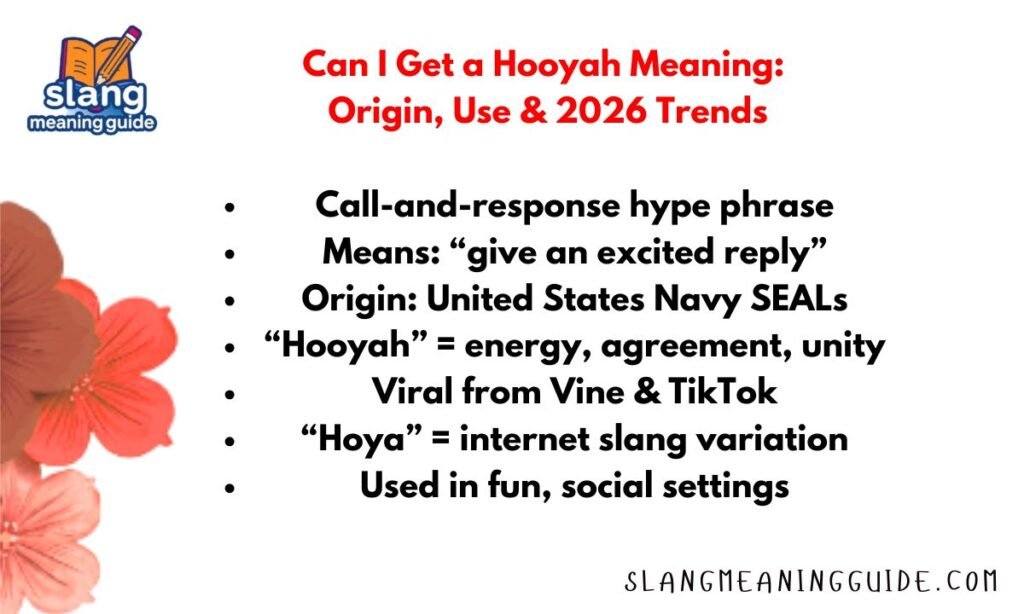
“Can I get a hooyah” is a call-and-response hype phrase. The person who says it is asking the crowd, group, or audience to shout “Hooyah!” back in agreement or excitement. It is not a question expecting a real answer. It is a crowd energy booster — a fun rally cry built for participation.
The Word Hooyah: Where It Started
Hooyah is a battle cry used by U.S. Navy SEALs. It signals enthusiasm, agreement, and team unity during training exercises and drills.
The word became widely recognized through military documentaries and Hollywood films from the 1980s and 1990s. Those films pushed hooyah into mainstream pop culture, where street slang eventually picked it up and ran with it.
Hooyah in Military Context
In U.S. Navy SEAL culture, hooyah is a response to orders — a loud, defiant declaration that you are ready, willing, and committed. Instructors use it during brutal training phases like Hell Week, where recruits repeat it to push through exhaustion.
It is not casual in military settings. It carries weight and discipline. The word is about morale, unity, and pushing through hard moments as a team.
From Military to Pop Culture
Once Hollywood started using hooyah in action films, the phrase crossed into everyday American life. Actors shouted it in training montages and battle scenes, giving it an exciting, high-energy connotation.
Teenagers and young adults absorbed the energy of the word without its military weight. Over time it became a general-purpose cheer, stripped of its serious context and rebuilt as a fun crowd interaction tool.
Can I Get a Hoya vs. Can I Get a Hooyah
These two phrases get used interchangeably online, but they have slightly different origins. Understanding the difference helps you use each one correctly.
| Phrase | Pronunciation | Primary Origin | Common Use |
| Can I get a hooyah | HOO-yah | U.S. Navy SEAL training | Military-influenced hype |
| Can I get a hoya | HOY-ah | Vine video / internet slang | Social media, TikTok content |
| Can I get a hell yeah | Standard English | General slang | Casual crowd response |
The Vine video that made this phrase viral used “hoya” — a softer, playful variation of hooyah. Internet users blended the two over time, and now both versions trend together on TikTok and in meme culture.
The Original Vine Video That Started It All
The phrase exploded in 2015 thanks to a Vine clip showing a kid shouting “Can I get a hoya?” before another kid jumped down a flight of stairs. The response — a drawn-out, nasally “HOYA!” — became instantly iconic.
That ten-second clip launched thousands of remixes, challenge videos, and meme formats. The phrase moved from Vine to YouTube to Instagram and eventually to TikTok, where it continued to resurface in new forms every year.
The Alissa Violet Connection
Before the Vine clip dominated, Instagram influencer Alissa Violet was using a version of the phrase as early as 2011. She would shout it to encourage fans to engage with her content, creating a direct call-and-response dynamic between creator and audience.
Her early use helped establish “hoya” as an influencer engagement tool. Fans recognized the format and played along eagerly. This laid the groundwork for the phrase to travel across platforms and grow into a broader internet trend.
How the Phrase Works: Call and Response Explained
The structure of “Can I get a hooyah” follows a classic call-and-response format. One person initiates. Everyone else replies. The energy builds instantly.
This pattern appears across cultures — in gospel music, military drills, sports stadiums, and political rallies. It works because it invites participation and makes people feel like part of something bigger than themselves.
Why It Works So Well Online
Short-form video platforms reward participation. When a creator shouts “Can I get a hooyah?” in a TikTok, viewers rush to the comments to type “HOOYAH!” — which drives comment count, signals engagement, and boosts the video algorithmically.
Creators discovered that interactive phrases like this outperform passive content. Viewers who respond feel connected to the creator. That sense of community keeps them watching, following, and coming back.
How Audiences Are Supposed to Respond
The ideal response to “Can I get a hooyah?” is loud, enthusiastic, and slightly drawn out — “HOOO-YAH!” or just “HOYA!” in comments and group chats. The response should match the energy of the call.
In real life, a flat or quiet response completely kills the moment. The whole point of the phrase is to amplify energy, not lower it. If the room does not respond loudly, the call falls flat.
How to Use “Can I Get a Hooyah” in Real Life
Timing and context determine whether this phrase lands well or comes off as awkward. Use it when the moment genuinely calls for excitement and shared energy.
Good settings include: parties, group chats after good news, sports watch parties, live streams, TikTok videos, and casual hangouts where everyone already knows each other.
Examples in Everyday Use
Group chat: “We just hit 10K followers — can I get a hooyah?!”
TikTok caption: “First day of summer break. Can I get a hooyah?”
Party: Shout it to the room after something exciting happens and wait for the response.
The phrase works best when the moment genuinely warrants celebration. Forcing it in flat or serious situations makes it land badly.
When Not to Use It
Avoid using “Can I get a hooyah” in formal settings, professional emails, job interviews, or any situation where maturity is expected. The phrase signals playfulness and casual energy — not authority or professionalism.
Also avoid overusing it. A phrase loses its punch when it appears in every post or every message. Save it for moments that actually deserve the hype.
Can I Get a Hooyah in 2026: The TikTok Revival
The phrase never fully disappeared, but 2026 saw a clear resurgence. New meme formats, dog remix videos, and challenge revivals pushed it back into trending territory on TikTok.
Search interest in “hooyah challenge,” “hoya original vine,” and “hooyah sound effect” all spiked in early 2026, according to current trend data. New creators discovering the phrase for the first time are mixing it with their own content styles, keeping it fresh for younger audiences who never saw the original Vine.
Alternatives to “Can I Get a Hooyah”
If you want similar crowd energy without repeating the same phrase, here are solid alternatives that serve the same purpose.
| Alternative Phrase | Best Setting | Energy Level |
| Can I get a hell yeah? | Casual groups, social media | High |
| Put your hands up | Live events, concerts | Very high |
| Make some noise | Sports, parties, live streams | High |
| Who’s with me? | Group motivation, rallies | Medium-high |
| Let’s go! | General hype, any setting | High |
Each phrase triggers participation in its own way. Mix and match based on your audience and platform.
Is “Can I Get a Hooyah” Inappropriate?
The phrase itself is not inappropriate. It carries no offensive meaning and does not reference anything harmful.
Context is the only real concern. Shouting it in a quiet or serious environment comes across as disruptive or immature.
On TikTok, some creators use it in mildly edgy situations, but that reflects how it is used — not what the phrase actually means. For most everyday and social media purposes, it is completely family-friendly.
Frequently Asked Questions
What does “Can I get a hooyah” mean?
It means “Can I get a loud, enthusiastic response from you?” — a hype phrase used to get a crowd or audience excited.
Where did “Can I get a hooyah” originally come from?
It traces back to U.S. Navy SEAL training slang and became a viral internet phrase through a 2015 Vine video and influencer use on Instagram.
What is the difference between hoya and hooyah?
Hooyah has military roots while hoya is the internet-slang variation — both are used as call-and-response hype phrases online.
Is “Can I get a hooyah” inappropriate?
No — the phrase is not offensive by nature, though using it in formal or serious contexts would be inappropriate.
How do you respond to “Can I get a hooyah?”
You shout or type “HOOYAH!” back — loud, enthusiastic, and drawn out for maximum effect.
Conclusion
“Can I get a hooyah” traveled from Navy SEAL training drills to viral Vine clips to TikTok trend cycles — and it is still going strong in 2026. It works because it is simple, interactive, and built for the kind of shared energy that social media thrives on. Know the context, match the moment, and when the vibe is right — you already know what to shout.