
Most people hear “leghorn” and picture a cartoon rooster — but the word goes back centuries. It names a real chicken breed, a specific type of Italian straw, and a style of hat worn across continents. Here is everything the word actually means and where it came from.
What Does Leghorn Mean?
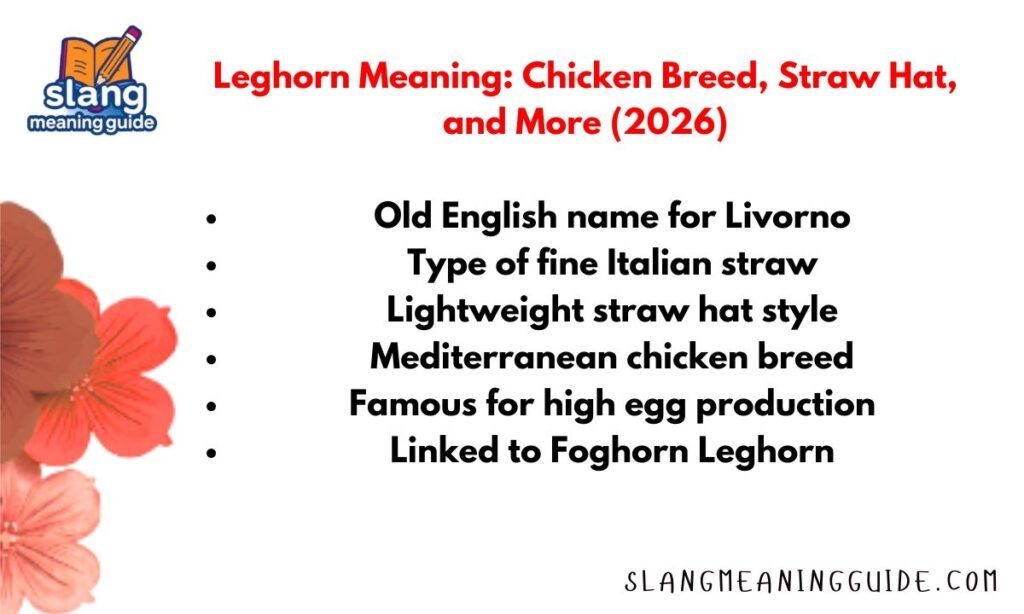
Leghorn has three core meanings in English: a fine plaited straw, a hat made from that straw, and a Mediterranean breed of domestic chicken. All three connect back to a single Italian city. The word is not slang. It is a standard English noun with a documented history stretching back to the early 1800s.
The Origin of the Word Leghorn
Leghorn is the old English name for Livorno, a port city on the western coast of Tuscany in Italy. English speakers anglicized “Livorno” into “Leghorn” over time, and that name stuck to the products that came out of the city — first the straw hats, then the chickens imported from the region.
The word first appeared in English writing around 1810, initially in reference to the hat. The chicken meaning followed as the breed spread internationally.
Why Livorno Became Leghorn
The shift from Livorno to Leghorn is a classic example of folk etymology. English traders and travelers heard the Italian name and adapted it to something that sounded more familiar in their own language.
The “Leg” and “horn” combination made the word easy to pronounce and remember for English speakers. Over two centuries, Leghorn became the accepted term in both poultry and fashion circles, even as the city kept its Italian name.
Leghorn the Chicken: Everything You Need to Know
The Leghorn chicken is one of the most productive egg-laying breeds in the world. It originated in the Mediterranean region and was first imported to the United States in 1828, arriving from the port of Livorno.
Today it is the most widely used commercial egg-laying breed in the United States. The White Leghorn is especially dominant in the egg industry.
Physical Characteristics
Leghorns are small, compact birds with a lean body and a single upright comb. Their feathers lie flat and tight, and they carry themselves with an alert, active posture.
The most common variety is pure white, though Leghorns do come in other colors including brown, black, buff, and silver. Their earlobes are white, which in chicken biology is a reliable indicator that they lay white-shelled eggs.
Egg Production and Temperament
A healthy White Leghorn hen lays around 280 to 320 white eggs per year — a figure that few other breeds match. They start laying earlier than many breeds, typically around 16 to 18 weeks of age.
Leghorns are energetic and independent. They do not tend toward being friendly lap birds. They forage actively and handle warm climates well, though they can struggle in very cold conditions because of their large combs.
White Leghorn vs. Other Varieties
The White Leghorn gets the most attention because it dominates commercial egg farming. Other color varieties exist and are more commonly kept by backyard poultry enthusiasts who want variety.
| Variety | Common Use | Notable Trait |
| White Leghorn | Commercial egg production | 280–320 eggs per year |
| Brown Leghorn | Backyard flocks | More docile than white |
| Black Leghorn | Exhibition and small farms | Striking appearance |
| Buff Leghorn | Hobby farming | Less common, golden-colored feathers |
Leghorn Straw and the Leghorn Hat
Before it became known for chickens, the word leghorn referred to a specific type of fine Italian straw. This straw was made from a particular variety of wheat grown in the Tuscany region, harvested while still green and then bleached dry.
The result was a pale, supple, lightweight material that hatmakers prized for weaving into summer hats.
What Makes Leghorn Straw Different
Leghorn straw is finer and more tightly woven than most other hat straws. The wheat was cut before it fully ripened, which kept the stalks thin and flexible.
Hatmakers could plait it into smooth, even bands and sew those bands into broad-brimmed hats that held their shape well. The finished fabric had a clean, almost silky quality that made it popular for women’s and men’s summer headwear throughout the 1800s and early 1900s.
The Leghorn Hat
A leghorn hat is typically broad-brimmed, lightweight, and pale in color. These hats were fashionable across Europe and America for much of the nineteenth century.
Women wore them as sun hats, often decorated with ribbons or flowers. The hats were practical — they blocked sunlight and stayed light enough to wear comfortably in warm weather.
Today, leghorn hats are considered vintage or collector pieces rather than everyday fashion, but they are still recognized by milliners and hat historians worldwide.
Foghorn Leghorn: The Cultural Connection
Most Americans recognize the name Leghorn from Foghorn Leghorn, the beloved Looney Tunes cartoon rooster. The character first appeared in 1946 and became one of the most recognizable cartoon characters in American television history.
The name is a deliberate joke. “Foghorn” refers to his booming, relentless voice. “Leghorn” connects to the Leghorn chicken breed — appropriate since the character is literally a rooster. The combination gave the character a comedic, old-fashioned Southern name that suited his personality.
Leghorn in Poultry Farming Today
Leghorns remain central to the global egg industry. In the United States alone, the vast majority of commercial white eggs sold in supermarkets come from White Leghorn hens.
Their efficiency is unmatched. They convert feed into eggs at a high rate and take up less space than heavier breeds. For commercial farmers focused on white egg production, Leghorn is still the default choice.
Leghorns in Backyard Flocks
Home poultry keepers do raise Leghorns, but they come with caveats. They are flighty and less affectionate than breeds like Orpingtons or Plymouth Rocks.
They do not brood often, meaning they rarely sit on eggs to hatch chicks. This suits commercial operations but can be a limitation for small-scale breeders who want natural hatching. For someone who just wants maximum egg production from a small backyard flock, though, Leghorns still deliver.
How to Pronounce Leghorn
The standard pronunciation is LEG-horn — two syllables, with the stress on the first. The International Phonetic Alphabet rendering is /ˈlɛgˌhɔrn/.
The first syllable sounds like the word “leg.” The second sounds like “horn.” Some regional accents shift the vowels slightly, but this two-syllable pronunciation is universally understood.
Leghorn Synonyms and Related Terms
Because leghorn covers multiple meanings, no single synonym covers all uses.
For the hat meaning, related terms include straw hat, Panama hat, boater, and sun hat — though none are exact equivalents. A leghorn hat specifically refers to the Italian wheat straw construction.
For the chicken meaning, the closest descriptor is “Mediterranean egg-laying breed” or simply “white egg layer.” The word Leghorn functions as a proper breed name in poultry science and cannot be fully replaced by a synonym.
For the straw meaning, Italian wheat straw or plaited straw captures the concept, but “leghorn straw” remains the precise technical term used in hatmaking history.
Frequently Asked Questions
What is the main meaning of leghorn in English?
Leghorn primarily means a Mediterranean chicken breed known for prolific white egg production, or a fine Italian straw used to make hats.
Where does the word leghorn come from?
It comes from Leghorn, the old English name for Livorno, a port city in Tuscany, Italy.
What is a White Leghorn?
A White Leghorn is the most common variety of Leghorn chicken, widely used in commercial egg farming and capable of laying 280 to 320 white eggs per year.
What is a leghorn hat?
A leghorn hat is a broad-brimmed hat woven from fine plaited Italian wheat straw, popular in Europe and America throughout the 1800s.
Is Foghorn Leghorn based on a real chicken breed?
Yes — the Looney Tunes character’s name directly references the Leghorn chicken breed, combined with “foghorn” to describe his loud, booming voice.
Conclusion
Leghorn is a word with more depth than most people expect — it connects a Tuscan port city, a century of hat-making craftsmanship, and one of the most productive chicken breeds on the planet.
Whether you encounter it on a restaurant menu, a vintage hat label, or a bag of poultry feed, the meaning traces back to the same Italian origin. It is a small word that quietly shaped both fashion history and global food production.