

You’ve heard it during rocket launches. You’ve seen it in texts and tweets. But do you actually know what “T minus” means — and where it really came from? Most people think it’s just a dramatic way to count down. The real answer is far more fascinating.
What Does T Minus Mean?
T minus is one of the most recognized phrases in science and pop culture. It signals the time remaining before a specific event occurs.
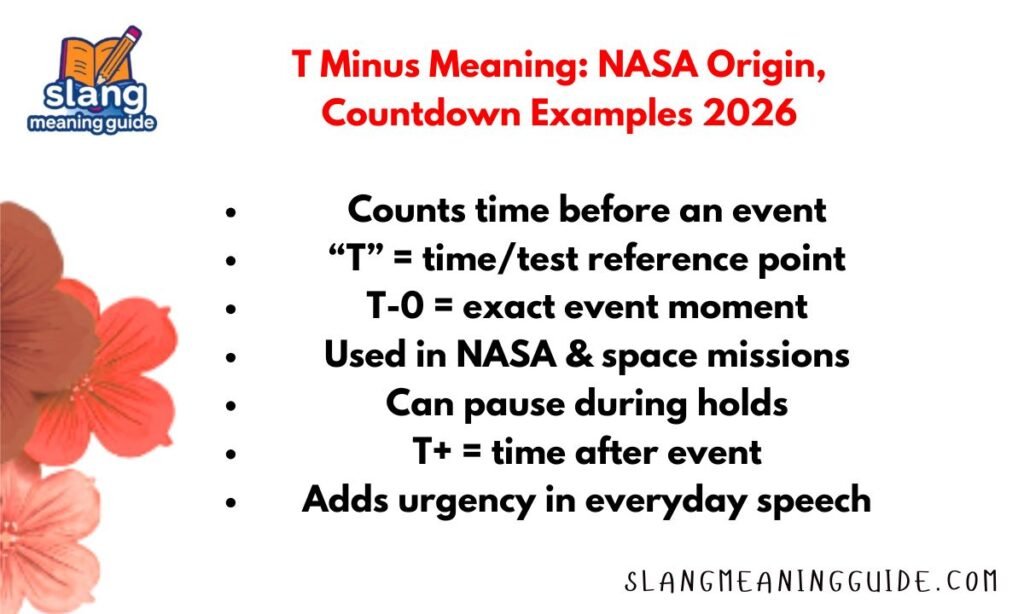
The “T” stands for time (or sometimes test). The “minus” tells you how much time is left. So “T minus 10 seconds” means the event happens in exactly 10 seconds.
Breaking Down the Formula
T minus works as a simple time equation built around a single reference point.
That reference point is called T-zero (T-0). Everything counts down toward it. Once the event happens, the clock flips — and you enter T-plus territory, measuring time after the event.
Every number in the countdown directly connects to T-0. Whether you say “T minus 3 hours” or “T minus 10 seconds,” you are measuring backward from that fixed zero point. This system keeps everyone — engineers, astronauts, ground crews — perfectly synchronized.
T Minus vs. Everyday Language
In everyday speech, T minus works exactly the same way — just without the rocket.
You can say “T minus 2 days until my vacation” and everyone understands. It builds excitement. It adds urgency. The phrase has moved far beyond NASA hallways and into text messages, social media captions, and office countdowns. In 2026, it remains one of the most borrowed phrases from aerospace science.
The NASA Origin of T Minus
NASA did not invent the countdown — but it perfected it.
The T minus system traces back to the 1950s and 1960s, born from military timekeeping practices. NASA adopted and standardized it during the early Space Race. Missions like Mercury, Gemini, and Apollo made the countdown clock a symbol of precision and human ambition.
Military Roots and Space Race Adoption
The “T” designation originally came from military terminology, where important moments were anchored to a reference time.
Just as the military used “D-Day” to mark a target date, engineers used “T” to mark a target time. The minus before a number indicated time remaining. The plus after a number showed elapsed time. This gave mission teams a universal language that worked across every department, every checklist, and every clock on the launch pad.
What Does the “T” Actually Stand For?
NASA Launch Director Mike Leinbach clarified this in a 2006 podcast interview. He stated that “T” stands for test, not always time — because the T-minus clock is a sequence of planned events, not just a wall clock.
This distinction matters. The T-minus countdown is a schedule, not a timer. It tracks when specific tasks and checks must be completed. That is why it can pause — unlike the clock on your wall, which never stops.
T Minus vs. L Minus: Key Difference
Many people confuse T minus and L minus. They are not the same thing.
Here is a clear comparison:
| Term | Stands For | Can It Stop? | What It Measures |
| T minus | Time / Test | Yes — pauses during holds | Planned countdown activities |
| L minus | Launch | No — runs continuously | Actual time until liftoff |
| T plus | Time after launch | Starts at liftoff | Mission elapsed time |
| E minus | Encounter / Event | Yes | Time to a space event like a flyby |
Why the T Clock Stops
During a launch countdown, the team may hit a hold. A hold is a planned or unplanned pause.
The T clock stops during holds. Engineers use the extra time to fix problems, complete delayed checks, or wait out bad weather. Meanwhile, the L clock keeps running — because real time never stops. Once the hold lifts, both clocks re-sync and the countdown resumes. This flexibility is what makes complex launches possible.
T Plus: After the Launch
Once the rocket lifts off, the countdown does not end. It converts to T plus (T+).
Mission teams track every post-launch event by T-plus time. “T plus 90 seconds” means 90 seconds after liftoff. This continues for the entire mission. It keeps the ground team and spacecraft aligned on a single shared timeline.
T Minus in Everyday Slang
T minus escaped the launch pad decades ago. Today, people use it in completely non-technical contexts.
Common everyday uses include:
- “T minus 30 minutes until dinner is ready.”
- “T minus 3 days until the exam — no sleep for me.”
- “T minus 1 hour until the game starts!”
- “T minus 5 days until I quit this job. Lol.”
The phrase works because it creates instant anticipation. It frames any event — big or small — as something worth counting down to. Social media amplified this. In 2026, you will find T minus used daily on Twitter/X, Instagram captions, TikTok countdowns, and group chats.
T Minus in Pop Culture and Media
Films have used T minus countdowns for decades to build tension. Science fiction movies, action films, and disaster thrillers all borrow the phrase.
When a movie character shouts “T minus 60 seconds!” the audience immediately feels pressure. The phrase carries built-in urgency — no explanation needed. That is the power of a term rooted in real high-stakes science.
How a Real NASA T Minus Countdown Works
A real launch countdown starts days before the rocket leaves the ground.
Here is a simplified look at key T-minus milestones for a major NASA launch:
| T Minus Time | Activity |
| T-43 hours | Countdown begins, launch team prepares |
| T-27 hours | Built-in hold — review systems |
| T-6 hours | Fueling begins |
| T-3 hours | Crew boards spacecraft |
| T-20 minutes | Final hold, teams check all systems |
| T-10 seconds | Automated launch sequence takes over |
| T-0 | Liftoff |
The Final 10 Seconds
The last 10 seconds of a NASA countdown are the most iconic.
The announcer counts aloud: “Ten, nine, eight, seven, six, five, four, three, two, one.” At T-0, the automated launch sequencer takes control. No human can stop the launch at this point. That moment — T-0 — is called launch commit. It is slightly before the rocket actually leaves the pad, because the ignition sequence takes a fraction of a second.
Built-In Holds: Planned Pauses
Most countdowns include pre-planned holds. These are intentional pauses built into the schedule.
They give teams extra time to solve unexpected problems without falling behind. A hold at T minus 20 minutes might last 15 minutes. After it lifts, the countdown resumes — and both the T and L clocks re-sync. SpaceX, NASA, and other agencies all use this system in 2026 for every major mission.
T Minus in the SpaceX Era (2026)
SpaceX has brought rocket launches back into mainstream culture.
Millions of people now watch live streams of Falcon 9, Falcon Heavy, and Starship launches. The T minus countdown plays a central role. SpaceX uses the same T-minus framework that NASA established decades ago. Commentators count down, holds are called, and T-0 is the moment of liftoff.
What Changes in Modern Countdowns
Modern launches are faster and more automated than Apollo-era missions.
The terminal countdown sequence — from about T minus 10 minutes onward — is now largely handled by automated systems. Computers run through go/no-go checks faster than any human team could. But the T-minus framework itself remains unchanged. It is one of the most durable systems in aerospace history.
Common Mistakes People Make with T Minus
Not everyone uses T minus correctly. Here are the most common errors.
Mistake 1: Using it backward. Some people say “T minus 10 until we’re done” when they mean “T plus” — because the event already happened.
Mistake 2: Treating T and L as identical. T minus is a schedule. L minus is a real-time clock. They are related but different.
Mistake 3: Thinking T-0 is liftoff. T-0 is launch commit — the moment liftoff can no longer be stopped. Actual liftoff follows within a second.
Frequently Asked Questions
What does T minus mean in simple terms?
T minus means the time remaining before a scheduled event, counting backward to zero.
What does the “T” stand for in T minus?
“T” stands for “time” or “test” — NASA’s Launch Director confirmed both interpretations are valid.
What is the difference between T minus and L minus?
T minus tracks planned countdown activities and can pause; L minus tracks actual time to launch and never stops.
Can you use T minus in everyday conversation?
Yes — “T minus 2 days until the weekend” is a perfectly common and widely understood usage in 2026.
What happens after T-0?
After T-0, the countdown switches to T-plus, which measures mission elapsed time from liftoff onward.
Conclusion
T minus is more than a countdown phrase — it is a precision tool born from decades of aerospace engineering. It started in military timekeeping, grew through NASA’s Space Race missions, and now lives in everyday speech, social media, and SpaceX live streams in 2026. Understanding T minus means understanding how humans organize time around the moments that matter most.