
Someone just texted you “LLY” — and now you are staring at your screen wondering what it means. Is it sweet? Is it flirty? Or is it something completely different? This guide gives you every meaning of LLY in text, with real examples and zero guesswork.
What Does LLY Mean in Text?
LLY is a short, punchy text abbreviation that carries real emotional weight. Its meaning shifts depending on the platform, the relationship, and the tone of the conversation around it. In 2026, LLY meaning in text covers three main interpretations — and knowing all three helps you read any message correctly.
LLY Basic Definition in Online Chat
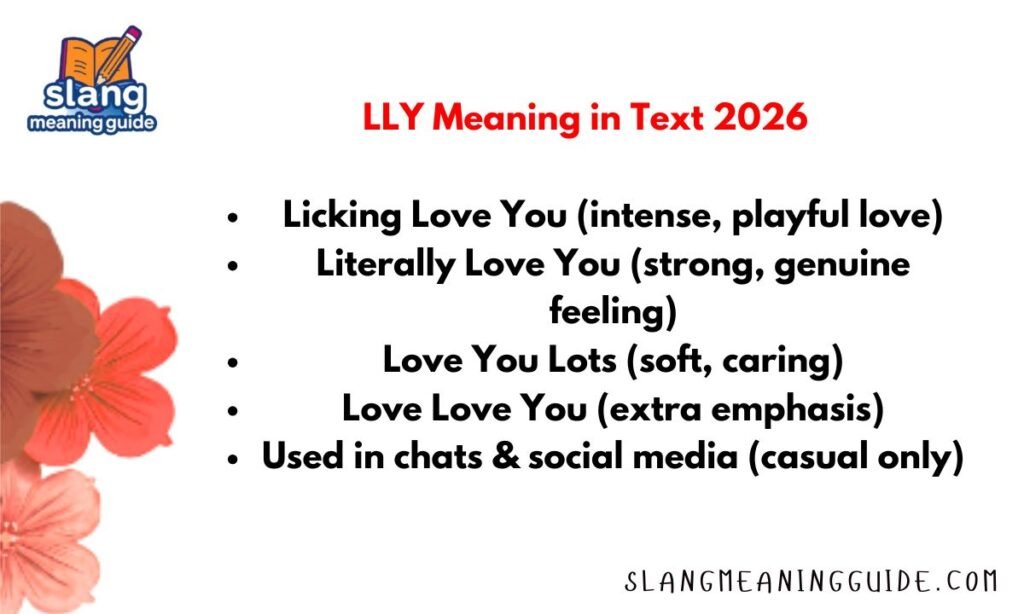
The most recognized definition of LLY is “Licking Love You.” It is an exaggerated, playful way of saying “I love you so much.” The word “licking” adds an extra layer of intensity — the sender is not just saying they love you, they are saying it overwhelmingly.
The term also stands for “Literally Love You” and “Love You Lots” in different contexts. These three meanings all revolve around affection, but they carry slightly different emotional temperatures. Understanding which one fits requires reading the conversation around it.
Where LLY Is Commonly Used
LLY travels across all the major messaging platforms. You will find it in WhatsApp conversations, Instagram DMs, TikTok comments, Snapchat streaks, and Discord friend chats.
It sits comfortably in personal, casual digital spaces. Nobody drops LLY in a professional email or a formal message. It belongs to the informal, fast-moving world of online chat — the same space where “ILY,” “LYSM,” and “XOXO” live.
Why People Use LLY in Text Messages
People use LLY because it says more than “LY” while still being quick to type. A single extra letter upgrades the emotional intensity of the whole message.
Gen Z and younger Millennials especially lean into abbreviations that feel expressive but concise. LLY fits that style perfectly. It is symmetrical, easy to type on any keyboard, and flexible enough to work in both romantic and platonic conversations.
Most Common LLY Text Meanings in 2026
LLY does not have a single locked-in definition. In 2026, three distinct meanings dominate conversations across social media and messaging apps.
Each one expresses affection — but the tone, intensity, and context behind each meaning are noticeably different.
LLY Meaning 1: “Licking Love You”
“Licking Love You” is the original and most widely cited definition of LLY. It first appeared on early internet chat platforms and dictionary sites like NetLingo, where it was defined as an expression of loving someone deeply — almost overwhelmingly so.
The phrase sounds unusual on the surface, but it works as internet hyperbole. It means: “I love you so much, words cannot quite hold it.” Between close friends or romantic partners, it lands as intense, warm, and slightly playful. Nobody is meant to take the “licking” literally.
LLY Meaning 2: “Literally Love You” or “Love Love You”
“Literally Love You” became the dominant interpretation in more recent years, especially among Gen Z users on Instagram and TikTok. Adding “literally” turns LLY into an emphasis word — a way to stress that the affection is genuine, not just a casual sign-off.
“Love Love You” follows the same logic. Doubling the word “love” creates intensity. Both versions signal that the sender wants their message to feel more real and sincere than a plain “I love you” would. This version is especially common after sharing something meaningful or after a particularly good conversation.
LLY Meaning 3: “Love You Lots”
“Love You Lots” is the warmest and softest of the three main meanings. It lands as caring and gentle rather than intense or exaggerated. This version appears most often between close friends, family members, or in early-stage relationships where things are still light and friendly.
It sits one step above “LY” (Love You) in emotional weight. It says: “I really do care about you” — without the dramatic flair of the licking interpretation. If someone sends LLY at the end of a sweet or wholesome conversation, this is almost certainly what they mean.
LLY as “Licking Love You” — Slang Use Explained
“Licking Love You” is the definition that most slang dictionaries and platforms like Urban Dictionary point to first. It is the founding meaning of LLY and the one that gave the abbreviation its distinctive character.
Understanding how it is used in real conversations makes it much easier to recognize in the wild.
What “Licking Love You” Really Means in Practice
“Licking Love You” is internet hyperbole. It works the same way that phrases like “I’m obsessed with you” or “I can’t even” work — by using dramatic language to emphasize genuine emotion.
When someone texts LLY in this sense, they are not describing a literal action. They are saying: this feeling is too big for ordinary words. It shows up in playful, emotionally open conversations between people who are comfortable expressing themselves freely.
LLY as a Playful and Flirty Expression
In romantic conversations, LLY as “Licking Love You” often carries a flirty undertone. It is more daring than “ILY” and signals that the sender is comfortable being a little bold.
It works well in the early stages of romance when someone wants to express strong feelings without writing a full paragraph. The abbreviation keeps it light enough to feel casual while still communicating genuine intensity.
How LLY Compares to “ILY” in Romantic Texts
“ILY” is the standard abbreviation for “I Love You.” It is familiar and widely understood, but it can sometimes feel automatic or routine after repeated use. LLY adds freshness and emphasis.
Choosing LLY over ILY signals intentionality. It tells the recipient: this is not a habit, this is a real feeling right now. In that sense, LLY functions as a kind of emotional upgrade in digital communication.
LLY as “Love You Lots” — Warm and Friendly Use
Not every LLY comes loaded with romantic intensity. The “Love You Lots” interpretation makes LLY one of the most versatile warmth-signals in casual texting.
This version shows up between friends, family members, and people who want to express care without anything romantic attached.
LLY Love You Lots in Everyday Conversations
“Love You Lots” fits naturally into the kinds of messages people exchange every day. Think of it as the texting equivalent of a warm hug. It is affectionate, low-pressure, and entirely non-threatening.
A parent texting their teenager. A best friend closing out a long venting session. A sibling wrapping up a phone call recap. All of these are perfect moments for LLY as “Love You Lots.”
How LLY Differs From “ILY” in Friendly Contexts
“ILY” in a friendly context can sometimes feel too intense — especially if the friendship is not the type that constantly uses “I love you.” LLY as “Love You Lots” feels warmer but lighter. It carries affection without the full weight of the three-word phrase.
This makes LLY especially useful in platonic relationships where someone wants to express genuine care without crossing any emotional lines or creating awkwardness.
LLY From a Guy vs. LLY From a Girl
The sender’s identity can add useful context to an LLY message. While the abbreviation itself is gender-neutral, the way it tends to be used can differ.
Reading those differences helps decode the message more accurately — and respond with the right energy.
What It Means When a Girl Texts LLY
When a girl sends LLY, it usually expresses genuine warmth and care. In friendships, it functions as a close, affectionate sign-off — the digital equivalent of a tight hug goodbye. Between close friends, it is completely natural and carries no romantic implication.
In romantic contexts, a girl using LLY is expressing strong, sincere affection. Whether she means “Literally Love You” or “Licking Love You,” the message is clear: this feeling is real, and she wants you to know it.
What It Means When a Guy Texts LLY
Guys tend to use LLY less frequently than girls in casual friendships, which means when a guy does send it, it often carries more weight. In a romantic context, LLY from a guy is a meaningful signal — he is stepping beyond the comfort of silence and actually expressing his feelings.
In close male friendships, LLY is less common but not unheard of, especially in the “Love You Lots” sense. If a guy sends LLY after a meaningful conversation or a vulnerable moment, it is almost always sincere and worth acknowledging warmly.
Context Matters: How to Know What LLY Really Means
The three main meanings of LLY share a family resemblance — they all express affection. But the specific flavor of affection changes depending on the situation. Reading context is the most reliable way to decode which version of LLY just arrived in your inbox.
How Tone and Relationship Change LLY
A message from your best friend of ten years reads differently from a message from someone you started talking to last week. The relationship sets the baseline. Close, comfortable relationships support more dramatic expressions like “Licking Love You.” Newer or more formal connections lean toward the softer “Love You Lots.”
Tone plays an equally big role. A playful conversation full of jokes and banter invites the bold, exaggerated LLY. A warm, supportive exchange about feelings invites the sincere, tender version.
LLY in Group Chats vs. Direct Messages
In group chats, LLY often plays to the audience. Someone might drop it after a funny moment or a wholesome story, and it lands as a collective expression of warmth. It is performative in a good way — a quick way to let the whole group feel appreciated.
In a direct message, LLY is more personal and deliberate. The sender chose to say it to you specifically. That one-on-one setting makes the message feel more intimate and worth taking seriously.
Is LLY Formal or Slang? Tone and Appropriateness
LLY is pure internet slang. It does not belong in professional emails, official documents, or any setting where formal language is expected.
That said, within personal digital communication, LLY operates across a surprisingly wide range — from heartfelt romantic messages to casual friend check-ins.
LLY as Internet Slang
LLY belongs to the same category as ILY, LYSM, BRB, and LOL. These are the abbreviations that keep digital conversations fast, warm, and personal. They evolved from the SMS era and thrived as social media took over daily communication.
In 2026, LLY remains distinctly Gen Z and younger Millennial territory. Older users tend to stick with “ILY” or type out the full phrase. This generational pattern makes LLY feel current and youth-coded in a way that older slang no longer does.
When to Use or Avoid LLY in Text
Use LLY freely in personal chats with close friends, family, or romantic partners. It works perfectly in casual social media comments and DMs. Drop it at the end of a warm conversation, after something funny, or when you want to remind someone they matter.
Avoid LLY in any professional setting. Do not use it with people you have just met unless the vibe clearly calls for it. And never use it sarcastically — because LLY is fundamentally an affectionate term, ironic usage tends to land poorly and create confusion.
Quick Reference: LLY Meanings at a Glance
| Meaning | Full Form | Tone | Common Context |
| Licking Love You | Exaggerated affection | Playful, intense | Romantic chats, close friends |
| Literally Love You | Sincere emphasis | Warm, genuine | Social media, heartfelt DMs |
| Love You Lots | Gentle affection | Soft, caring | Friendship, family, casual chat |
| Love Love You | Double emphasis | Expressive, sweet | Romantic or close friendships |
Frequently Asked Questions
What does LLY mean in text messages?
LLY usually means “Love You Lots” or “Literally Love You,” used to express strong affection in messages.
Is LLY romantic or friendly?
LLY can be both romantic and friendly depending on the relationship and context.
How is LLY different from ILY?
LLY adds extra emphasis and emotion compared to the simpler “ILY” (I Love You).
Can LLY be used in professional settings?
No, LLY is informal slang and should only be used in personal conversations.
How should I respond when someone sends LLY?
You can reply with “LLY too,” “ILY,” or a warm emoji to match the tone of the message.
Conclusion
LLY mean in text covers three core meanings — Licking Love You, Literally Love You, and Love You Lots — each carrying its own emotional intensity and ideal context. Reading the tone of the conversation and the relationship between the people involved always points you toward the right interpretation. Whether it arrives from a best friend, a romantic partner, or a family member, LLY is always a signal of genuine warmth.