
Your period showed up uninvited. A whole week ahead of schedule. Before you spiral, here’s what your body is actually telling you — and when you actually need to worry.
Is It Normal to Get Your Period a Week Early?
An early period can catch you completely off guard, especially when your cycle has been running like clockwork. But here is the honest truth: a single early period is rarely a sign that something is seriously wrong. Menstrual cycles are not rigid.
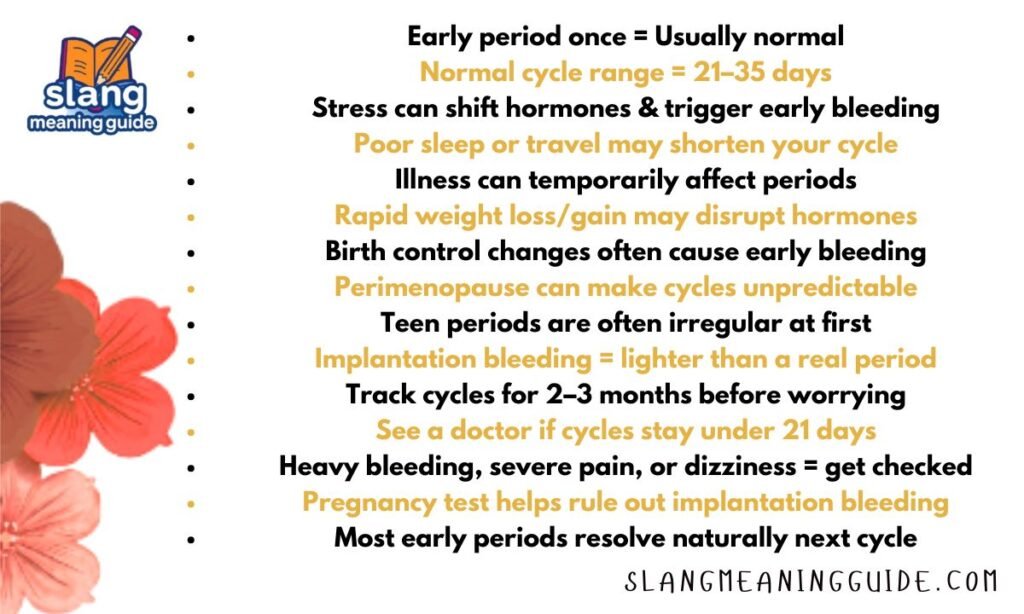
They respond to your sleep, your stress levels, what you eat, where you travel, and the hormones that shift throughout your life. Most doctors draw the line at cycles shorter than 21 days or longer than 35 days as a consistent pattern worth investigating. One week early, one time, almost always has a simple explanation.
What Counts as an “Early” Period?
A normal menstrual cycle runs anywhere from 21 to 35 days. The often-cited 28-day cycle is an average, not a universal rule. Research involving over a million women found that only about 16% have a true 28-day cycle.
So if your period shows up five to seven days before you expected it, it means your current cycle was shorter than usual. That is worth noting. It does not automatically mean something is wrong.
A period that arrives one or two days before schedule falls within normal variation. A period that arrives a full week early means your cycle ran shorter this month. If that keeps happening month after month, it is time to dig deeper.
The Most Common Reasons Your Period Came a Week Early
Several things can shorten your cycle and pull your period forward. Most of them are temporary and tied to everyday life.
Stress
Stress is one of the most common reasons cycles get disrupted. When you are under pressure, your body releases more cortisol.
Cortisol can interfere with the hormones that regulate your menstrual cycle, including estrogen and progesterone. Your hypothalamus, the part of your brain that controls hormone release, is sensitive to stress signals.
It can shift your cycle timing in response. A hard week at work, a breakup, a family crisis, even chronic low-grade anxiety can all push your period to show up earlier than expected. The good news is that your cycle usually snaps back the following month once the stressor passes.
Poor Sleep or Disrupted Routine
Your body runs on a circadian rhythm. That internal clock helps regulate hormones, including the ones that control your cycle. When your sleep schedule gets disrupted — whether from shift work, travel across time zones, pulling all-nighters, or just a few rough weeks of poor sleep — your hormonal rhythm can shift too.
Nurses and others who rotate between day and night shifts often notice irregular periods for exactly this reason. If you recently flew internationally or had a stretch of bad sleep, that alone could explain an early period.
Recent Illness
Even a garden-variety cold or flu can temporarily throw off your cycle. When your body is fighting an infection, it redirects energy and shifts hormone levels to support the immune response.
Some people notice cycle changes in the first few months after being sick. It is not permanent. Your body is just prioritizing recovery over reproductive regularity.
Significant Weight Changes
Your body fat plays a role in estrogen production. When your weight changes rapidly — whether from extreme dieting, intense new exercise, or rapid weight gain — your hormone levels can shift along with it.
This can shorten or lengthen your cycle. Athletes who train heavily and undereat are especially prone to cycle disruptions. If your weight or exercise habits have changed dramatically recently, that could be the explanation.
Birth Control Changes
Starting, stopping, or missing doses of hormonal birth control is a very common trigger for an early or unexpected period. When you start a new pill, patch, or ring, your body takes a few months to adjust. Breakthrough bleeding and shifted timing are expected during that window.
If you missed pills or forgot to change your patch, dropping hormone levels can trigger early bleeding. Emergency contraception like Plan B also contains hormones that delay ovulation — and that hormonal shift can cause your next period to arrive earlier or later than usual.
Perimenopause
If you are in your late 30s or 40s, an early period might be one of the first signs that perimenopause has started. During this transition, estrogen and progesterone levels fluctuate significantly.
Ovulation becomes less predictable. Cycles can shorten, lengthen, or become irregular in ways they never were before. Perimenopause typically begins in the mid-40s but can start as early as the late 30s for some women. It does not mean you are entering menopause — it means your hormones are in transition.
Puberty
On the other end of the age spectrum, young people who have recently started their periods can expect irregular cycles for the first couple of years. The hormonal system is still maturing. Cycles that are shorter than 21 days or longer than 45 days are common during this phase and generally resolve on their own as the body settles into a rhythm.
Could It Be Implantation Bleeding, Not a Real Period?
This is worth considering if there is any chance you might be pregnant. Implantation bleeding happens when a fertilized egg attaches to the lining of the uterus. It typically occurs around 6 to 10 days after ovulation — which can fall right around the time you would expect your period.
The difference matters. Implantation bleeding is usually much lighter than a regular period. It tends to be pink or brown, lasts a few hours to a couple of days, and does not require a tampon or pad.
A true period typically starts lighter and gets heavier, has a clear flow, and lasts at least two to three days. If you had unprotected sex during your fertile window and your “period” is unusually light, short, or brown-colored, take a pregnancy test. If it is negative but symptoms continue, test again 48 to 72 hours later.
When an Early Period Could Signal an Underlying Condition
Most early periods are harmless. But in some cases, consistently shortened cycles point to something worth addressing with a doctor.
| Condition | Key Signs |
| Thyroid disorder | Fatigue, weight changes, hair loss, irregular periods |
| PCOS | Irregular or missed cycles, acne, weight gain |
| Endometriosis | Painful periods, spotting, pain during sex |
| Fibroids or polyps | Heavy bleeding, pressure, spotting between periods |
| STIs or pelvic infection | Unusual discharge, pelvic pain, fever |
Thyroid disease is more common than most people realize. One in eight women will develop a thyroid condition at some point. Both an underactive thyroid (hypothyroidism) and an overactive thyroid (hyperthyroidism) can cause irregular periods, including cycles that are shorter than usual.
PCOS affects roughly one in ten women of reproductive age. Irregular cycles are one of its hallmark features. Periods may come early, late, or not at all. If irregular periods are paired with other symptoms like acne, excess hair growth, or difficulty losing weight, PCOS is worth discussing with your doctor.
Endometriosis occurs when tissue similar to the uterine lining grows outside the uterus. It can cause spotting before your period, painful cramps, and unpredictable cycle timing. It affects around 11% of women between ages 15 and 44 in the United States.
How to Tell If You Should See a Doctor
One early period does not require a doctor visit. Watch for patterns and red flags.
Track your next two to three cycles. Note when bleeding starts, how heavy it is, how long it lasts, and any other symptoms. A pattern of cycles consistently shorter than 21 days is worth discussing with a doctor. A one-off shift usually is not.
See a doctor sooner if you experience any of the following:
- Soaking through a pad or tampon every hour or two for more than one day
- Large blood clots, severe dizziness, or fainting
- Spotting between periods for more than two consecutive cycles
- Severe pain that stops you from functioning normally
- A positive pregnancy test alongside heavy bleeding or one-sided pain
- Any new period changes if you are under 9, over 55, or postmenopausal
These symptoms go beyond a simple early period and deserve prompt evaluation.
What You Can Do Right Now
If your period came a week early and you feel fine otherwise, here is a practical approach.
Start tracking. Use an app, a journal, or even a notes app on your phone. Log the start and end dates, flow heaviness, cramps, and anything unusual. Two to three months of data gives your doctor something concrete to work with — and gives you peace of mind.
Look at your recent life. Think back over the past few weeks. Did you travel? Sleep poorly? Go through a stressful event? Start or miss birth control pills? Make a big change to your diet or exercise routine? Any of these could be the explanation. If the answer is yes and nothing else feels off, there is a good chance your cycle will return to its usual pattern next month.
Manage stress where you can. It does not have to be elaborate. A daily walk, consistent sleep times, and even a few minutes of deep breathing can meaningfully lower cortisol. That is not just advice for your mental health — it genuinely helps regulate the hormones that control your cycle.
Eat enough. Under-eating is a surprisingly common cause of menstrual disruption. If you have been restricting calories, skipping meals, or dramatically cutting food groups, your body may not have the energy it needs to ovulate on schedule.
Take a pregnancy test if there is any doubt. It is quick, inexpensive, and removes uncertainty. If the result is negative but you still have questions, test again in a couple of days.
Frequently Asked Questions
Is it normal for my period to come a week early?
Yes, a one-time early period is usually normal and often tied to stress, sleep changes, or a disrupted routine.
Can stress actually make my period come early?
Yes — stress raises cortisol, which interferes with the hormones that regulate ovulation and cycle timing.
How do I know if it is implantation bleeding or an early period?
Implantation bleeding is lighter, shorter, and often pink or brown rather than red; take a pregnancy test to know for sure.
Should I see a doctor about one early period?
Not usually — track your next two to three cycles and see a doctor if the pattern continues or if you have severe symptoms.
Can birth control cause an early period?
Yes — starting, stopping, or missing doses of hormonal contraception commonly causes early or unexpected bleeding as hormone levels shift.
Conclusion
Getting your period a week early is rarely a reason to panic. Most of the time it reflects a temporary hormonal shift driven by stress, sleep, or lifestyle changes — and your cycle corrects itself the following month.
Track the pattern, pay attention to any additional symptoms, and reach out to a doctor if the early periods keep coming or feel different from your normal.