
Most people have opened a utility bill and felt a jolt of surprise. The amount you paid last month has nothing to do with what you owe today. Summer AC cranked up your electricity bill. Winter heat doubled your gas costs. That unpredictability makes budgeting feel like a guessing game.
Equal billing fixes that problem. It takes your yearly utility costs and spreads them out into one consistent monthly payment. No spikes. No surprises. Just the same number every single month.
What Equal Billing Means
Definition of Equal Billing
Equal billing is a payment plan offered by utility companies that averages your annual energy, gas, or water usage into fixed monthly payments. Instead of paying based on what you actually use each month, you pay the same amount every month, all year long.
You may also hear it called budget billing, levelized billing, or flat rate billing. These terms all describe the same basic idea: one predictable number, 12 months in a row.
What Bills It Usually Covers
Equal billing is most commonly available for:
- Electricity
- Natural gas
- Water and sewer services
Some utility providers offer it for all of the above. Others only offer it for one or two services. It depends entirely on your provider, so it is worth checking directly.
Equal Billing vs. Standard Usage-Based Billing
With standard billing, your monthly bill reflects exactly what you used. Use more energy in January to heat your home, and your January bill goes up. Use less in April, and it drops. Your actual consumption drives the number.
With equal billing, your bill is the same regardless of usage in any given month. The real usage is tracked behind the scenes, and any difference between what you paid and what you actually used gets settled at the end of the year.
How Equal Billing Works
How Providers Estimate Your Annual Usage
Your utility company starts by looking at your usage history, typically the last 12 months of consumption at your address. They use that data to estimate your total annual costs.
If you just moved in and there is no history on your account, the provider will usually estimate based on:
- The home’s square footage
- Usage patterns from previous occupants
- Average consumption for similar homes in your area
Some providers require 12 months of actual usage before you can enroll. Others are fine using estimates from day one. Ask your utility company directly if you are unsure.
How the Monthly Amount Is Calculated
The math is straightforward.
Example:
- Your estimated annual electricity cost: $1,440
- Monthly equal billing amount: $1,440 ÷ 12 = $120 per month
That $120 stays constant whether you crank the heat up in December or barely touch the thermostat in October.
Some providers also factor in projected rate changes for the coming year. So instead of just dividing your historical bill by 12, they adjust slightly to account for rising energy prices. This makes the estimate more accurate going forward.
Providers may also review and adjust your monthly rate every few months during the year if your actual usage is tracking significantly above or below the estimate. This helps prevent a large surprise at year-end.
What Happens at Annual Reconciliation
At the end of your 12-month billing cycle, your utility company compares what you actually paid against what you actually used.
If you overpaid: You typically receive a credit on your account, or in some cases a refund.
If you underpaid: You will owe the difference. This can come as a lump sum charge or get spread across the next billing cycle, depending on your provider.
This year-end reconciliation is the part most people forget about. It is important to keep a small financial buffer for it, especially if your usage went up mid-year due to a new appliance, a baby, working from home, or an unusually hot summer.
Why Equal Billing Helps With Monthly Budgeting
Predictable Monthly Payments
This is the main draw. When you know exactly what your utility bill will be before the month starts, you can plan around it.
That consistency turns a variable expense into a fixed one. Fixed expenses are far easier to manage in a monthly budget because you do not have to estimate or guess. You plug in the number and move on.
For people who use budgeting methods like the 50/30/20 rule or zero-based budgeting, fixed costs are essential to making the system work. Equal billing helps you build that stability into your utility spending.
Easier Cash-Flow Planning
Variable utility bills can create real cash-flow problems. A high bill during peak season might land in the same month as a car insurance renewal or a quarterly expense you forgot about. Suddenly you are stretched thin.
Equal billing removes that timing risk. You pay the same amount in July as you do in February. Your cash flow stays level all year, which makes it easier to plan savings transfers, debt payments, and other financial goals on a consistent schedule.
Less Stress During High-Usage Seasons
Seasonal bill spikes cause anxiety. Even if you have the money to cover them, the uncertainty is stressful.
Knowing your utility cost is locked in regardless of whether it is a brutal summer or a bitter winter gives you one less thing to worry about. That peace of mind is a real benefit, especially for families managing tight household budgets.
Pros, Cons, and Best Use Cases
Benefits at a Glance
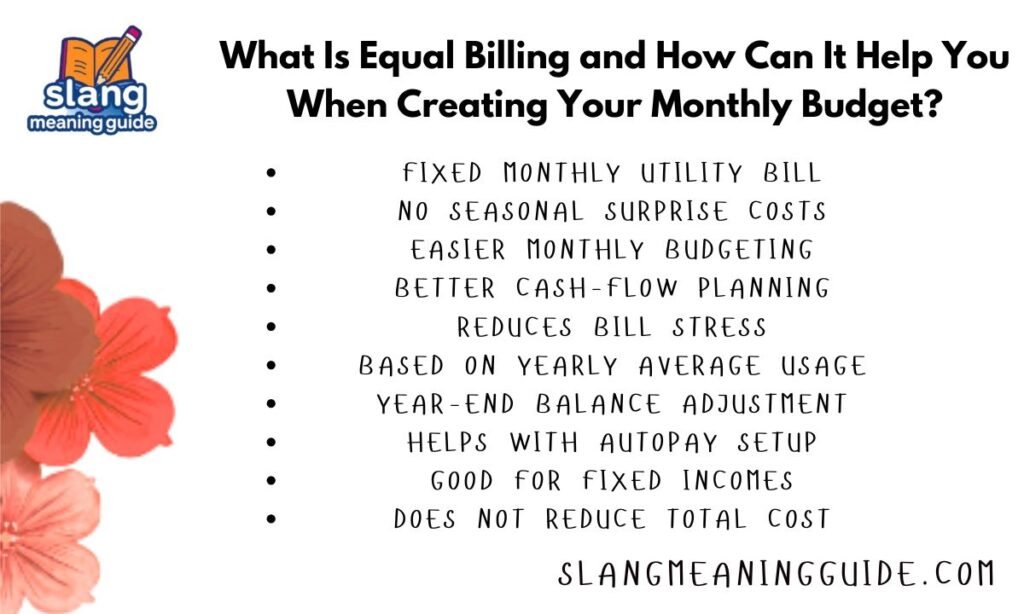
- Consistent monthly expense: Same bill every month, no matter the season.
- Easier budget tracking: One fixed line item instead of a range.
- Fewer late payments: Predictability makes autopay and scheduling simple.
- Reduced anxiety: No shock bills during peak usage months.
- Better long-term planning: Stable expenses make it easier to commit to savings goals.
Risks to Understand
You might owe money at year-end. If your usage was higher than estimated — a new baby, working from home, a hot-tub you bought in April — you could face a true-up balance at the end of the cycle. Keep a small buffer for this.
It can mask actual usage. Because the bill never changes, you might not notice that you are using significantly more energy than you did last year. Without reviewing your actual consumption, you may be surprised at reconciliation time.
Estimates can be off for new residents. If the previous occupants used very different amounts of energy than you do, your equal billing estimate may be inaccurate from the start. It will correct over time, but expect some adjustment in year one.
It does not lower your total annual cost. Equal billing is a payment smoothing tool, not a discount. You still pay for every unit of energy you actually use. The total annual bill does not change, only when you pay it does.
Who Gets the Most Value From It
Equal billing is especially useful if you:
- Live on a fixed or predictable income
- Use the 50/30/20 rule or any fixed-budget system
- Want to set up autopay and stop thinking about utility bills
- Have experienced large seasonal spikes that disrupted your budget
- Are new to budgeting and want to simplify your fixed expenses
It is less ideal if your usage changes dramatically from year to year, or if you prefer paying exactly what you use with no reconciliation surprises.
Comparison: Equal Billing vs. Standard Billing
| Feature | Equal Billing | Standard Billing |
| Monthly amount | Fixed | Varies by usage |
| Predictability | High | Low |
| Seasonal spikes | Eliminated | Present |
| Year-end reconciliation | Yes | No |
| Reflects actual monthly usage | No | Yes |
| Best for budgeting | Yes | Harder |
How to Decide If It Fits Your Budget
Step 1: Check Eligibility
Most utility providers require your account to be in good standing with no past-due balance. Many also want at least 12 months of usage history at your address. Log into your utility account online or call customer service to check.
Step 2: Review Your Usage Patterns
Pull up your last 12 months of bills. If the difference between your highest and lowest bill is significant, equal billing will have a noticeable impact on your planning. If your bills are already fairly stable year-round, the benefit is smaller.
Step 3: Plan for the True-Up
Look at your average monthly bill and compare it to the equal billing amount your provider quotes. If they are similar, your reconciliation at year-end should be minor. If the equal billing rate seems low, be prepared to set a little aside in savings each month just in case.
Step 4: Combine It With a Budget System
Equal billing works well alongside other budgeting strategies. Once your utility payment is fixed, pair it with expense tracking, a savings plan, and a small emergency fund. Having your utility cost locked in frees up mental bandwidth to focus on the rest of your finances.
Frequently Asked Questions
What is equal billing in simple terms?
Equal billing lets you pay the same fixed amount for utilities every month instead of paying different amounts based on actual usage.
Does equal billing save you money?
No. It spreads your payments evenly but does not reduce your total annual cost. You still pay for all the energy you use.
What happens if I use more energy than estimated?
At year-end reconciliation, you will owe the difference. Some providers may also raise your monthly rate mid-year if usage is running significantly higher than expected.
Can I cancel equal billing if I change my mind?
Yes, most utility companies let you opt out at any time. When you cancel, your account will be reconciled to reflect any balance owed or credit due, and you will return to standard usage-based billing.
Who should sign up for equal billing?
It is a good fit for anyone on a fixed income, new to budgeting, or dealing with large seasonal utility spikes. If you value predictability and want simpler monthly expense planning, it is worth enrolling.
Conclusion
Equal billing is one of the simplest tools available for making monthly budgeting more manageable. It does not cut your energy costs, but it does something almost as valuable — it makes those costs predictable.
When your utility bill is the same every month, you can budget with confidence. You avoid seasonal shocks, plan your cash flow more accurately, and reduce the stress of opening your bill during a heatwave or a cold snap.
If you have not looked into it yet, contact your utility provider and ask whether equal billing is available on your account. For most people, it is a small enrollment step with a noticeable impact on how smoothly the rest of the month runs.