
You are writing an essay, polishing a cover letter, or drafting a professional email — and “I believe” keeps showing up. The problem is simple: that phrase signals doubt. It weakens your argument before you even make it. This guide gives you 50+ powerful alternatives, organized by context, tone, and purpose.
What Does “I Believe” Mean in Writing?
“I believe” expresses a personal opinion or conviction. It signals that what follows is your view, not a proven fact.
The phrase feels natural in spoken conversation. In writing, especially formal writing, it often makes statements sound unsupported and subjective. Readers and markers expect evidence and reasoning, not declarations of personal faith.
Why the Phrase Loses Power in Formal Contexts
When you write “I believe,” you are essentially saying: this is my feeling, not my proof. Academic readers want the evidence to do the talking. The phrase puts the focus on the writer rather than the argument, which is the opposite of what formal writing requires.
Professional readers react similarly. A hiring manager reading your cover letter does not need to know you believe you are qualified. They want to see proof. Stating your belief is weaker than stating your record.
When Should You Avoid Using “I Believe”?
There are specific writing situations where “I believe” actively hurts your credibility. Replacing it in these contexts is not optional — it is essential.
Avoid it in:
- Academic essays and research papers
- IELTS, TOEFL, and other English proficiency exams (B2, C1, C2 levels)
- Cover letters and job applications
- Professional reports and business proposals
- Persuasive and argumentative writing
- Formal emails to clients or senior colleagues
The rule is straightforward. If the writing is being evaluated or judged, replace “I believe” with something more precise and confident.
Is “I Believe” Ever Acceptable in Essays?
Yes — but only in specific situations. Knowing the exceptions helps you use the phrase strategically rather than accidentally.
When First-Person Language Is Permitted
Some assignments specifically ask for personal reflection. Journals, opinion pieces, and narrative essays invite first-person voice. In these cases, “I believe” is acceptable because the entire point is to share your perspective.
Some instructors and exam formats also allow it. IELTS Task 2, for instance, permits phrases like “In my opinion” and “I believe.” Even then, alternating between multiple expressions makes your writing more sophisticated and vocabulary-rich.
When You Signal Personal Interpretation
In literary analysis or philosophy essays, you sometimes need to flag that your reading of a text is one interpretation among many. “I believe” can serve that purpose, though “I would argue” or “I contend” do the same job with more confidence.
The key rule: if you use it, use it once. Using “I believe” multiple times in one piece signals limited vocabulary and reduces impact.
50+ Other Ways to Say “I Believe” in an Essay
This is the core list. Each alternative includes its tone, best use case, and a clean example sentence. Use this as your writing reference.
Formal and Evidence-Based Alternatives (Best for Academic Essays)
These expressions remove “I” entirely and anchor your claim in logic or data. They are the strongest choices for essays, research papers, and analytical writing.
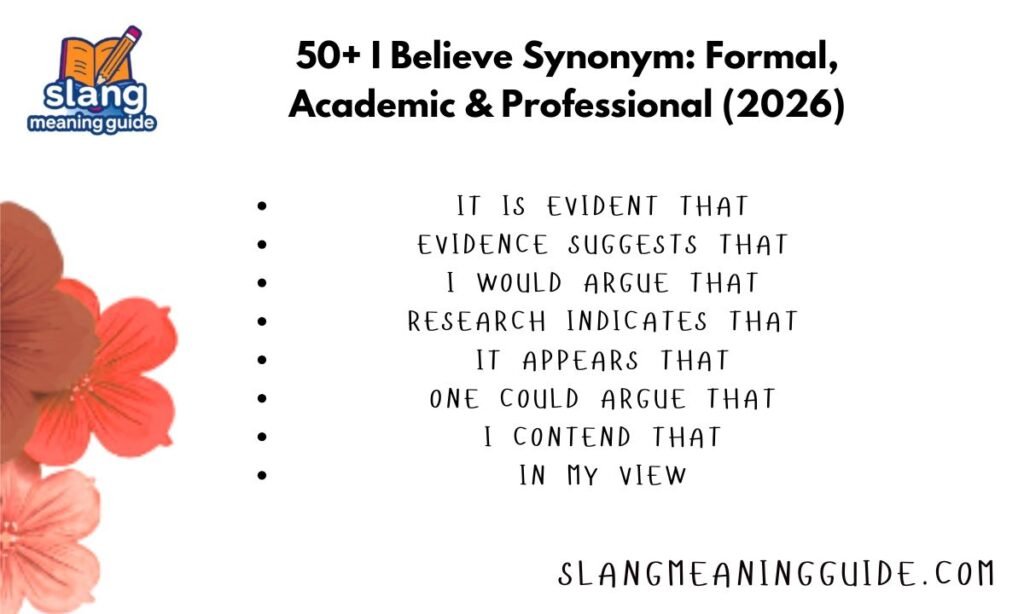
1. It is evident that Tone: Confident, formal. Use when: The point is clearly supported by facts or widely observable. Example: It is evident that economic inequality affects educational outcomes.
2. Evidence suggests that Tone: Scholarly, data-driven. Use when: You are interpreting research findings. Example: Evidence suggests that regular exercise reduces the risk of chronic disease.
3. Research indicates that Tone: Scientific, academic. Use when: Citing studies or academic sources. Example: Research indicates that sleep deprivation impairs cognitive function.
4. It can be argued that Tone: Analytical, balanced. Use when: Presenting a reasoned position in a debate or discussion essay. Example: It can be argued that social media has reshaped political discourse.
5. This demonstrates that Tone: Direct, assertive. Use when: Drawing a clear conclusion from evidence already presented. Example: This demonstrates that leadership training produces measurable results.
6. It follows that Tone: Logical, structured. Use when: Leading into a conclusion that flows from prior reasoning. Example: It follows that investment in infrastructure drives long-term growth.
7. It can be inferred that Tone: Analytical, careful. Use when: Drawing a conclusion not explicitly stated in the source. Example: It can be inferred that public trust in institutions has declined significantly.
8. It is apparent that Tone: Formal, observational. Use when: The point is noticeable from the evidence at hand. Example: It is apparent that consumer behavior has shifted since the pandemic.
9. It may be concluded that Tone: Formal, summary-focused. Use when: Wrapping up an argument or section. Example: It may be concluded that early childhood education yields lasting social benefits.
10. This suggests that Tone: Neutral, interpretive. Use when: Pointing to an implication without overstating certainty. Example: This suggests that the current policy framework requires revision.
11. The data supports the view that Tone: Empirical, authoritative. Use when: Citing measurable findings. Example: The data supports the view that automation increases production efficiency.
12. Findings suggest that Tone: Research-oriented. Use when: Discussing results of a study or analysis. Example: Findings suggest that mentorship programs reduce employee turnover.
13. This underscores the fact that Tone: Emphatic, academic. Use when: Reinforcing an important point. Example: This underscores the fact that preventive healthcare reduces long-term costs.
14. It is reasonable to assume that Tone: Careful, balanced. Use when: Making a defensible assumption based on available evidence. Example: It is reasonable to assume that demand will increase as the population grows.
15. This aligns with the view that Tone: Scholarly. Use when: Connecting your argument to established theory or prior research. Example: This aligns with the view that language acquisition peaks in early childhood.
Third-Person Alternatives (Best for Academic Writing Without “I”)
Many academic contexts require you to avoid first-person language entirely. These expressions let you share a viewpoint without using “I” at all.
16. One could argue that Tone: Academic, neutral. Use when: Presenting a position in third-person voice. Example: One could argue that digital literacy should be a core curriculum subject.
17. One might consider that Tone: Reflective, open. Use when: Inviting the reader to think through a point. Example: One might consider that access to resources shapes individual ambition.
18. It is widely accepted that Tone: Consensus-based. Use when: Referencing something broadly agreed upon in the field. Example: It is widely accepted that biodiversity loss threatens global ecosystems.
19. From this perspective, Tone: Analytical, third-person. Use when: Shifting viewpoint without introducing “I.” Example: From this perspective, urban planning must prioritize public transport.
20. This reflects the view that Tone: Connecting, formal. Use when: Showing how your argument relates to a broader position. Example: This reflects the view that institutional trust is foundational to democracy.
21. This reinforces the idea that Tone: Building, academic. Use when: Strengthening an argument you have already begun to make. Example: This reinforces the idea that consistent feedback improves team performance.
22. This supports the assertion that Tone: Confident, evidence-linked. Use when: Backing a claim with the point you just made. Example: This supports the assertion that preventive policy reduces downstream costs.
23. This highlights the idea that Tone: Emphasis-focused. Use when: Drawing attention to a key implication. Example: This highlights the idea that collaboration drives creative problem-solving.
24. This implies that Tone: Subtle, analytical. Use when: Pointing to an indirect but logical conclusion. Example: This implies that further regulatory oversight is necessary.
25. It is possible that Tone: Cautious, measured. Use when: Acknowledging uncertainty while still making a point. Example: It is possible that the long-term effects of this policy are underestimated.
First-Person Formal Alternatives (Best for Cover Letters, Emails, IELTS)
These keep “I” but upgrade the phrasing to sound more deliberate and confident. They work well in cover letters, professional emails, and exams that permit first-person voice.
26. I would argue that Tone: Assertive, formal. Use when: Taking a strong position in a persuasive essay or professional context. Example: I would argue that cross-functional teams produce more innovative solutions.
27. I contend that Tone: Confident, formal. Use when: Defending a clear stance with conviction. Example: I contend that transparent communication is essential to organizational trust.
28. I maintain that Tone: Firm, consistent. Use when: Holding a position even after considering counterarguments. Example: I maintain that ethical considerations must guide technological development.
29. In my view, Tone: Semi-formal, personal. Use when: First-person is allowed and you want a slightly softer opener. Example: In my view, the current approach to urban housing is unsustainable.
30. I am of the opinion that Tone: Formal, deliberate. Use when: You want to signal that your view is considered, not impulsive. Example: I am of the opinion that flexible work arrangements benefit both employees and employers.
31. I am convinced that Tone: Strong, confident. Use when: Expressing a position backed by experience or evidence. Example: I am convinced that my background in data analysis will benefit this team.
32. I hold the view that Tone: Formal, thoughtful. Use when: Presenting a stance in academic or professional writing. Example: I hold the view that access to education is a fundamental human right.
33. I am persuaded that Tone: Considered, formal. Use when: Showing that your position is based on reasoning. Example: I am persuaded that digital transformation requires significant cultural change.
34. I am firmly of the view that Tone: Very formal, strong. Use when: You need maximum conviction in professional or academic writing. Example: I am firmly of the view that long-term sustainability requires systemic policy reform.
35. My position is that Tone: Direct, formal. Use when: Stating your stance clearly in a debate or report. Example: My position is that universal healthcare improves overall productivity.
Cover Letter and Resume Alternatives (Best for Job Applications)
In cover letters, the goal is to state your value without hedging. These replacements drop unnecessary doubt and project confidence.
36. My experience demonstrates that Tone: Evidence-based, professional. Example: My experience demonstrates that I can manage cross-functional projects under tight deadlines.
37. My background equips me to Tone: Confident, forward-looking. Example: My background equips me to deliver results in fast-paced environments.
38. I am confident that Tone: Direct, assured. Example: I am confident that my skills align with the requirements of this role.
39. I have demonstrated Tone: Past-proof, assertive. Example: I have demonstrated consistent ability to lead teams through organizational change.
40. I bring Tone: Direct, value-focused. Example: I bring over seven years of experience in financial analysis and strategic planning.
Cautious and Hedging Alternatives (For Balanced Arguments)
Sometimes academic writing requires expressing uncertainty honestly. These phrases do that without sounding weak.
41. It seems likely that Tone: Cautious, measured. Example: It seems likely that these trends will continue into the next decade.
42. There is reason to believe that Tone: Formal, careful. Example: There is reason to believe that the treatment produces beneficial outcomes.
43. It may be suggested that Tone: Soft, academic. Example: It may be suggested that structural reform is the most viable long-term solution.
44. It appears that Tone: Observational, neutral. Example: It appears that the policy has had unintended consequences for small businesses.
45. It is likely that Tone: Probability-based. Example: It is likely that the market will stabilize within the next two years.
Transition-Based Alternatives (For Essays That Flow Between Ideas)
These work as connectors — they move your argument forward while expressing your viewpoint.
46. Overall, it can be seen that Tone: Summary, formal. Example: Overall, it can be seen that the intervention produced significant gains.
47. On balance, Tone: Weighing both sides. Example: On balance, the advantages of this approach outweigh its limitations.
48. In light of the evidence, Tone: Evidence-driven transition. Example: In light of the evidence, stricter regulation appears necessary.
49. Taken together, these findings suggest Tone: Synthesis-focused. Example: Taken together, these findings suggest a strong correlation between stress and productivity loss.
50. It is therefore reasonable to conclude that Tone: Logical, closing. Example: It is therefore reasonable to conclude that early intervention delivers measurable long-term value.
Quick Reference: Choosing the Right Alternative
Use this table to pick the right phrase for your context.
| Context | Best Alternatives |
| Academic essay | It is evident that / It can be argued that / Evidence suggests that |
| IELTS / C1 / C2 exam | In my view / I would argue that / It is widely accepted that |
| Cover letter | I am confident that / My experience demonstrates / I bring |
| Research paper | Research indicates that / Findings suggest that / The data supports |
| Persuasive essay | I contend that / I maintain that / One could argue that |
| Formal email | I am of the opinion that / My position is that / It appears that |
| Third-person only | One might consider / It can be inferred that / From this perspective |
| Balanced argument | It seems likely that / On balance / It appears that |
Common Mistakes to Avoid
Switching phrases is not enough on its own. These are the errors writers make when they try to replace “I believe.”
Overusing one alternative. Saying “it is evident that” five times in one essay is just as weak as repeating “I believe.” Vary your expressions.
Using a formal phrase without supporting evidence. Writing “evidence suggests that” and then offering no evidence is worse than using “I believe.” The phrase sets an expectation. Meet it.
Choosing the wrong tone for the context. “I am convinced that” works in a persuasive essay but sounds odd in a lab report. Match the phrase to the writing type.
Adding hedging phrases when confidence is needed. In a cover letter, “it seems possible that I could contribute” is far weaker than “I am confident I can contribute.” Save caution for academic arguments, not job applications.
Frequently Asked Questions
What is a formal synonym for “I believe”?
“It can be argued that,” “I contend that,” and “Evidence suggests that” are strong formal alternatives suited to essays and professional writing.
Can I use “I believe” in an IELTS essay?
Yes, but limit it to once and prefer stronger alternatives like “In my opinion” or “I would argue that” for higher band scores at B2, C1, or C2 level.
What should I say instead of “I believe” in a cover letter?
Replace it with confident, evidence-backed phrases like “My experience demonstrates” or “I am confident that” — both project more authority.
What is a third-person alternative to “I believe”?
“One could argue that,” “It is evident that,” and “From this perspective” all express a viewpoint without using first-person language.
What is the difference between “I believe” and “I would argue”?
“I believe” sounds personal and feeling-based. “I would argue” signals that a reasoned case follows, making it far stronger in formal writing.
Conclusion
“I believe” is not a bad phrase — it is just the wrong tool for most formal writing situations. Replacing it with precise, evidence-linked, or context-appropriate alternatives makes your essays more credible, your cover letters more compelling, and your professional emails more authoritative. Use this list as a reference every time you write, and your arguments will do the convincing without a single hedging phrase holding them back.