
Three letters. Zero confusion — once you know what they stand for. ICL is everywhere in 2026. TikTok comments, Snapchat DMs, Instagram captions. And if you still don’t know what it means, you’re about to find out — completely.
What Does ICL Mean?
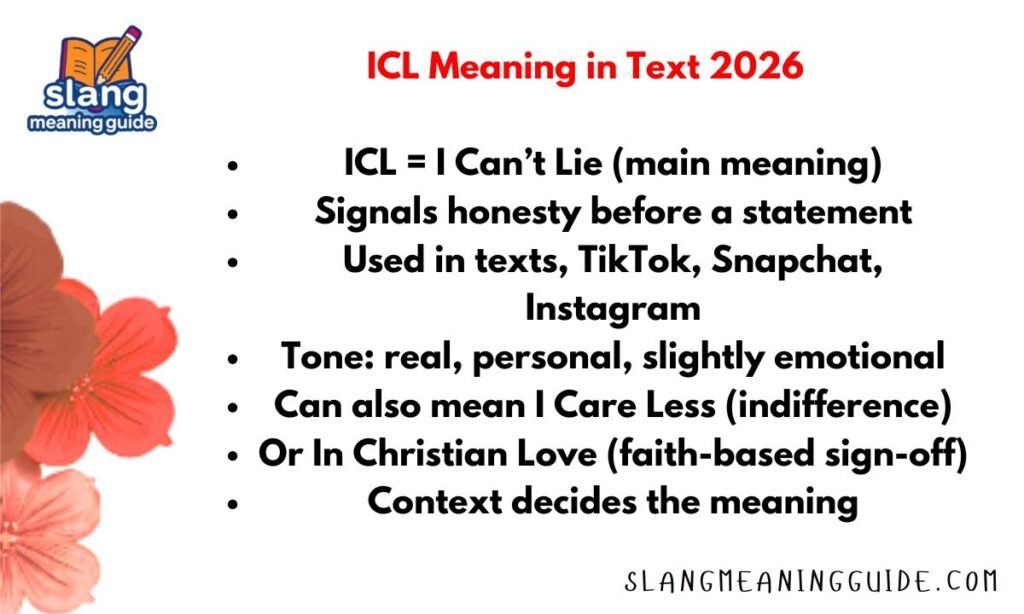
ICL stands for “I Can’t Lie.” It is a texting abbreviation used to signal honesty before making a statement. Think of it as a digital truth badge — a quick way to tell the reader: what comes next is real.
The ICL acronym belongs to the broader family of Gen Z slang that prioritizes short, punchy expressions over long sentences. It signals sincerity without drama. It adds emotional weight without sounding over the top.
ICL Full Form
ICL is short for “I Can’t Lie.” That is its full form in the context of digital communication, texting abbreviations, and social media slang. The phrase existed long before the internet — people have always said “I can’t lie” in everyday speech. The internet just made it shorter.
ICL grew from casual speech into a recognized internet slang term through texting culture in the early 2020s. Its simplicity made it stick. Three letters replaced five words. That trade-off fits perfectly into the speed-first culture of modern messaging.
ICL Slang Definition
As a slang term, ICL works as a sentence opener. It frames whatever follows as an honest, personal opinion or feeling. It softens statements while making them feel more genuine.
The ICL slang definition goes beyond just “I Can’t Lie.” It carries an emotional tone. When someone writes “ICL, that hit different,” they are not just being honest — they are being vulnerable. That subtle layer of emotion is what separates ICL from colder, more neutral phrases.
ICL in Modern Internet Language
In 2026, ICL is fully mainstream. It is no longer niche slang limited to specific online communities. Gen Z uses it casually across platforms. Younger millennials have picked it up. Even some brands now use it in captions to sound relatable.
ICL sits comfortably alongside other honesty-based acronyms like TBH, NGL, and No Cap. It has earned its place in modern internet language because it fills a specific emotional gap: the need to express raw, unfiltered honesty in a way that still feels warm and approachable.
ICL Meaning in Text
In texting, ICL is most powerful because text messages strip away tone of voice and facial expressions. You cannot hear sarcasm. You cannot see a smile. ICL fixes that gap. It tells the reader exactly how serious the sender is being.
The ICL meaning in text is about more than honesty — it is about trust. When someone opens a message with ICL, the reader knows to take the next part seriously. It creates a sense of intimacy in casual conversation.
ICL on TikTok
TikTok is where ICL really exploded. Creators use it in captions, voiceovers, and comment replies. It pairs especially well with emotional or vulnerable content. A creator might write “ICL, this song changed how I see things” under a relatable edit.
On TikTok, ICL carries a slightly heavier emotional tone than in casual texting. The platform rewards authenticity and vulnerability. ICL fits that culture perfectly. It signals that a creator is being real, not performing.
ICL on Snapchat
Snapchat DMs are fast and private. ICL thrives in that environment. Users drop it casually when sharing a personal take or reacting to something genuine. It keeps conversations honest without making them feel heavy.
On Snapchat, ICL appears in quick replies and streaks. It is lightweight but sincere. Someone might snap back with “ICL that outfit is fire” — short, real, and direct. No fluff. Just honest feedback delivered fast.
ICL on Instagram
Instagram users drop ICL in captions and comment sections. Influencers use it to make their posts feel less curated and more personal. It signals to followers: this is my actual opinion, not a sponsored take.
In DMs, ICL works the same way it does on Snapchat. It makes honest compliments and reactions feel more genuine. In comment sections, it adds personality to a short reaction without requiring a full sentence of context.
ICL Usage Examples
Seeing ICL in real sentences makes the meaning click instantly. Context is everything with chat slang, and examples show exactly how this texting abbreviation works in practice. The examples below cover different tones and situations.
Honest Opinion Examples
ICL is most often used before sharing a genuine opinion. These examples show that clearly:
- “ICL, that was the best meal I’ve had all year.”
- “ICL, your feedback actually helped me improve.”
- “ICL, I wasn’t expecting to like that show — but here we are.”
Each sentence starts with ICL to frame the honest opinion that follows. The phrase makes the statement feel personal and deliberate.
Casual Conversation Examples
ICL also works in light, everyday conversation. It does not always need to carry deep emotion. Sometimes it just replaces “honestly” in a relaxed exchange.
- “ICL, I completely forgot we had plans today.”
- “ICL, I thought that game was overrated.”
- “ICL, your new profile picture is a huge upgrade.”
The tone in these examples is lighter. ICL here is a natural, casual filler — not a confessional moment, just an easy honesty signal.
Gen Z Texting Examples
Gen Z uses ICL with a specific energy that blends humor, irony, and sincerity. These examples reflect that style:
- “ICL, my brain stopped working after 3 PM.”
- “ICL, we really ate and left no crumbs on that project.”
- “ICL, the plot twist destroyed me.”
These examples show how ICL fits Gen Z’s conversational tone. It is honest but relaxed. Serious but still fun. That balance is what makes the phrase so widely used.
Other Meanings of ICL
The dominant meaning of ICL is “I Can’t Lie.” But the acronym does carry other interpretations depending on context. Understanding these alternate meanings helps avoid confusion in different conversations and communities.
| ICL Meaning | Context |
| I Can’t Lie | Texting, TikTok, Snapchat, Instagram — most common |
| I Care Less | U.S. slang for showing indifference or emotional distance |
| In Christian Love | Faith-based communities, used to close messages warmly |
| I Chuckled Lightly | Rare online humor expression, subtle laugh reaction |
| I Cried Laughing | Extreme humor response, less common than LOL |
Religious Meaning of ICL
In Christian communities and faith-based group chats, ICL sometimes means “In Christian Love.” It is used to close messages — similar to how some people sign off with “blessings” or “grace and peace.” This meaning is warm and community-specific.
If you see ICL at the end of a message in a faith-based context, it almost certainly means “In Christian Love.” The surrounding conversation and community will make this clear. Context clues are everything with this variation.
Less Common Acronym Meanings
“I Care Less” is a secondary slang meaning of ICL. It signals indifference or emotional distance. Someone might write “ICL about the drama, honestly” to show they are not affected by gossip or conflict.
This version has a completely different tone from “I Can’t Lie.” Where “I Can’t Lie” is warm and honest, “I Care Less” is cool and detached. The emotional register flips entirely. Be careful about context here — misreading this could cause confusion in a conversation.
Meaning Based on Context
ICL’s meaning shifts based on the platform, the relationship between users, and the surrounding message content. No single meaning applies everywhere. Reading the context is essential.
A message that starts with ICL followed by praise almost certainly means “I Can’t Lie.” A message where ICL appears in the middle of a sentence about not caring probably means “I Care Less.” The surrounding words do the heavy lifting.
Is ICL the Same as TBH or NGL?
ICL, TBH, and NGL all express honesty — but they are not identical. Each carries a different emotional tone and is used in slightly different ways. Knowing the difference helps you choose the right one for the right moment.
Similar Slang Terms
TBH means “To Be Honest.” NGL means “Not Gonna Lie.” ICL means “I Can’t Lie.” All three are honesty markers. All three signal that the speaker is about to say something real. They function similarly as sentence openers in casual messaging.
The key similarity is purpose. Each acronym prepares the listener to receive a genuine statement. They all serve as social signals that say: pay attention, this part is real. That shared function makes them feel interchangeable — but they are not quite.
Differences in Tone
NGL tends to feel slightly older in internet terms. It became popular earlier and carries a cooler, more neutral energy. ICL feels fresher and more emotionally open. It is warmer than NGL and more specific than TBH.
TBH is often used before general opinions that do not carry strong emotion. ICL is more personal. It suggests something slightly more vulnerable or surprising is coming. That emotional weight is what sets ICL apart from its closest competitors.
When to Choose Each Acronym
Use TBH when sharing a general, mild opinion. Use NGL when softening a blunt take. While Use ICL when what you are about to say is genuinely honest, personal, or emotionally weighted. The right choice depends on how much sincerity you want to convey.
Think of it this way: TBH is a slight lean forward. NGL is a small confession. ICL is a moment of real honesty. Each level of intensity has its own word.
When Not to Use ICL
ICL is powerful in casual settings — but it has clear limits. Using it in the wrong context can confuse people or make you seem unprofessional. Knowing when to hold back is just as important as knowing how to use it.
Avoid ICL in formal emails, professional reports, academic writing, and workplace communication. It belongs in casual digital spaces only. Most people outside of Gen Z and younger millennials will not understand it immediately — and that confusion defeats the purpose of using it.
Formal Email Limitations
ICL does not belong in professional emails. Period. If you are writing to a client, manager, recruiter, or professor, skip the slang entirely. Abbreviations like ICL can make you appear careless or unprepared in formal contexts.
Replace ICL with plain language in professional writing. Instead of “ICL, I think this approach has issues,” write “To be direct, I have concerns about this approach.” The meaning is the same. The register is appropriate.
Workplace Communication
Even in casual workplace messaging apps like Slack or Teams, ICL should be used carefully. It depends entirely on your workplace culture. In a young, creative team it might fit. In a formal corporate environment it would likely feel out of place.
When in doubt, use words instead of acronyms at work. The risk of being misunderstood is not worth the few characters you save. Clarity always wins in professional settings.
Misunderstanding Risk
ICL can be misread easily if the reader does not know the slang. Someone unfamiliar with the term might guess it means something completely different — or simply be confused by it. This kills the honest, clear communication ICL is supposed to create.
Use ICL where you are confident the other person speaks the same digital language. With close friends and online contacts who use similar slang, it works perfectly. With anyone outside that circle, spell it out.
Frequently Asked Questions
What does ICL mean in text?
ICL means “I Can’t Lie” — it is used to signal honesty before sharing a genuine opinion or feeling.
Is ICL slang for “I can’t lie”?
Yes, “I Can’t Lie” is the primary and most widely used meaning of ICL across all platforms.
What does ICL mean on TikTok?
On TikTok, ICL means “I Can’t Lie” and is commonly used in captions and comments to express authentic, emotional reactions.
Does ICL have more than one meaning?
Yes — ICL can also mean “I Care Less,” “In Christian Love,” or “I Chuckled Lightly,” depending on context.
Is ICL formal or informal?
ICL is completely informal slang. It is not appropriate for professional emails, academic writing, or formal communication of any kind.
Conclusion
ICL is one of the most versatile honesty signals in modern texting and social media slang. It packs real emotional weight into just three letters, making it a go-to choice for Gen Z across TikTok, Snapchat, Instagram, and everyday text messages. Understanding ICL — and its alternate meanings — gives you the tools to read digital conversations more accurately and communicate more naturally in online spaces.