
You just got a text that says “kms” and now you’re staring at your screen. Does your friend need help? Are they joking? Is this serious? This guide breaks it all down — fast, clearly, and honestly.
What Does KMS Mean in Text?
KMS is one of the most misunderstood abbreviations in texting today. It shows up on Snapchat, Instagram, TikTok, iMessage, and almost every chat app. The meaning depends heavily on context, tone, and who sent it.
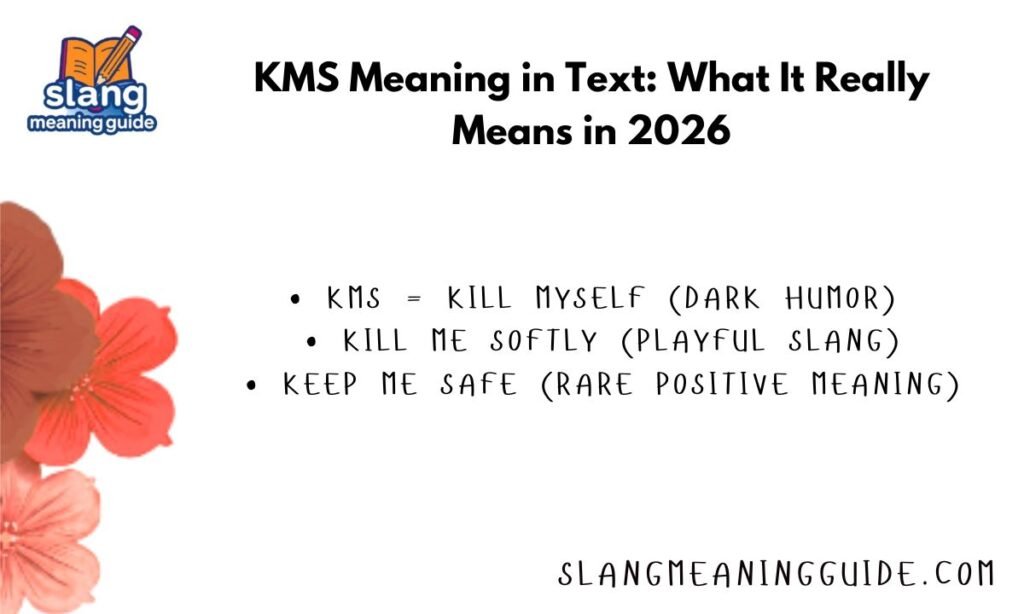
Kill Myself
The most common meaning of KMS is “kill myself.” But before you panic — most of the time, it is not literal. Teens and young adults use it as a dramatic way to say they are frustrated, embarrassed, or exhausted. It functions like an exaggerated eye-roll in text form.
Example: “I just tripped in front of everyone at school kms.” The person is embarrassed. They are not in danger. This is a venting expression used casually among close friends.
Kill Me Softly
“Kill me softly” is a slightly more playful variation. It carries the same exaggerated frustration energy but with a softer, more humorous edge. You might see this version used when something is cringey or painfully awkward.
Example: “My mom just read my diary out loud at dinner… kill me softly.” It is still dramatic, still a joke, but with a touch more flair. Gen Z loves this version for its theatrical feel.
Keep Me Safe
This is a much rarer use of KMS. You might see it in heartfelt messages, song lyrics, or prayer-style captions on Instagram. It flips the meaning completely from dark humor to something warm and protective.
Example: “God kms through every storm.” This context is positive, spiritual, and emotionally open. It is important to recognize this meaning when the surrounding content is uplifting.
How KMS Is Used in Real Conversations
People use KMS differently depending on the platform and relationship. Knowing the context tells you almost everything you need to know.
From a Girl
Girls often use KMS to vent about social stress, embarrassing moments, or overwhelming schedules. It tends to come with more emotional detail. “I have three exams tomorrow and my car broke down kms” is a classic example of how girls use it to release frustration in a relatable way.
They also use it as a bonding tool. When a friend shares something relatable, responding with “same kms” signals empathy and connection. It is a way of saying “I completely understand your pain.”
From a Boy
Boys tend to use KMS in shorter, punchier ways. Less emotional buildup, more blunt delivery. “Lost the game in overtime kms” or “coach made us run laps again kms” — simple, direct, and clearly joking.
It also appears heavily in gaming culture. Male gamers use KMS constantly after a bad match, a missed shot, or a frustrating loss. In that world, it is basically a synonym for “I’m so done right now.”
On Snapchat and Instagram
On Snapchat, KMS appears in streaks, quick replies, and story reactions. It is fast and throwaway. Nobody is writing an essay — it is used for quick emotional shorthand.
On Instagram, you see it in comment sections and caption responses. Someone posts a relatable meme and the comments fill up with “kms this is literally me” or “ok but kms why is this so accurate.” It is part of the platform’s humor language.
KMS in Gen Z Slang Culture
KMS is deeply embedded in Gen Z’s online vocabulary. This generation grew up using dark humor as a coping tool, and KMS fits perfectly into that style of communication.
It sits alongside phrases like “I’m dead,” “I can’t,” and “I want to disappear” — all used casually to express strong emotion without literal meaning. This is how Gen Z processes stress publicly: through humor, hyperbole, and community.
KMS on TikTok
TikTok turned KMS into a content staple. Creators use it in text overlays, voiceovers, and comment threads. A video of someone making a social blunder might have “kms” stitched right into the caption.
Comment sections under relatable content are flooded with it. “This is me every Monday kms” or “my professor just cold-called me kms.” On TikTok, KMS signals that you found something painfully, hilariously relatable.
KMS in Gaming Communities
Online gaming communities use KMS more than almost any other group. After a missed shot, a server crash, or an impossible boss — “kms” is right there. It is the verbal equivalent of slamming your controller down, minus the actual damage.
Platforms like Discord and Twitch chat are full of it. In gaming, nobody bats an eye. Everyone knows it is frustration, not a crisis. The context makes it completely clear.
Is KMS Rude or Offensive?
KMS can feel jarring to older generations or people unfamiliar with internet slang. To many parents, teachers, or coworkers, seeing “kms” in a message could feel alarming or inappropriate.
Within Gen Z peer groups, though, it is not considered rude. It is a normalized expression. That said, using it in professional settings, with older family members, or with people who struggle with mental health is a bad idea. Read the room before you type it.
How to Respond When Someone Says KMS
Your response should match the energy of the message. Most of the time, a casual reply is perfectly fine.
Casual replies:
- “Same honestly lol”
- “Bro why are you like this 😭”
- “Noooo what happened”
Funny replies:
- “Not before you tell me what happened”
- “You can’t kms until you spill the tea”
- “We kms together or not at all”
Neutral replies:
- “That bad huh?”
- “Tell me everything”
Professional or concerned reply: If something feels off — if the message is unusually quiet, arrives out of nowhere, or follows a hard conversation — check in genuinely. Ask “hey are you okay?” without drama. Your instinct matters.
When Should You Actually Worry About KMS?
This is the most important question. Most uses of KMS are harmless. But some are not. Knowing the difference could matter.
Signs It Is Just a Joke
The tone is light. There is an lol, an emoji, or a funny story attached. The person is their usual self in the conversation. They use it often and casually. It follows something embarrassing or frustrating but not devastating.
Signs It Might Be Serious
The message comes out of nowhere with no context. The person has been quiet or withdrawn lately. There are no emojis, no humor, no follow-up. It is paired with phrases like “nobody cares” or “I’m done with everything.” The person has mentioned real pain recently.
If any of these apply, do not assume it is just slang. Reach out. Ask directly. Be present. You do not need to be a therapist — you just need to be a friend.
KMS vs Similar Slang Terms
| Slang | Meaning | Tone |
| KMS | Kill myself | Dark humor / frustration |
| KMSL | Kill myself laughing | Humor |
| IKR | I know right | Agreement |
| SMH | Shaking my head | Disappointment |
| NGL | Not gonna lie | Honesty |
| DWU | Don’t wait up | Casual / dismissive |
| FTO | For the one | Affection / respect |
| ATP | At this point | Exasperation |
These terms often appear together. “Ngl kms this week has been atp the worst” is a perfectly normal Gen Z sentence. Breaking it down: honestly, I’m exhausted, at this point this week has been the worst.
KMS Meaning on Different Platforms
The platform changes the weight of KMS significantly. Here is a quick breakdown.
Text message: Usually more personal. If someone texts you KMS one-on-one, pay a bit more attention than if they posted it publicly.
Snapchat: Very casual. Often used in streaks, reactions to stories, or quick venting. Low concern level in most cases.
Instagram: Public and performative. Used in captions and comments for relatability. Almost always a joke.
TikTok: Extremely normalized. Appears constantly. Virtually never literal in this context.
Discord/Gaming: Zero concern level. It is essentially punctuation in gaming chat.
How to Talk to Your Kid About KMS
If your child uses KMS and you are not sure what to make of it, do not panic or punish. Instead, open a calm conversation. Ask what it means to them, where they learned it, and how their friends use it.
This approach builds trust. Kids who feel safe talking to their parents are more likely to tell you if something is actually wrong. Treating normal slang as a crisis creates distance — not safety.
Keep the conversation light unless there is a real reason for concern. Slang literacy as a parent is a genuine advantage. Understanding how your kid communicates is how you stay connected.
Frequently Asked Questions
What does kms mean in texting?
KMS most commonly means “kill myself” and is used as dramatic slang for frustration or embarrassment, not literally.
Is kms always serious?
No. In most cases it is casual dark humor, especially in teen and Gen Z conversations online.
Can I use kms at work or in school?
No. It is inappropriate in professional or formal settings and can be misunderstood by people unfamiliar with the slang.
Does kms mean the same thing from a girl and a boy?
The meaning is the same, but tone and context may differ slightly. Girls tend to attach more emotional context, boys tend to use it more bluntly.
What should I do if I am worried someone meant it seriously?
Reach out directly and calmly. Ask how they are doing. Do not overthink the approach — just show you care.
Conclusion
KMS meaning in text is almost always dark humor, not a genuine cry for help. It lives in the same category as “I’m dead” and “I can’t even” — exaggerated frustration used to connect with others. But context always matters, and when something feels off, checking in costs nothing and could mean everything.