
You’ve seen the word pop up in texts, dating profiles, or online forums. It made you pause. It sounds technical, a little edgy, and maybe even confusing. Before you assume anything, the real meaning is more layered — and more grounded in trust — than most people expect.
Quick Answer: What Does “Rigger Meaning in Bed” Really Mean?
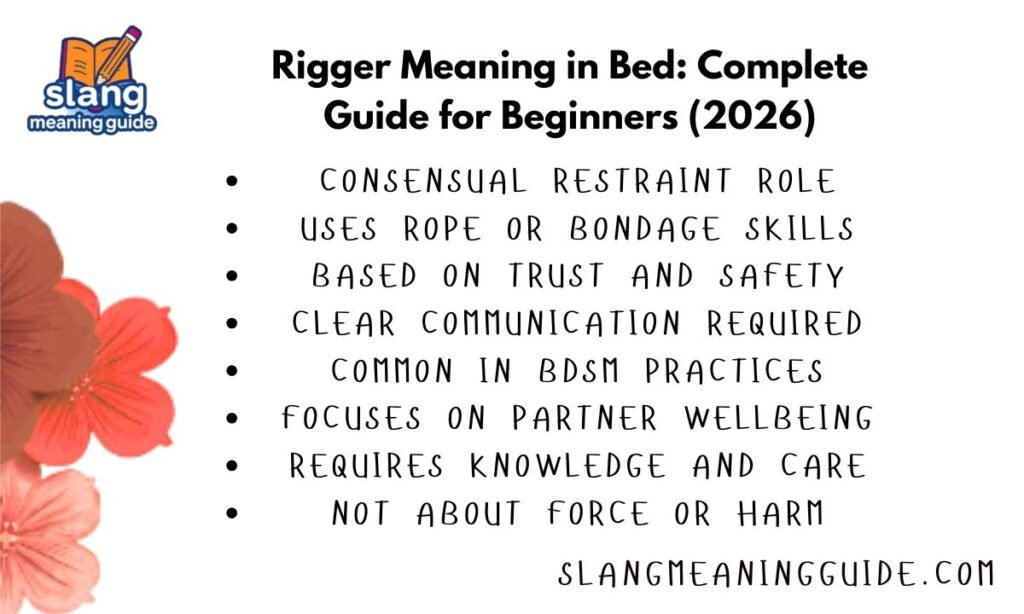
A rigger in bed is a person who ties, restrains, or binds their partner during consensual intimate activity — most commonly within BDSM or bondage practice. The role is built entirely on skill, safety, and mutual agreement.
- A rigger is the one who applies the restraints (ropes, straps, etc.)
- Their partner — often called a “rope bunny” — is the one being restrained
- The dynamic is always consensual and agreed upon in advance
- It is not about force, control outside agreed limits, or dominance alone
Meaning of Rigger in Different Contexts
The word “rigger” doesn’t mean the same thing everywhere. Context shapes the definition entirely.
In Texting and Messaging
When someone uses “rigger” in a text or DM, they usually mean one of two things:
- BDSM context → referencing their role in rope bondage or restraint play
- Casual flirting → hinting they like to “take the lead” in intimacy
- Slang shorthand → used in kink-friendly spaces to signal identity or preference
- It rarely appears in everyday texting unless the conversation is already about intimacy or lifestyle preferences
In Love and Relationships
In a relationship, the rigger role goes deeper than physical technique:
- A rigger often acts as the emotionally responsible partner during a scene
- They check in, adjust, and ensure their partner feels safe and valued
- Good riggers tend to be strong communicators inside and outside the bedroom
- The role builds a specific type of trust that many couples describe as deeply bonding
In Slang and Casual Language
Outside strict BDSM circles, “rigger” is sometimes used loosely:
- To describe someone who naturally takes charge in romantic or sexual situations
- As an identity label on dating apps or in bio sections
- Occasionally used humorously to mean someone who “sets things up” in a relationship
- Can be misused or misunderstood — context always matters
On Social Media Platforms
On platforms like Reddit, TikTok, and Twitter/X:
- Rigger appears in kink education content, rope art communities, and lifestyle discussions
- Hashtags like #shibari and #ropebondage often overlap with rigger identity
- Many creators post educational content on technique, safety, and communication
- The term has grown mainstream enough that non-BDSM audiences now search it regularly
Spiritual or Symbolic Meaning
Some within kink communities attach a deeper meaning to the rigger role:
- The act of tying is seen as a form of ritual — intentional, focused, and present
- Japanese rope bondage (Shibari/Kinbaku) carries artistic and meditative roots
- For some, being a rigger represents a caretaker archetype — holding space, not just rope
- The rope itself can symbolize connection, vulnerability, and trust made visible
Numerology or Cultural Meaning
There is no significant numerological meaning tied to “rigger.” Culturally:
- The word traces back to sailing and maritime work — a rigger set up ropes and rigging on ships
- That technical, careful, rope-skilled identity transferred into BDSM language
- In the film and theater industry, a rigger still refers to someone who manages ropes, cables, and rigging equipment for productions
- The BDSM usage borrowed the precision and responsibility of the original trade meaning
Examples and Usage
Real-world examples make this much easier to understand.
Text conversation example:
Person A: “Would you call yourself a rigger or more of a rope bunny?” Person B: “Definitely a rigger. I love the preparation and making sure my partner feels completely safe.”
Dating app bio example:
“Into Shibari, active rigger, consent-first always.”
Casual conversation example:
“She said her partner is a rigger — apparently they’ve been doing rope bondage for years.”
How Context Changes Meaning
| Setting | What “Rigger” Means |
| BDSM community | Person who performs rope bondage safely and skillfully |
| Dating app | Someone who takes the lead in intimate experiences |
| Film/theater set | Technician managing ropes, cables, and rigging gear |
| Sailing/maritime | Worker who installs and maintains ship rigging |
| Casual texting | Person signaling they like to guide or lead intimacy |
The setting tells you almost everything. A rigger on a film set has nothing to do with a rigger in bed — same word, completely different world.
Personality Traits of a Rigger
People who identify as riggers in intimate contexts tend to share common qualities:
- Patient — tying safely takes time; rushing is a safety risk
- Detail-oriented — they study knots, pressure points, and anatomy
- Emotionally attuned — they read their partner’s body language constantly
- Strong communicators — they negotiate clearly before and during any scene
- Creative — many treat rope work as an art form, not just a function
- Responsible — they carry safety scissors and know how to respond to emergencies
Common Mistakes and Misconceptions
Many people get this wrong the first time they encounter the term:
Misconception: A rigger is just someone who ties people up aggressively
Reality: A rigger prioritizes safety, consent, and partner wellbeing above everything
Misconception: Only dominant people are riggers
Reality: Riggers can operate in any dynamic — the role is about skill, not dominance
Misconception: It’s always sexual
Reality: Some people practice rope bondage for the art, the meditation, or the connection — not always for sexual purposes
Misconception: Anyone can do it without training
Reality: Improper tying can cut off circulation, compress nerves, or cause injury — education matters
Misconception: The term only applies to men
Reality: Any gender can be a rigger — the role is not gendered
Modern and Relatable Examples (Updated for 2026)
The term has shifted with the times. Here’s how it shows up today:
- On dating apps, users list “rigger” alongside other identity markers like relationship style or communication preference
- In TikTok comment sections, people ask what rigger means and receive educational, non-judgmental answers
- Online BDSM communities host rigger certification workshops and beginner rope classes
- Couples use the word in private conversation to define roles without lengthy explanation
- Some therapists and relationship coaches now discuss rigger dynamics in the context of trust-building and vulnerability
Rigger Essentials for Beginners
If you’re new to this role or curious about it, here’s what to know first:
Before you start:
- Research basic rope safety and anatomy (nerves, circulation, pressure points)
- Have a clear, detailed consent conversation with your partner
- Agree on a safe word or non-verbal signal before anything begins
- Keep safety scissors within arm’s reach at all times
During:
- Check in with your partner regularly — verbally and by reading body language
- Never leave a restrained partner unattended
- Watch for signs of numbness, tingling, or color change in the skin
- Go slow — especially as a beginner
After:
- Practice aftercare — this means checking in emotionally and physically after the scene ends
- Debrief together about what felt good and what to adjust
- Clean and store rope properly for the next session
Frequently Asked Questions
What does “rigger” really mean in a sexual context?
A rigger is the person who ties or restrains their partner during consensual bondage or BDSM play — always based on agreed-upon rules and clear communication.
Is being a rigger positive or negative?
It’s neutral to positive — within consensual relationships, it represents skill, trust, and care, not harm.
Is a rigger role romantic?
It can be deeply intimate, but it’s more about trust and connection than traditional romance — many couples describe it as a unique form of emotional bonding.
How should someone respond if a partner says they’re a rigger?
Ask questions, express your comfort level honestly, and research together — open communication is the only right answer.
Does being a rigger require professional training?
Formal certification isn’t required, but learning proper technique through workshops, books, or experienced mentors is strongly recommended for safety.
Conclusion
A rigger in bed is not a complicated concept once the context is clear. It describes a person who takes on the skilled, responsible role of restraining a partner — always with consent, always with care. The term has roots in maritime work, evolved through BDSM communities, and now appears in everyday dating language.
Whether you encountered it in a text, on a dating app, or in a conversation, the core meaning stays the same: skill plus trust plus consent equals the rigger role. Understanding it fully means understanding that the rope is never the point — the connection is.