

Your semester GPA tells one chapter. Your cumulative GPA tells the whole story. Most students track grades every term but never fully understand what cumulative GPA actually measures — or why it follows you for life. This guide breaks down every angle: definition, calculation, types, common mistakes, and what your number really means.
What Does Cumulative GPA Mean?
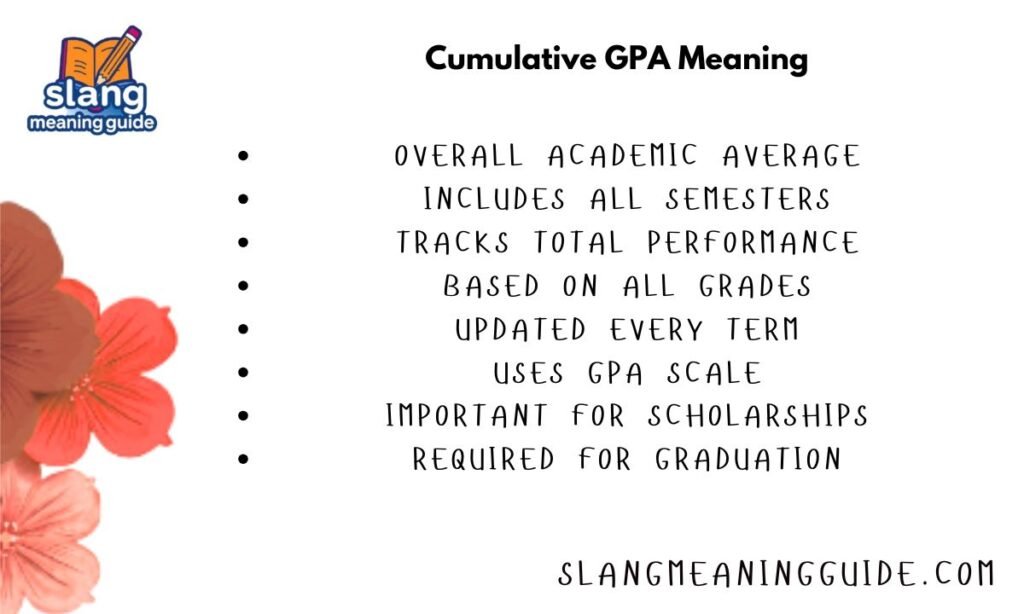
Cumulative GPA (Grade Point Average) is the overall academic average of every grade you have earned across all semesters, terms, or academic years in a program. It is a running calculation — updated after every term ends.
It reflects your complete academic performance record, not just one class or one period of time.
- Cumulative = all courses, all semesters, combined
- GPA = Grade Point Average — a numerical expression of your grades
- Scale = typically 0.0 to 4.0 in the US system
- Updated = recalculated every time a new semester concludes
- Permanent = stays on your transcript unless officially reset or forgiven
Simple examples:
- “My semester GPA was 3.8, but my cumulative GPA is 3.5 because of a rough first year.”
- “Even though I improved this term, my cumulative GPA still reflects earlier lower grades.”
- “My program requires a minimum cumulative GPA of 2.0 to remain enrolled.”
Does Cumulative GPA Mean All Years and All Semesters?
Yes — cumulative GPA includes every course from every semester across your entire academic program. This is one of the most commonly misunderstood aspects of the term.
Does cumulative GPA mean all semesters? Absolutely. Does it mean both semesters per year? Yes — every graded term is included unless your institution applies academic forgiveness rules.
- Does cumulative GPA mean all years? Yes — from your first semester to your last
- Does it include both semesters? Yes — fall, spring, and summer terms all count
- Is GPA cumulative by default? Yes — most transcripts track a running cumulative average automatically
- Which GPA is cumulative? The “Overall GPA” or “Cumulative GPA” line on your transcript is your cumulative figure
- Enrollment cumulative GPA — some institutions calculate a separate figure for your current period of enrollment vs. your total academic history
Cumulative GPA vs Term GPA: Key Difference
People confuse these two constantly. They measure completely different things and serve different purposes. Knowing the difference helps you read your transcript accurately and respond to applications correctly.
The term GPA (also called semester GPA) shows how you performed in one specific period. The cumulative GPA shows your performance across your entire academic history combined.
| Term | Scope | Updates | Purpose |
| Cumulative GPA | All semesters combined | Each term end | Full academic record |
| Semester / Term GPA | One term only | Each term end | Short-term snapshot |
| Program / Major GPA | Subject courses only | Each term end | Field-specific average |
| Degree GPA | Degree-required courses | At graduation | Graduation eligibility |
| Department GPA | Departmental courses | Each term end | Field performance |
| Enrollment Cumulative GPA | Current enrollment period | Each term end | Institutional standing |
| Weighted GPA | AP/Honors adjusted | Each term end | Rigorous coursework credit |
| Unweighted GPA | Standard 4.0 scale | Each term end | Universal comparison |
| Institutional GPA | Per university rules | Each term end | Local academic standing |
| Final Cumulative GPA | At program completion | Graduation | Permanent record |
Key insight: Cumulative GPA is the most universally recognized academic metric. Degree GPA covers only courses required for your specific degree program — it may differ from cumulative GPA if you took many electives.
Cumulative GPA Meaning: Weighted or Unweighted?
This question trips up many students, especially on applications. Cumulative GPA can be either weighted or unweighted — they use different formulas and produce different numbers.
Unweighted Cumulative GPA
Unweighted cumulative GPA uses a standard 0.0–4.0 scale regardless of course difficulty. Every class carries the same maximum grade point value — whether it is basic English or Advanced Placement Chemistry.
- Standard scale: 0.0 to 4.0
- An A or A+ = 4.0
- An A- = 3.7
- A B+ = 3.3
- A B = 3.0
- A B- = 2.7
- A C+ = 2.3
- A C = 2.0
- A D = 1.0
- An F = 0.0
Weighted Cumulative GPA
Weighted cumulative GPA adds extra points for more challenging courses. This rewards students who take rigorous coursework even if they earn a slightly lower letter grade.
How the weighting works:
- Regular courses — no additional points added (0.0 bonus)
- Honors, IB SL, and dual enrollment — add 0.5 to the grade point
- AP, post-AP, IB HL, and college courses — add 1.0 to the grade point
This means a weighted GPA can exceed 4.0. A student earning a B+ (3.3) in an AP course gets a 4.3 weighted grade point for that class.
Cumulative GPA meaning weighted or unweighted: On most college applications including Common App, you will be asked for both. Always label clearly which type you are reporting.
How to Calculate Your Cumulative GPA
Calculating cumulative GPA is straightforward once you understand the formula. The calculation weights each course by the number of credits it carries — not just the grade.
Step-by-Step Unweighted Cumulative GPA Calculation
Follow these four steps:
- Step 1 — Convert each letter grade to its grade point value using the standard scale
- Step 2 — Multiply each course’s grade point by its number of credits (this gives the raw value per course)
- Step 3 — Add all raw values together to get the total grade points
- Step 4 — Divide the total grade points by the total number of credits earned
Formula: Cumulative GPA = Total Grade Points ÷ Total Credit Hours
Worked Example: Calculating Cumulative GPA Across Two Semesters
Here is a practical example for a student completing their first year:
Semester 1 — Sample Courses:
| Course | Grade | Points | Credits | Raw Value |
| English I (Honors) | A | 4.0 | 3 | 12.0 |
| World History | A- | 3.7 | 3 | 11.1 |
| French I | A- | 3.7 | 3 | 11.1 |
| Biology | B+ | 3.3 | 3 | 9.9 |
| Art | A | 4.0 | 2 | 8.0 |
| Algebra II (Honors) | A- | 3.7 | 3 | 11.1 |
| TOTAL | 17 | 63.2 |
Semester 1 unweighted GPA = 63.2 ÷ 17 = 3.72
Semester 2 — Sample Courses:
| Course | Grade | Points | Credits | Raw Value |
| English I (Honors) | A | 4.0 | 3 | 12.0 |
| World History | A- | 3.7 | 3 | 11.1 |
| French I | A | 4.0 | 3 | 12.0 |
| Biology | A- | 3.7 | 3 | 11.1 |
| Financial Literacy | A | 4.0 | 2 | 8.0 |
| Algebra II (Honors) | A | 4.0 | 3 | 12.0 |
| TOTAL | 17 | 66.2 |
Semester 2 unweighted GPA = 66.2 ÷ 17 = 3.89
Cumulative GPA = (63.2 + 66.2) ÷ (17 + 17) = 129.4 ÷ 34 = 3.81
Common Cumulative GPA Calculation Mistakes
Many students arrive at a wrong number and cannot figure out why. These are the most common errors — check each one carefully.
- Forgetting the + or – — An A- (3.7) and an A (4.0) are different. Small distinctions add up across many courses
- Not weighting correctly — If you take Honors or AP classes, confirm you added the correct bonus before multiplying by credits
- Forgetting to account for credits — Every course has a credit value; a 4-credit course impacts your GPA more than a 2-credit course
- Dividing by courses instead of credits — Always divide by total credit hours, not the number of courses
- Simple arithmetic errors — Rounding too early or copying a number incorrectly throws off the final result
- Mixing weighted and unweighted values — Never combine both types in a single calculation
If your number seems wrong: start from scratch with pencil and paper. Go slowly, course by course.
Current Cumulative GPA vs Rolling Cumulative GPA
These terms appear in student portals and academic records — and they confuse many people.
- Current cumulative GPA — your running average at this point in time, including all completed terms
- Rolling cumulative GPA — updates continuously as each new grade posts; same concept, different institutional terminology
- Final cumulative GPA — your permanent, locked-in GPA recorded at the time of graduation
- Program cumulative GPA — calculated only within a specific academic program, not your full university record
All four refer to variations of the same underlying calculation. The difference is timing and scope.
Cumulative GPA on a 4.00 Scale: What Each Number Means
The 4.0 scale is the standard used across most US high schools, colleges, and universities. Here is what each common GPA value represents:
- 4.0 — All A grades; perfect unweighted GPA
- 3.7–3.9 — Mostly A grades with occasional A-
- 3.5–3.6 — Strong A and B+ mix; typically Dean’s List territory
- 3.0–3.4 (B average cumulative GPA) — Solid academic standing; meets most graduate program minimums
- 2.7–2.9 — B- range; above academic probation at most schools
- 2.5–2.6 — Average; meets minimum requirements for most programs
- 2.0–2.4 — Minimum cumulative GPA threshold at many institutions
- Below 2.0 — Academic probation risk at most colleges and universities
- What is grade B in GPA? — A B = 3.0; B+ = 3.3; B- = 2.7
- What is GPA for B+? — 3.3 on the standard unweighted scale
- What is an F GPA? — 0.0; included in cumulative GPA calculation unless formally forgiven
Read Must: Monotonia Meaning: Definition, Song, Synonyms & Examples (2026)
3.0 Cumulative GPA: What It Means in Real Terms
A 3.0 cumulative GPA represents a straight-B average across all your courses. It is a meaningful benchmark that appears in many academic and professional requirements.
What a 3.0 cumulative GPA means in practice:
- Meets the minimum GPA requirement for most graduate programs
- Qualifies for many merit-based scholarships
- Acceptable for most entry-level job applications
- Keeps students off academic probation at virtually all institutions
- Demonstrates consistent, solid academic performance over time
A 3.0 is not exceptional — but it is genuinely respectable and widely recognized as meeting baseline standards.
Cumulative GPA Meaning in High School vs College
The same term carries slightly different weight depending on where you are in your academic journey.
Cumulative GPA Meaning in High School (HS)
High school cumulative GPA covers grades from typically grade 9 through grade 12. This is the number colleges and universities review during admissions.
Key facts about HS cumulative GPA:
- Reported on Common App as both weighted and unweighted
- Used by college admissions offices to assess academic readiness
- Harvard’s average incoming freshman unweighted GPA is approximately 3.95
- Temple University’s average is approximately 3.5 — showing how target school benchmarks vary widely
- Selective colleges evaluate GPA within the context of your specific school’s grading rigor
Cumulative GPA Meaning in College
College cumulative GPA tracks your full undergraduate performance. This figure determines graduation eligibility, academic standing, and graduate school admissions prospects.
College cumulative GPA matters for:
- Graduate school applications — most programs require a minimum 3.0
- Dean’s List and honors recognition — typically requires 3.5+
- Academic probation — triggered when GPA falls below 2.0 at most schools
- Professional school admissions (law, medicine, business) — highly scrutinized
- Entry-level job applications — often requested for roles at top employers
Cumulative GPA on Applications: Common App and Beyond
Applications ask about GPA in specific ways. Knowing exactly what each field means prevents errors that could hurt your application.
Common App Cumulative GPA Meaning
On the Common Application, students must enter their GPA as reported on their transcript. The form asks for:
- Your cumulative GPA
- The GPA scale used (4.0, 5.0, 100-point, etc.)
- Whether the GPA is weighted or unweighted
Common App cumulative GPA meaning: Report exactly what appears on your official transcript. Do not self-calculate a different number unless specifically asked to.
Cumulative GPA on a Job Application
Many employers — especially for entry-level positions, internships, and graduate trainee programs — ask for cumulative GPA on applications.
Tips for reporting GPA on job applications:
- Report your actual cumulative GPA — never round up dishonestly
- Include your major GPA separately if it is higher and relevant to the role
- Only include GPA if it is above 3.0 unless specifically required
- If asked “what was your cumulative GPA,” report the official transcript figure
- Phrase it as: “3.4/4.0” to clarify the scale being used
Minimum Cumulative GPA Requirements: What You Need to Know
Most institutions and programs set a minimum cumulative GPA threshold. Falling below it triggers consequences — and knowing the threshold matters.
Common minimum cumulative GPA benchmarks:
- 2.0 — Minimum to avoid academic probation at most US colleges
- 2.5 — Minimum for many scholarship renewals
- 2.75–3.0 — Minimum for graduate program eligibility at most universities
- 3.0 — Common minimum for graduate assistantships and fellowships
- 3.5 — Required for Latin honors (Magna Cum Laude) at many institutions
Minimum cumulative GPA meaning in practice: It is the floor — the lowest GPA that keeps you in good academic standing or eligible for a specific program, scholarship, or opportunity.
Cumulative GPA Meaning in Different Languages and Regions
Academic systems across the world use different scales and terms. Here is how cumulative GPA translates globally.
Cumulative GPA Meaning in Hindi
In India, cumulative GPA is commonly referred to as CGPA (Cumulative Grade Point Average). It operates on a 10-point scale under the CBSE system rather than the US 4.0 scale.
- CGPA on 10-point scale: 9–10 = Outstanding; 7–8 = Good; 5–6 = Average
- To convert CGPA to percentage (approximate): CGPA × 9.5
- Cumulative grade point average meaning in Hindi: संचयी ग्रेड प्वाइंट औसत (sanchayee grade point average)
Cumulative GPA Meaning in Bengali and Assamese
In Bangladesh and West Bengal, CGPA is widely used in university transcripts on a 4.0 scale similar to the US system.
- Cumulative GPA meaning in Bengali: সামগ্রিক গ্রেড পয়েন্ট গড় (samagrik grade point gora)
- Cumulative grade point average meaning in Assamese: সামগ্ৰিক গ্ৰেড পইন্ট গড়
- Both systems use CGPA as the standard transcript term in higher education
Cumulative GPA Meaning in Arabic and South Africa
- Cumulative GPA meaning in Arabic: المعدل التراكمي (al-mu’addal al-tarakumi) — used across Middle Eastern universities; often on a 4.0 or 5.0 scale
- Cumulative GPA meaning in South Africa: South African universities primarily use percentage-based systems; GPA equivalents are used for international applications and are typically calculated as a weighted average of course marks
What Is a Good Cumulative GPA? Benchmarks by Context
“Good” is relative — it depends entirely on what you are using it for. Here is a practical breakdown.
- 4.0 — Perfect; rare; extremely competitive programs and scholarships
- 3.7–3.9 — Excellent; competitive for top graduate schools and employers
- 3.5–3.6 — Very good; qualifies for most honors, scholarships, and graduate programs
- 3.0–3.4 — Good and solid; meets requirements for most opportunities
- 2.5–2.9 — Average; limits some opportunities but does not close all doors
- 2.0–2.4 — Minimum standing; limits graduate school and many scholarship options
- Below 2.0 — Academic risk zone; probation territory at most institutions
All students cumulative GPA context: Compare your GPA against your school’s average, not just the national standard — admissions and employers often evaluate you within your specific institutional context.
Cumulative GPA and Scholarships
Scholarships are one of the most direct, financial reasons your cumulative GPA matters. Most merit-based awards set explicit GPA floors — and many require ongoing GPA maintenance to keep the funding.
Key points about GPA and scholarships:
- Many scholarships require a minimum 3.0 cumulative GPA to apply
- Renewal conditions often require maintaining 3.0 or 3.5 each year
- Even scholarships without explicit GPA requirements favor applicants with higher averages
- Program cumulative GPA (within your major) sometimes matters more than overall cumulative GPA for subject-specific awards
- International student scholarships frequently require a minimum 3.5 or equivalent
Cumulative GPA and Academic Probation
Academic probation is one of the most serious consequences tied directly to cumulative GPA. Understanding the threshold prevents a surprise that can derail enrollment.
How academic probation works:
- Most US colleges trigger probation when cumulative GPA falls below 2.0
- Students on probation typically have one or two semesters to raise their GPA
- Failure to recover often leads to academic suspension or dismissal
- Financial aid — including federal loans and grants — can be suspended during probation
- Academic forgiveness programs at some institutions allow students to reset specific grades
Enrollment cumulative GPA vs cumulative GPA: Some institutions distinguish between the GPA calculated since your most recent enrollment period and your all-time cumulative figure — relevant when students return after a gap or transfer.
Frequently Asked Questions
What is the difference between GPA and cumulative GPA?
Regular GPA typically refers to a single semester’s average, while cumulative GPA combines all semesters into one overall academic average.
Does cumulative GPA mean all semesters and all years?
Yes — cumulative GPA includes every graded course across every term from your entire academic program history.
What is a good cumulative GPA for college and graduate school?
A 3.5 and above is considered excellent; 3.0 is the standard minimum for most graduate programs and merit scholarships.
Is cumulative GPA weighted or unweighted on the Common App?
Common App asks for both — always report exactly what your official transcript shows and specify the scale used.
Can a low cumulative GPA be improved?
Yes — strong performance in future semesters raises it, though earlier low grades always carry some weight in the running average.
Conclusion
Cumulative GPA meaning is straightforward once you understand what it actually measures — not a snapshot, but your complete academic story told in a single number.
It follows you through college applications, scholarships, graduate admissions, and early career opportunities, making it one of the most consequential figures in your academic life. Whether your current GPA is strong or still improving, understanding exactly how it works gives you the clarity and control to manage it with intention.